
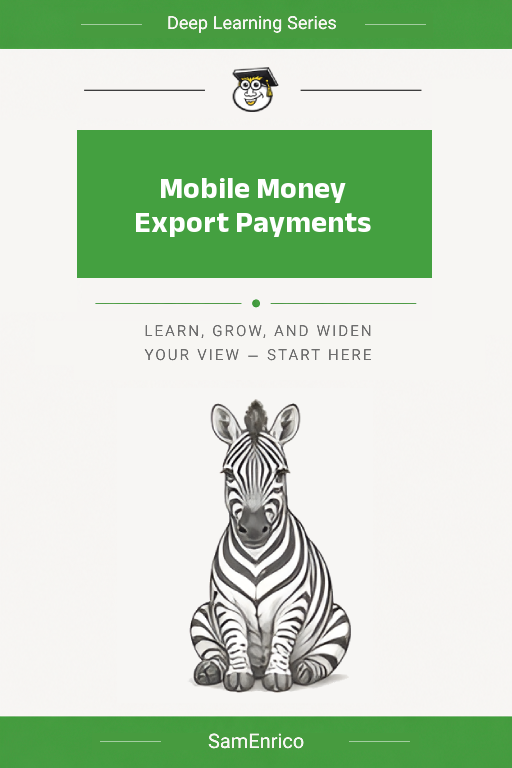
Non-FictionBusiness BriefFintech Guide
Mobile Money Export Payments eBook
Use mobile money for cross-border export collectio
by Mast Jimmie
Use mobile money for cross-border export collections. M-Pesa, MTN MoMo, and Airtel Money integration.
Formats
Free sample
Chapter 1: The Trillion-Dollar Blind Spot--The first time I watched a merchant in Accra lose a $4,200 sale because her customer in Nairobi could not pay via M-Pesa, I realized the global payments industry had a blind spot the size of a continent. She had done everything right: beautiful product photography, a fast website, competitive pricing, and even a Whats App marketing campaign that generated fifty qualified leads. But when those Kenyan customers clicked "checkout," they were greeted with options for Visa, Mastercard, Pay Pal, and bank transfer. Not a single mobile money option. Not M-Pesa, which 87% of Kenyan adults use daily.
Not Airtel Money, which dominates rural Uganda. Not MTN Mo Mo, which reaches from Ghana to Zambia. Her customers closed their browsers, and she closed nothing. That lost sale was not her fault. It was the fault of a fintech industry that has spent two decades perfecting domestic mobile money while leaving cross-border export collections as an afterthought.The Scale of the Oversight Let me give you a number that should keep you awake at night: $5.4 trillion.
That is the projected size of global remittance flows by 2030, according to the World Bank. For two decades, the fintech establishment has celebrated this number as proof that digital payments are transforming the global economy. And they are not wrong. Mobile money has lifted hundreds of millions out of financial exclusion, enabled a generation of micro-entrepreneurs, and proven that the unbanked are not unbankable.But here is what the celebrations miss. That $5.4 trillion figure is almost entirely person-to-person (P2P) remittances.
A construction worker in Dubai sends money home to his family in Ghana. A nurse in London sends school fees to her sister in Nairobi. These are vital, beautiful flows of capital. They are also completely irrelevant to you if you are trying to run an export business.You are not sending money to your aunt. You are collecting payments from customers.
You are a business. And the tools built for P2P remittances do not fit a C2B (consumer-to-business) or B2B (business-to-business) export model. They lack merchant accounts, settlement reporting, reconciliation webhooks, and the ability to handle refunds or disputes. They treat every payment as a gift, not a transaction.This book exists because of that gap.The Exporter's Reality Consider the typical cross-border exporter using traditional financial rails. She sells handmade shea butter products from Ghana to customers across West and East Africa.
A customer in Kenya wants to buy $120 worth of products. Here is what happens if she uses a traditional bank:First, the customer must have a bank account. In Kenya, only 39% of adults have traditional bank accounts, versus 87% who have M-Pesa. So right away, she has lost 61% of her potential market. Second, the bank will charge a fee between 8% and 12% for a cross-border transaction of this size.
On 120,thatis120, that is 120,thatis9.60 to $14.40. Third, the payment will take three to five business days to settle, assuming no compliance holds. Fourth, if the customer makes a mistake in the account number or SWIFT code, the funds may disappear for weeks while the banks investigate.Now multiply that pain across hundreds of customers. Multiply it across dozens of countries, each with different banking regulations, different currencies, and different settlement times. Multiply it by the reality that banks actively reject micro-transactions under 50asunprofitable,eventhoughexportersneedtocollecteverythingfrom50 as unprofitable, even though exporters need to collect everything from 50asunprofitable,eventhoughexportersneedtocollecteverythingfrom5 digital products to $500 artisan goods.The result is not just friction.
It is market exclusion.The Mobile Money Opportunity You Are Missing While banks have ignored cross-border micro-transactions, mobile money networks have grown into a parallel financial system that serves the majority of adults in dozens of countries. Consider these numbers:M-Pesa, launched by Safaricom in Kenya in 2007, now processes over $300 billion in annual transactions across seven countries. It reaches 87% of Kenyan adults and has become so ubiquitous that the word "M-Pesa" is now a verb meaning "to send money." MTN Mo Mo operates across twenty-four countries in Africa and the Middle East, with over 200 million registered wallets. Airtel Money spans thirteen countries, dominating Francophone Africa where traditional banking penetration is below 20%.Combined, these three networks serve over 5.2 billion registered wallets globally. That is 60% of the world's population having access to a mobile money account.
And yet, the vast majority of cross-border export platforms treat mobile money as an afterthought, if they support it at all.Why? Because the technical integration is messy. Because the regulatory landscape is fragmented. Because most developers in Silicon Valley, London, or Bangalore have never heard of USSD codes, STK pushes, or Daraja APIs. Because the payment gateways that dominate global e-commerce (Stripe, Pay Pal, Adyen) have built their businesses around card networks, not mobile wallets.This is your opportunity.The C2B vs.
P2P Distinction Before we go any further, we need to be absolutely clear about the fundamental difference between what most mobile money providers are optimized for and what you need as an exporter.P2P (Person-to-Person) Remittances are what mobile money was originally built for. A user opens their wallet app, enters another user's phone number, enters an amount, and sends money. The receiving user gets a notification and can withdraw cash from an agent or use it for other P2P transfers. This flow is simple, fast, and well-supported by every mobile money network. But it is useless for collecting export payments.Why?
Four reasons:No merchant identification. In a P2P transfer, the recipient is just another wallet user. There is no way for the sender to know they are paying a legitimate business, no way for the business to issue receipts, and no way for tax authorities to distinguish business revenue from personal gifts.No reconciliation. When fifty customers send you P2P transfers, you receive fifty notifications. Each one has a sender's name (which may be their nickname, not their legal name) and a transaction ID.
You cannot easily match these to invoices, track which orders are paid, or automate your accounting.No dispute resolution. If a customer claims they paid and you claim they did not, there is no formal mechanism. The mobile money operator will not mediate commercial disputes. You are left with screenshots and hope.No merchant tools. You cannot issue refunds, manage subscriptions, or generate payment links.
You are limited to giving customers your phone number and hoping they type it correctly.C2B (Consumer-to-Business) Collections are what you need. In a C2B flow, the business has a merchant account—a special type of wallet that can receive payments from consumers, generate receipts, reconcile transactions, issue refunds, and provide settlement reports. The customer knows they are paying a business. The mobile money operator knows they are processing a commercial transaction. The tax authorities have a clear audit trail.When you set up M-Pesa for business, you get a Pay Bill number (for high-volume collections) or a Till number (for retail point-of-sale).
When you set up MTN Mo Mo for business, you get a merchant code that customers can pay to via USSD or the Mo Mo app. When you set up Airtel Money, you get a similar merchant identifier.This book is about C2B…
This is the end of the free sample. Get the eBook to keep going. Buy now
About this book
Details
- Author
- Mast Jimmie
- Publisher
- SamEnrico
- Language
- English
- Genre
- Non-Fiction, Business Brief, Fintech Guide
- Released
- 2026-06-01
- Pages (approx.)
- 139
- Available as
- eBook, Audiobook

Read better in the ZLOADR app
Your eBooks on your phone or tablet. Sign in with your SamEnrico account and start reading.
More by Mast Jimmie
 Undermined By Peer Anger HandbookMast Jimmie$11.99
 Nobel Laureates in EnzymologyMast Jimmie$11.99
 Rosie O Donnell Loud LifeMast Jimmie$11.99
 The Flexible Time Blocking SystemMast Jimmie$11.99
 Rent Burden Coping GuideMast Jimmie$11.99
 The Djinn’s Last Bargain: A Sultan’s FollyMast Jimmie$11.99
 Understanding QuadriparesisMast Jimmie$17.99
 Shopify PLG GuideMast Jimmie$12.99
 Ghost HuntingMast Jimmie$11.99
 How to Start a Chicken Ready To Eat Meals Business (Beginners Guide)Mast Jimmie$11.99
You may also like
 Hong Kong Handover 1997Dunn Johnnie$11.99
 Zumba For Postnatal Recovery CourseNeal Christian$11.99
 Zumba for BeginnersLadner Nikia$11.99
 YouTube Comment Mining GuideHumes Pandora$12.99
 Worry Box MeditationCarlin Rudy$11.99
 Workplace Stress MeditationNguyen Lynn$11.99
 Workplace Stress and Sleep RepairHawley Ivory$11.99
 Workplace Perfectionism CureDelaney Jeffry$11.99
 Workplace Injustice Anger GuideWallen Isabelle$11.99
 Work Addiction and Burnout LinkGreenwood Ester$11.99
 Women in Yoga and WellnessBeattie Galina$11.99
 Women in Stand Up ComedyChun Evangeline$11.99