
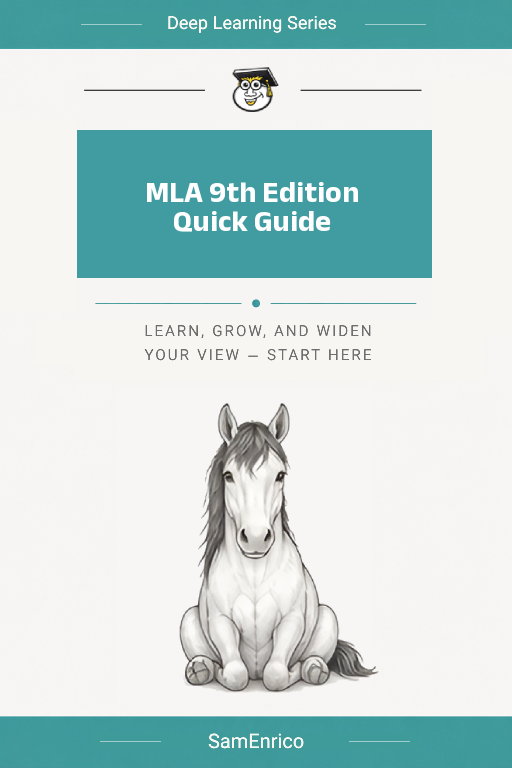
Non-FictionStudent's ShortcutMLA Style
MLA 9th Edition Quick Guide eBook
Master MLA citation rules for books, articles, and
by Fry Clora
Master MLA citation rules for books, articles, and websites in 20 minutes with color coded examples.
Formats
Free sample
Chapter 1: The Container Trap...--Most students don't realize they are losing points on citations before they even type a single word. They open their laptop at 11:00 PM, pull up a You Tube video, a journal article from JSTOR, and a chapter from an online textbook, then spend the next forty-five minutes searching Google for "how to cite a You Tube video MLA" followed by "how to cite JSTOR MLA" followed by "how to cite a book chapter with no page numbers." Each search leads to a different website with slightly different rules. By 11:45 PM, they have three citations in three different formats, none of which are correct, and they have lost forty-five minutes they could have spent writing their actual paper.The problem is not that MLA is too complicated. The problem is that most students are taught to memorize citation formulas for every possible source type, as if each source follows its own unique set of rules. A book has one formula.
A journal article has another. A website has a third. A You Tube video has a fourth. This approach forces you to memorize dozens of separate formulas, and when you encounter a source that doesn't fit neatly into any category—like a government report inside a database that was originally a podcast—you freeze.The ninth edition of the MLA Handbook solved this problem in 2021, but almost no one knows how to use its solution properly. The solution is called the container system, and once you understand it, you will never again need to memorize a citation formula.
You will not need to look up "how to cite a tweet" or "how to cite a Netflix show." You will simply apply the same template to every source, every time, and the citation will write itself.This chapter will teach you that container system in five minutes. By the end of this chapter, you will understand the single template that works for every source you will ever cite. You will also learn the six formatting rules that apply to every MLA paper you will ever write. And unlike the official MLA Handbook—which is 400 pages of dense, repetitive explanations that students consistently describe as "heavy," "annoying to navigate," and "unnecessarily bloated"—this chapter gives you only what you need, in the order you need it, with color-coded examples that show you exactly what to type and where to type it.Let us begin with the problem that the container system was designed to solve.The Myth of the Single Source Type Before the internet, most sources were simple. A student found a book on a library shelf.
The book had a title page, a copyright page with a publisher and a year, and a single author. Citations were straightforward because sources were straightforward. You copied the author, the title, the publisher, the year, and you were done. The MLA Handbook from 1985 was a slim 80-page pamphlet because the citation world was small and predictable.Then the internet arrived. Suddenly, a single source could exist in multiple places.
A journal article could be printed on paper, scanned into a PDF, uploaded to JSTOR, linked on a university website, and downloaded by a student who accessed it through a library proxy server. Which version do you cite? Do you cite the print version or the digital version? Do you include the URL? Do you include the database name?
Do you include the date you accessed it? The old system of memorizing formulas for each source type collapsed under the weight of these questions.The eighth edition of the MLA Handbook, published in 2016, introduced the container system to solve this problem. The ninth edition, published in 2021, refined and clarified it. But the core insight is simple: every source lives inside something else. That "something else" is the container.A journal article lives inside a journal.
The journal is the container. A chapter lives inside a book. The book is the container. A video lives inside You Tube. You Tube is the container.
A song lives inside an album. The album is the container. A blog post lives inside a blog. The blog is the container.Sometimes, a source lives inside two containers. The same journal article might live inside the journal AND inside a database like JSTOR.
The journal is Container 1. JSTOR is Container 2. The same You Tube video might live inside You Tube AND inside a playlist or an embedded article. The same book chapter might live inside the book AND inside an anthology. The container system handles this elegantly because it does not create a new rule for every combination.
It simply repeats the same template for Container 1 and then again for Container 2.This means you only need to learn one template. One template to rule them all, as the saying goes. Learn the template once, and you can cite anything.The Universal Container Template (Color-Coded)Below is the complete MLA 9th edition container template. Every citation you will ever write follows this exact pattern. The colors correspond to the fixed color legend that appears inside the front cover of this book and at the top of every chapter.
Do not skip over this diagram. Read it slowly. The colors are not decorative; they tell you which part of the citation does which job.The Template (Color Legend Applied):Dark Blue = Author Last Name Light Blue = Author First Name Green = Title of Source (in quotation marks)Purple = Title of Container (italicized)Orange = Publication Date Teal = Volume and Issue Numbers Gray = DOI, URL, or Physical Location Black = Punctuation (periods, commas, colons)Red = Text you replace with your own information Here is the template written as a single string of text. The colors are indicated in brackets for this printed version, but in the actual book, the colors appear directly on the page:[Dark Blue:Last Name], [Light Blue:First Name]."[Green:Title of Source],"[Purple:Title of Container],other contributors (if any),version (if any, e.g., "3rd ed."),number (if any, e.g., vol. [Teal:2], no.
[Teal:1]),publisher,[Orange:publication date],[Gray:location (DOI, URL, or page range)].That looks intimidating, but most citations use only five or six of these elements. Here is the same template stripped down to its absolute core—the version you will use for 90 percent of your citations:[Dark Blue:Last Name], [Light Blue:First Name]. "[Green:Title of Source]." [Purple:Title of Container], [Orange:date], [Gray:location].Let us see this core template in action with a real example. Suppose you are citing a journal article titled "The Future of Citation" written by Jane Smith in volume 12, issue 3 of the Journal of Academic Writing, published in 2022, with a DOI of 10.1234/jaw.2022.12.3.45.Following the core template:Dark Blue:Smith, Light Blue:Jane.Green:"The Future of Citation,"Purple:Journal of Academic Writing,Teal:vol. 12, no.
3,Orange:2022,Gray:doi:10.1234/jaw.2022.12.3.45.That is the entire citation. You did not need to memorize a special formula for "journal article with two authors" or "journal article accessed through a database." You simply filled in the template.Now suppose the same article has no DOI and you found it on JSTOR. The citation changes slightly:Dark Blue:Smith, Light Blue:Jane.Green:"The Future of Citation,"Purple:Journal of Academic Writing,Teal:vol.…
This is the end of the free sample. Get the eBook to keep going. Buy now
About this book
Details
- Author
- Fry Clora
- Publisher
- SamEnrico
- Language
- English
- Genre
- Non-Fiction, Student's Shortcut, MLA Style
- Released
- 2026-06-01
- Pages (approx.)
- 144
- Available as
- eBook, Audiobook

Read better in the ZLOADR app
Your eBooks on your phone or tablet. Sign in with your SamEnrico account and start reading.
More by Fry Clora
 Alcohol Recovery for PerfectionistsFry Clora$11.99
 Caffeine Anxiety CalmingFry Clora$11.99
 Daniel Day Lewis CraftFry Clora$11.99
 SSRI for Seasonal Affective DisorderFry Clora$11.99
 Widow s Identity RebuildingFry Clora$11.99
 Job Loss and ParentingFry Clora$11.99
 Asana Dependency Task LinkingFry Clora$11.99
 Catholic Worker Movement FounderFry Clora$11.99
 Kasserine Pass: Rommel's First Defeat in the DesertFry Clora$11.99
 The Battle of Penghu: The Dutch Defeat That Shaped Taiwan (1624)Fry Clora$11.99
 How to Produce Mounting BoardsFry Clora$11.99
 How to Become a Propulsion-motor-and-generator RepairerFry Clora$11.99
You may also like
 Hong Kong Handover 1997Dunn Johnnie$11.99
 Zumba For Postnatal Recovery CourseNeal Christian$11.99
 Zumba for BeginnersLadner Nikia$11.99
 YouTube Comment Mining GuideHumes Pandora$12.99
 Worry Box MeditationCarlin Rudy$11.99
 Workplace Stress MeditationNguyen Lynn$11.99
 Workplace Stress and Sleep RepairHawley Ivory$11.99
 Workplace Perfectionism CureDelaney Jeffry$11.99
 Workplace Injustice Anger GuideWallen Isabelle$11.99
 Work Addiction and Burnout LinkGreenwood Ester$11.99
 Women in Yoga and WellnessBeattie Galina$11.99
 Women in Stand Up ComedyChun Evangeline$11.99