
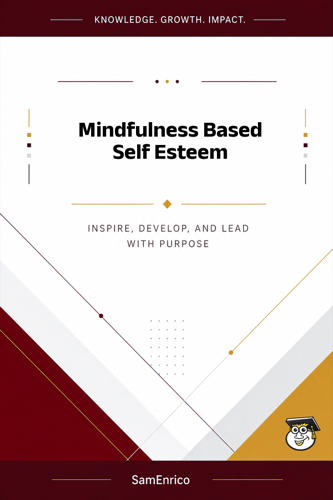
Non-FictionSelf-HelpMindfulness
Mindfulness Based Self Esteem eBook
Cultivates non-judgmental awareness to observe and
Cultivates non-judgmental awareness to observe and release worthlessness thoughts.
Formats
Free sample
Chapter 1: The Performance Prison--You have been lied to. Not by a single person or a single institution, but by an entire culture that has spent decades convincing you that your worth is a problem to be solved, a score to be raised, a mountain to be climbed. The lie sounds like common sense: “If you have low self-esteem, the answer is to build higher self-esteem.” This seems so obvious that questioning it feels almost dangerous. But this book will ask you to question it anyway. What if the pursuit of self-esteem is precisely what keeps you trapped in worthlessness?
What if every book, program, and seminar that promised to raise your self-esteem accidentally reinforced the very mechanism of suffering you were trying to escape?The woman we will call Sarah knows this trap intimately. At forty-two, she has done everything the self-help industry recommends. She has repeated affirmations in front of a mirror: “I am worthy. I am enough. I am lovable.” She has visualized her success.
She has made vision boards. She has attended workshops where strangers held hands and declared their inherent value. And yet, on Tuesday afternoons, when her boss passes her desk without saying hello, the old feeling crashes over her like a wave of cold water: You are invisible. You are unimportant. You do not matter.
The affirmations evaporate. The vision board mocks her. And she is left wondering what is wrong with her that she cannot seem to get this right.Nothing is wrong with Sarah. She is not failing at self-esteem. She is succeeding at something else entirely: she is succeeding at revealing the fundamental flaw in how self-esteem is usually understood.
The problem is not that her self-esteem is too low. The problem is that she has any self-esteem at all.The Architecture of the Performance Prison Let us name the structure that holds Sarah and millions like her. It is called the Performance Prison. The Performance Prison is not a physical place, but it is just as real as any jail cell. Its walls are made of four invisible beliefs that most people never recognize as beliefs—they mistake them for reality.Wall One: Worth Must Be Earned.
The first wall is the conviction that you are not born worthy. You arrive on this planet as a blank slate, a zero, a nobody. Only through achievement, productivity, and effort can you accumulate enough merit to deserve love, respect, or even basic self-acceptance. This wall is built so early and so thoroughly that most adults never think to question it. Of course worth must be earned, they say.
What else could it possibly be?Wall Two: External Validation Is the Currency. The second wall is the belief that other people’s opinions are the measure of your value. If they praise you, you rise. If they criticize you, you fall. If they ignore you, you cease to exist.
This wall makes you dependent on forces you cannot control. You become a puppet, and other people’s reactions become the strings.Wall Three: Perfection Is the Minimum Standard. The third wall is the belief that any flaw, any mistake, any imperfection invalidates your worth. You are not allowed to be human. You must be exceptional at all times, in all domains, with no exceptions.
This wall ensures that you can never rest, because rest is unproductive, and unproductive is unacceptable.Wall Four: Comparison Is the Verdict. The fourth wall is the belief that your worth is determined by how you stack up against others. If you are ahead, you are winning. If you are behind, you are losing. If you are equal, you are in danger of falling behind.
This wall turns every human interaction into a competition and every stranger into a potential threat.Together, these four walls create a prison that feels like a career. You wake up every morning and go to work earning your worth, seeking validation, pursuing perfection, and running comparisons. You tell yourself you are being ambitious, driven, responsible. You are actually being incarcerated. The guard is your inner critic, and the warden is a culture that profits from your insecurity.Why Building Higher Self-Esteem Backfires Here is the paradox that the self-esteem industry does not want you to understand: attempting to raise your self-esteem requires you to first believe that your self-esteem needs raising.
Every affirmation you repeat, every goal you achieve, every compliment you seek is built on the foundation of a perceived deficit. You are trying to fill a hole that you have to believe exists in order to try to fill it. This is like trying to dig yourself out of a hole by digging deeper.The research supports this uncomfortable conclusion. Psychologists Roy Baumeister and Jean Twenge have documented that self-esteem interventions often produce no lasting improvement and can sometimes make things worse. Why?
Because focusing on your self-esteem focuses you on your self, and focusing on your self is precisely what generates self-consciousness, self-criticism, and self-doubt. The more you try to feel good about yourself, the more you think about yourself. The more you think about yourself, the more you notice your flaws. The more you notice your flaws, the worse you feel. This is the self-esteem paradox: the pursuit of self-esteem undermines the very thing it seeks.Consider the difference between running toward a destination and running away from a predator.
When you run toward a destination, you have a target. You can measure your progress. You know when you have arrived. When you run away from a predator, you have no destination. You only have fear.
You never know if you have run far enough because the predator might still be behind you. Most self-esteem work is running away from worthlessness. You are not running toward worthiness; you are running from the fear that you are not worthy. And because that fear is not a physical predator with a fixed location but a thought pattern that lives inside your own mind, you can never outrun it. It follows you everywhere because it is you.
Or rather, it is a story you have been telling yourself for so long that you forgot it was a story.The Neuroscience of Self-Judgment To understand why the Performance Prison feels so real, we need to look inside your brain. The Default Mode Network (DMN) is a collection of brain regions that becomes active when you are not focused on the external world. It is the storyteller of your mind, weaving together memories, future plans, and self-referential thoughts into the ongoing narrative of “me.” The DMN is essential for planning, reflecting, and learning from the past. But it has a dark side: when it becomes overactive, it turns into a rumination machine.Functional MRI studies have shown that the DMN is hyperactive in people who struggle with depression, anxiety, and low self-worth. These individuals are literally over-practicing the neural pathways of self-criticism.
Each time you think “I am not good enough,” you strengthen the synaptic connections that make that thought more likely to arise in the future. This is neuroplasticity: neurons that fire together wire together. Your brain is a learning machine, and you…
This is the end of the free sample. Get the eBook to keep going. Buy now
About this book
Details
- Author
- Moriarty Chanell
- Publisher
- SamEnrico
- Language
- English
- Genre
- Non-Fiction, Self-Help, Mindfulness
- Released
- 2026-06-06
- Pages (approx.)
- 120
- Available as
- eBook, Audiobook

Read better in the ZLOADR app
Your eBooks on your phone or tablet. Sign in with your SamEnrico account and start reading.
More by Moriarty Chanell
 Sibling Suicide GriefMoriarty Chanell$11.99
 Talent Migration Patterns for Green JobsMoriarty Chanell$11.99
 The Kercher Family Pursuit of JusticeMoriarty Chanell$11.99
 Positive Outlook LongevityMoriarty Chanell$11.99
 The Unseen Crown: How a Forgotten Queen Changed HistoryMoriarty Chanell$11.99
 CytotechnologistMoriarty Chanell$11.99
 Understanding Leukodystrophy, PseudometachromaticMoriarty Chanell$17.99
 Real Estate Workout StrategiesMoriarty Chanell$12.99
 Franchise One Page Marketing GuideMoriarty Chanell$12.99
 How to Become a Collection ClerkMoriarty Chanell$11.99
You may also like
 Hong Kong Handover 1997Dunn Johnnie$11.99
 Zumba For Postnatal Recovery CourseNeal Christian$11.99
 Zumba for BeginnersLadner Nikia$11.99
 YouTube Comment Mining GuideHumes Pandora$12.99
 Worry Box MeditationCarlin Rudy$11.99
 Workplace Stress MeditationNguyen Lynn$11.99
 Workplace Stress and Sleep RepairHawley Ivory$11.99
 Workplace Perfectionism CureDelaney Jeffry$11.99
 Workplace Injustice Anger GuideWallen Isabelle$11.99
 Work Addiction and Burnout LinkGreenwood Ester$11.99
 Women in Yoga and WellnessBeattie Galina$11.99
 Women in Stand Up ComedyChun Evangeline$11.99