
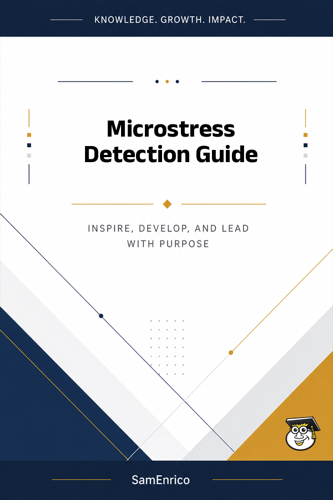
Non-FictionSelf-HelpStress Identification
Microstress Detection Guide eBook
Identify tiny cumulative stressors that drain ener
Identify tiny cumulative stressors that drain energy and eliminate them before they compound.
Formats
Free sample
Chapter 1: The Body Knows First--–- You wake up tired. Not the groggy, need-coffee tired of a poor night’s sleep. Something deeper. A dull, gray exhaustion that sits behind your eyes and in the hinges of your jaw. You tell yourself you slept fine.
You check your phone—seven hours and forty-two minutes, according to the sleep tracker. Perfect. So why do you feel like you’ve already run a marathon before your feet have touched the floor?This is the central paradox of modern life. By every objective measure, you are fine. No major trauma.
No job loss. No divorce. No diagnosis. Yet you feel chronically depleted. You snap at your partner over nothing.
You stare at your computer screen for twenty minutes unable to remember what you were about to do. You cancel plans with friends not because you’re busy but because the thought of small talk feels like lifting a barbell. You are fine. And you are exhausted.The gap between “fine” and exhausted is where microstress lives. But here is the cruelest part: by the time you feel the exhaustion, the damage has already been happening for weeks, months, or even years.
Your body knows long before your brain admits it. And your body keeps a scorecard that you never see.This chapter is about learning to read that scorecard. We will explore the biology of invisible stress, why your nervous system cannot distinguish between a mountain of work and a mountain lion, and how tiny, repeated cortisol spikes do more long-term damage than a single traumatic event. You will learn why “I’m fine” is the most dangerous lie you tell yourself. And you will be introduced to the first and most important tool in the S.E.E.P.
framework: the Energy Map, a simple but ruthless method for finding the fingerprints of microstress hidden in plain sight.By the end of this chapter, you will never again be able to say “I don’t know why I’m so tired.” You will know. And knowing is the first step toward elimination.The Lie of “Fine”Let us start with a thought experiment. Imagine you are walking through a field and you are bitten by a venomous snake. Your heart races. Your palms sweat.
Your body floods with cortisol and adrenaline. You feel the fear viscerally. Later, you tell the story: “I was bitten by a snake. It was terrifying.” Your body recovers over days or weeks.Now imagine a different scenario. You are at your desk.
An email arrives from your boss: “Quick question when you have a moment.” Your heart rate increases slightly. Your jaw tenses. Cortisol ticks up. You answer. Then Slack pings: “Urgent?” from a colleague.
Another tiny spike. Then your phone buzzes with a news alert. Another. Then you remember a task you forgot yesterday. Another.
By noon, you have experienced fifty of these tiny spikes. Individually, each is trivial. But collectively, your body has been in a low-grade state of alert for four hours straight.Which scenario causes more long-term damage to your health? The snake bite—a single, intense, recoverable event—or the 50 micro-spikes that never fully resolve?Research on allostatic load, pioneered by neuroscientist Bruce Mc Ewen, gives us a surprising answer. The snake bite triggers a massive but clean stress response.
Your body knows exactly when the threat begins and ends. Recovery is linear. The 50 micro-spikes, however, keep your stress physiology activated all day, every day, without a clear off-ramp. This chronic, low-grade activation is far more destructive to your long-term health than occasional acute stress. It is the difference between a sprint and a slow drowning.Yet when someone asks how you are, you say “fine.” Because nothing catastrophic happened.
Because you cannot point to a single event and say “that is why I am exhausted.” Because you have learned to normalize the low-grade hum of anxiety that follows you from meeting to meeting, notification to notification, obligation to obligation.“Fine” is not a feeling. It is a verdict you have reached after deciding that your exhaustion does not meet the threshold for complaint. But your body does not care about your verdict. It is keeping score anyway.Allostatic Load: The Body’s Hidden Scorecard To understand microstress, you must first understand allostatic load. Allostasis is your body’s ability to maintain stability through change.
When you encounter a stressor—a deadline, an argument, a near-miss in traffic—your brain activates the hypothalamic-pituitary-adrenal (HPA) axis. Cortisol and adrenaline release. Your heart rate increases. Blood vessels constrict. Glucose floods your bloodstream for quick energy.
This is the stress response, and it is essential for survival.Allostatic load is the cumulative wear and tear on your body’s systems as a result of repeated or chronic stress. Think of it as the total mileage on a car. A single cross-country road trip (acute stress) adds mileage, but the car can handle it. Driving five miles a day in stop-and-go traffic, every day, for years (chronic microstress) adds less mileage per day but causes far more wear on the brakes, transmission, and engine.Here is what research has revealed about allostatic load:Cardiovascular system. Each microstress spike raises blood pressure slightly.
Over a day of 50 spikes, your blood pressure never fully returns to baseline. Over months, this chronic elevation leads to arterial stiffening, left ventricular hypertrophy, and increased risk of hypertension. A 2017 study in the Journal of the American Heart Association found that individuals with high allostatic load had a 45% higher risk of cardiovascular events over 10 years, even after controlling for traditional risk factors like smoking and obesity.Immune system. Cortisol is a natural anti-inflammatory. In small, acute doses, this is helpful—it prevents the immune system from overreacting to minor threats.
But chronic cortisol elevation suppresses immune function. You get more colds. Wounds heal more slowly. Vaccines are less effective. And chronic low-grade inflammation—the hallmark of high allostatic load—is now understood to be a driver of depression, Alzheimer’s disease, and autoimmune disorders.Metabolic system.
Chronic stress dysregulates glucose metabolism. Cortisol increases appetite, particularly for high-sugar, high-fat foods. Over time, this leads to insulin resistance, weight gain—especially visceral fat around the organs—and increased risk of type 2 diabetes. A landmark study from University College London followed over 3,000 civil servants for 12 years and found that high allostatic load predicted metabolic syndrome independently of lifestyle factors.Brain structure. This is where microstress becomes truly insidious.
Chronic cortisol exposure actually shrinks the hippocampus—the brain region responsible for memory, learning, and emotional regulation. Simultaneously, it enlarges the amygdala, the brain’s fear center. You become worse at remembering, worse at staying calm, and more reactive to threats. The very organ you need to detect and eliminate microstress is being damaged by the microstress itself.Sleep. High allostatic load disrupts sleep architecture.
You fall asleep fine, but you wake up at 3:00 AM with racing thoughts. Or you sleep eight hours but wake up unrefreshed. Cortisol follows a natural circadian rhythm—low at midnight, high at 8:00 AM. Chronic stress flattens this curve. Your body never gets the deep, restorative sleep it needs to clear metabolic…
This is the end of the free sample. Get the eBook to keep going. Buy now
About this book
Details
- Author
- Manning Bradley
- Publisher
- SamEnrico
- Language
- English
- Genre
- Non-Fiction, Self-Help, Stress Identification
- Released
- 2026-06-09
- Pages (approx.)
- 147
- Available as
- eBook, Audiobook

Read better in the ZLOADR app
Your eBooks on your phone or tablet. Sign in with your SamEnrico account and start reading.
More by Manning Bradley
 Grit for Students with ADHDManning Bradley$11.99
 Half Smile for AnxietyManning Bradley$11.99
 Team Creative WarmupsManning Bradley$11.99
 London Staffing SolutionsManning Bradley$11.99
 Morning Visualization GuideManning Bradley$11.99
 Offering Choices GuideManning Bradley$11.99
 POLST Form GuideManning Bradley$11.99
 The Symphony of the Deep: How Western Composers Conquered the Ocean’s SoulManning Bradley$11.99
 The Philosophers of Axum: Wisdom from the Horn of AfricaManning Bradley$11.99
 Service Providers Guide to FacialistsManning Bradley$11.99
 A Collector's Handbook to the Matra-simca BagheeraManning Bradley$11.99
 YouTrack JetBrains AgileManning Bradley$12.99
You may also like
 Hong Kong Handover 1997Dunn Johnnie$11.99
 Zumba For Postnatal Recovery CourseNeal Christian$11.99
 Zumba for BeginnersLadner Nikia$11.99
 YouTube Comment Mining GuideHumes Pandora$12.99
 Worry Box MeditationCarlin Rudy$11.99
 Workplace Stress MeditationNguyen Lynn$11.99
 Workplace Stress and Sleep RepairHawley Ivory$11.99
 Workplace Perfectionism CureDelaney Jeffry$11.99
 Workplace Injustice Anger GuideWallen Isabelle$11.99
 Work Addiction and Burnout LinkGreenwood Ester$11.99
 Women in Yoga and WellnessBeattie Galina$11.99
 Women in Stand Up ComedyChun Evangeline$11.99