
Non-FictionSelf-HelpMeeting Management
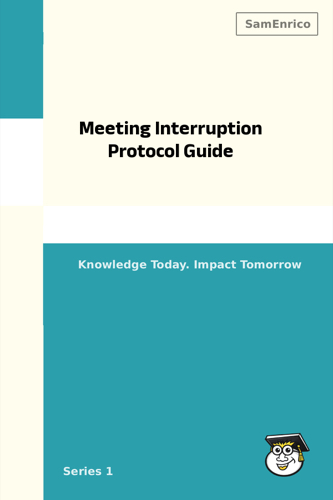
Meeting Interruption Protocol Guide eBook
Handle unexpected meeting requests and context swi
by Eaton Piedad
Handle unexpected meeting requests and context switching with this practical productivity handbook.
Formats
Free sample
Chapter 1: The Twenty-Three Minute Heist--–- The first time someone stole twenty-three minutes from you, you probably thanked them.You smiled, looked up from your screen, and said, “Sure, no problem. What’s up?” A colleague needed “just a quick answer.” Five minutes later, they left, satisfied. You turned back to your work—the complex report, the code logic, the strategic plan—and froze. Where was I? What was I about to write?
The thought was gone. You scrolled back, re-read the last three paragraphs, and tried to reconstruct the thread. Ten minutes passed. Then fifteen. By the time you felt fully re-engaged, nearly half an hour had vanished.
And you never once blamed the interruption. You blamed yourself for being distractible.This is the great deception of modern knowledge work. We treat unexpected requests as minor irritations—the price of being helpful, the cost of collaboration. The data tell a different story. A five-minute interruption during cognitively demanding work does not cost five minutes.
It costs an average of twenty-three minutes of resumption lag, plus the five minutes of interruption itself, for a total of twenty-eight minutes of lost productivity. One interruption. Nearly half an hour. Three interruptions in a morning, and you have lost more than an hour and a half—not to meetings, not to email, but to the gap between stopping and restarting.This chapter is not about blaming your colleagues. It is not about building walls or becoming unapproachable.
It is about understanding the true physics of attention so that you can make intelligent choices about when to be available and when to be inviolable. Because here is the uncomfortable truth: if you do not understand the twenty-three minute heist, you will continue to bleed time without ever knowing where it went. And worse, you will design your defenses incorrectly—guarding shallow work as if it were deep, and leaving your most valuable cognitive hours vulnerable to the next person who says, “Got a sec?”The Hidden Math of Resumption In 2005, researchers at the University of California, Irvine, conducted a field study that should have changed the way offices are designed. They shadowed knowledge workers—engineers, editors, project managers—and tracked every interruption. The headline finding was startling enough: the average worker was interrupted every eleven minutes.
But the deeper discovery was what happened after the interruption. When a worker was pulled away from a complex task, it took an average of twenty-three minutes to return to the same level of cognitive focus.Let us pause on that number. Twenty-three minutes is not the time to “get back to work.” It is the time to fully re-engage—to rebuild the mental context, to recall the half-formed idea, to remember where you stopped and where you were heading. Think of your brain as a suspension bridge under construction. An interruption is not a gentle pause.
It is a dropped wrench that sends the whole structure swaying. You do not simply pick up where you left off. You spend twenty-three minutes stabilizing the cables before you can lay another beam.Later research refined this finding. Gloria Mark, the lead researcher on that study, found that resumption lag varies dramatically by task complexity. For routine, low-cognition work—filing emails, entering data, updating spreadsheets—the lag is negligible, sometimes as little as a few seconds.
For high-complexity work—writing, coding, analyzing, strategizing, creating—the lag extends to the full twenty-three minutes. This distinction is the single most important nuance in this entire book. The twenty-three minute recovery applies to deep work, not shallow work. It applies to your Red Zone, not your Green Zone. And confusing the two is why most interruption management advice fails.Consider two scenarios.
In the first, you are answering routine emails—marketing messages, calendar coordination, expense approvals. A colleague interrupts you for five minutes. You return to your inbox. Recovery time? Almost zero.
You have lost only the five minutes. In the second, you are debugging a complex software issue, tracing a logic error through three layers of code. The same colleague interrupts you for five minutes. When you return, you have lost the context. You stare at the screen, unable to remember which variable you were tracking.
Twenty-three minutes later, you are back. The same interruption, two radically different costs.This is why the Time-Limited Yes from Chapter 6—offering five minutes right now—is not a contradiction of this chapter. It is a conditional tool. In Green Zone shallow work, five minutes costs five minutes. In Red Zone deep work, five minutes costs twenty-eight minutes.
The Traffic Light System, which we will explore in Chapter 5, exists precisely to help you know which zone you are in before you answer.The Anatomy of a Cognitive Heist To understand why resumption lag is so expensive, you must understand what your brain is doing during deep work. When you engage in a complex task, your brain builds what cognitive scientists call a “mental model”—a temporary structure of related concepts, priorities, and next steps. This model is not stored in a single location. It is distributed across working memory, long-term memory, and environmental cues: the half-written sentence, the open tab, the sticky note on your desk. Think of it as a house of cards.
Each card is a piece of relevant information. The structure is stable but fragile.An interruption does not simply pause the construction. It knocks the house down. When you turn your attention to the colleague’s question, your brain dismantles the mental model to free up working memory for the new task. This dismantling is automatic and necessary—you cannot hold two complex models simultaneously.
The problem is the rebuilding cost. After the interruption ends, you must reconstruct the model from scratch. Which tab was I on? What was the last line I wrote? What was the question I was about to answer?
This reconstruction is not instantaneous. It requires re-scanning, re-reading, and re-orienting. Twenty-three minutes, on average, for high-complexity work.But resumption lag is only part of the cost. Interruptions also increase error rates. A study published in the journal Human-Computer Interaction found that interrupted workers made twice as many errors on complex tasks as uninterrupted workers.
The mechanism is straightforward: when you rush to rebuild your mental model, you skip steps. You assume you remember something that you have forgotten. You make a decision based on incomplete context. The error is not discovered until later, triggering rework—another form of hidden cost that rarely appears on any timesheet.And then there is the emotional tax. Repeated interruptions trigger a low-grade stress response.
Cortisol rises. Frustration accumulates. You begin to anticipate the next interruption, which further degrades focus. Psychologists call this the “vigilance decrement”: the more you expect to be interrupted, the harder it becomes to sustain deep attention. You start checking your email preemptively.
You leave your phone visible on your desk. You keep one ear open for footsteps in the hallway. Your deep work becomes shallow work by anticipation, long before anyone actually knocks on your door.The True Cost Calculation Let us put real numbers on this. Assume you are a knowledge worker who does four hours of deep…
This is the end of the free sample. Get the eBook to keep going. Buy now
About this book
Details
- Author
- Eaton Piedad
- Publisher
- SamEnrico
- Language
- English
- Genre
- Non-Fiction, Self-Help, Meeting Management
- Released
- 2026-06-06
- Pages (approx.)
- 141
- Available as
- eBook, Audiobook

Read better in the ZLOADR app
Your eBooks on your phone or tablet. Sign in with your SamEnrico account and start reading.
More by Eaton Piedad
 Personal Ing For Success FreelanceEaton Piedad$11.99
 Hypnotic Deepener CollectionEaton Piedad$11.99
 Wedding Toast Speech GuideEaton Piedad$11.99
 Postpartum Period ReturnEaton Piedad$11.99
 The Silk Road of Light: Ancient Astronomy in the SteppesEaton Piedad$11.99
 The Last Debt of the Pharaohs: Egypt's Forgotten Financial CollapseEaton Piedad$11.99
 Understanding Ectodermal Dysplasia Absent DermatoglyphicsEaton Piedad$17.99
 How to Become a Car-dumper-operator HelperEaton Piedad$11.99
 Voiceover LinkedIn GuideEaton Piedad$12.99
 China Data Breach GuideEaton Piedad$12.99
 Data Quality AnalystEaton Piedad$11.99
You may also like
 Hong Kong Handover 1997Dunn Johnnie$11.99
 Zumba For Postnatal Recovery CourseNeal Christian$11.99
 Zumba for BeginnersLadner Nikia$11.99
 YouTube Comment Mining GuideHumes Pandora$12.99
 Worry Box MeditationCarlin Rudy$11.99
 Workplace Stress MeditationNguyen Lynn$11.99
 Workplace Stress and Sleep RepairHawley Ivory$11.99
 Workplace Perfectionism CureDelaney Jeffry$11.99
 Workplace Injustice Anger GuideWallen Isabelle$11.99
 Work Addiction and Burnout LinkGreenwood Ester$11.99
 Women in Yoga and WellnessBeattie Galina$11.99
 Women in Stand Up ComedyChun Evangeline$11.99