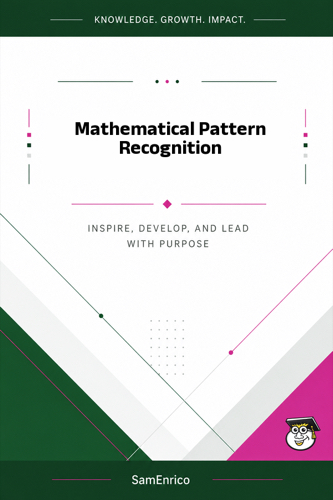
Mathematical Pattern Recognition eBook
Spot sequences, series, and functions to solve pro
by Sells Ressie
Spot sequences, series, and functions to solve problems more intuitively.
Formats
Free sample
Chapter 1: The Grammar of Numbers--–- Imagine standing in front of a chessboard. You see sixty-four squares, thirty-two pieces, and what looks like chaos to a beginner. Now imagine a grandmaster walking past that same board. In two seconds, without calculating a single move, she knows who is winning. She hasn’t added up point values or simulated future captures.
She recognized a pattern. The pieces are arranged in a configuration she has seen thousands of times before—slight variations of a known structure. The grandmaster doesn’t calculate her way to understanding. She sees her way there.This is the central secret of mathematical intuition, and it has almost nothing to do with being “good at math” in the way schools define it. Schools teach calculation.
They reward speed with arithmetic, fluency with formulas, and precision with pencil-and-paper algorithms. But calculation is what you do after you have already recognized the pattern. Calculation is the slow, mechanical, error-prone labor of turning a recognized structure into an answer. Pattern recognition is the flash of insight that tells you which calculation to perform in the first place—or whether to calculate at all.Most people struggle with mathematics not because they cannot calculate, but because they cannot see. They look at a sequence of numbers—2, 4, 6, 8, ?—and they see isolated digits.
Someone who recognizes patterns sees a relationship: each term is two more than the previous term. The answer, 10, appears almost without effort. The calculation was trivial. The recognition was the skill.This book is not another collection of formulas to memorize. It is not a textbook disguised as a self-help guide.
It is a training manual for your visual and numerical intuition. By the time you finish these twelve chapters, you will look at numbers, shapes, sequences, and functions differently. You will see the hidden grammar that organizes them. And you will solve problems before you pick up a pencil—sometimes without writing a single number.Why Raw Calculation Fails Let us test a simple idea. Here is a sequence: 3, 6, 9, 12, ?If you said 15, you recognized that each term adds 3.
That was easy. Now try this one: 2, 4, 8, 16, ?You probably said 32, recognizing multiplication by 2. Still easy. Now try this: 1, 4, 9, 16, ?If you said 25, you recognized perfect squares. Good.
Now try this: 1, 1, 2, 3, 5, ?You might have said 8, recognizing the Fibonacci pattern where each term is the sum of the two before it. Excellent. Now try this: 2, 12, 1112, 3112, 132112, ?If you are like most people, you have no idea. This sequence is famous among puzzle enthusiasts. The pattern is not arithmetic, geometric, or Fibonacci.
The pattern is look-and-say: each term describes the previous term verbally. “2” is read as “one 2,” so the next term is 12. “12” is read as “one 1, one 2,” so the next term is 1112. “1112” is read as “three 1s, one 2,” so the next term is 3112. And so on.
The next term after 132112 is 1113122112.Did you feel the difference between the first four sequences and the last one? The first four used patterns you already knew from school. The last one required you to see a completely different kind of relationship—not numeric growth, but linguistic description. Most people stare at 2, 12, 1112, 3112, 132112 and see random numbers. Someone who recognizes patterns sees a story being told in a weird numerical dialect.The critical failure of raw calculation is that calculation assumes you already know what kind of pattern you are dealing with.
If you mistakenly treat the look-and-say sequence as geometric, you will calculate ratios, find none, and conclude that there is no pattern. But there is a pattern. You just didn’t recognize its type. This is why pure computational fluency is not enough. You can be the fastest arithmetician in the world and still fail to see the next term in the look-and-say sequence.
Pattern recognition is a separate skill, and it is the skill this book exists to build.The Four Lenses: Seeing Patterns in Everyday Life Before we learn formal mathematical categories like arithmetic sequences or quadratic functions, let us develop an intuitive vocabulary for talking about patterns. You already use this vocabulary unconsciously. The goal of this chapter is to make it conscious.Every pattern you will ever encounter in mathematics—and in most of daily life—can be described through four simple lenses. Think of these as different pairs of glasses you can put on. Each pair reveals something different about what you are looking at.Lens One: Repetition The simplest pattern is pure repetition.
Every day, the sun rises. Every year, the seasons cycle. In numbers, repetition looks like constant difference or constant ratio. The sequence 5, 5, 5, 5 repeats the same value. The sequence 2, 4, 6, 8 repeats the operation of adding 2.
Repetition is the comfort zone of pattern recognition. When you see something happen the same way multiple times, you start to trust that the next time will be the same.Real-world example: Your morning coffee costs $4.50 every day. That is repetition of value. Your commute takes 28 minutes on Monday, 32 on Tuesday, 26 on Wednesday—that is not perfect repetition, but there is a repeated *range*. Recognizing repetition helps you predict.
If your coffee has cost $4.50 for the last 30 days, you would be surprised if it suddenly cost $9.00. Your surprise is pattern recognition at work.Lens Two: Growth Many patterns are not about staying the same but about getting larger or smaller in a predictable way. Growth patterns can be slow and steady or explosive and surprising. Your savings account grows by adding the same amount each month (linear growth). A viral video’s views double every hour (exponential growth).
A falling object covers more distance each second than the second before (quadratic growth).Real-world example: A child’s height increases each year, but not by the same amount. Infants grow quickly, toddlers grow steadily, teenagers have growth spurts. The pattern of human height over time is not a simple multiplication or addition—but it is still a pattern. Recognizing the type of growth tells you whether to expect a smooth line, a curve, or a staircase.Lens Three: Alternation Some patterns switch back and forth. Alternation is rhythm in numbers.
A sequence like 1, -1, 1, -1 alternates sign. A traffic light alternates red, green, yellow, red. Your heartbeat alternates contraction and relaxation. Alternating patterns are often described as periodic—they repeat after a fixed number of steps.Real-world example: Sales tax is added to your purchase, not added, added, not added—no, that is not alternation. But consider store hours: open, open, open, closed, open, open, open, closed.
That is alternation with a period of seven days. Alternation patterns are everywhere once you start looking for the rhythm behind the noise.Lens Four: Structure Some patterns are not about the sequence of values but about the shape or arrangement of elements. Structure includes symmetry (a face mirrored left and right), tiling (honeycomb cells fitting together without gaps), and branching (a tree splitting into limbs, then branches, then twigs). Structural patterns are often visual, but they also appear in numbers. The digits of pi have no repeating pattern, but they have structure in their distribution—each digit appears roughly equally often over long runs.Real-world example: A snowflake has six-fold rotational symmetry.
You do not need to measure every arm to know that the sixth arm looks like the first. Recognizing structural…
This is the end of the free sample. Get the eBook to keep going. Buy now
About this book
Details
- Author
- Sells Ressie
- Publisher
- SamEnrico
- Language
- English
- Genre
- Non-Fiction, Self-Help, Math Study
- Released
- 2026-06-09
- Pages (approx.)
- 131
- Available as
- eBook, Audiobook

Read better in the ZLOADR app
Your eBooks on your phone or tablet. Sign in with your SamEnrico account and start reading.
More by Sells Ressie
 Personal Ing For Success HandbookSells Ressie$11.99
 Adrenal Fatigue and Cold HandsSells Ressie$11.99
 Sugar Addiction and Dental Health HandbookSells Ressie$11.99
 Developer Flow State ProtectionSells Ressie$11.99
 The Velvet Bribe: How a Swiss Bank Laundered Dictators' SecretsSells Ressie$11.99
 Riders of the Midnight Sun: The Forgotten Black Cavalry of the ArcticSells Ressie$11.99
 Family CaregiverSells Ressie$11.99
 Chinese Logistics DirectorySells Ressie$12.99
 Bookkeeping LLC FormationSells Ressie$12.99Bookkeeping LLC FormationSells Ressie$12.99
 Understanding Elliott–ludman–teebi SyndromeSells Ressie$17.99
 How to Start a Power-driven Straddle Carriers Business (Beginners Guide)Sells Ressie$11.99