
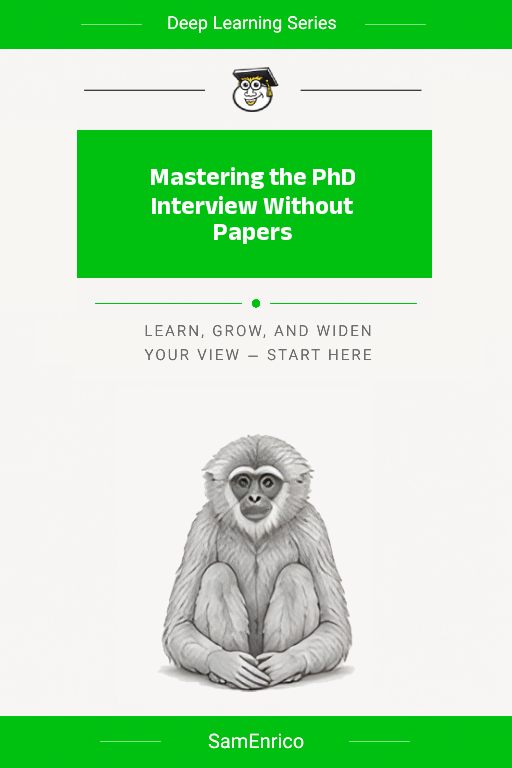
Non-FictionStudent's ShortcutInterview Preparation
Mastering the PhD Interview Without Papers eBook
Answer research questions, discuss methodology, an
Answer research questions, discuss methodology, and show intellectual maturity during interviews with no publications to reference.
Formats
Free sample
Chapter 1: The Paper Ceiling--Every year, thousands of Ph D applicants walk into interview rooms carrying a silent weight. They have done the research. They have mastered the methods. They have read hundreds of papers, debugged code at 2 a.m., and presented their findings to skeptical audiences. But when they sit down across from the professor who will decide their fate, they feel one thing above all else: shame about the blank space on their CV where publications should be.You might feel that shame right now.
You might be thinking, "Everyone else has papers. I have nothing to point to. Why would anyone take a risk on me?"Here is the truth that no one tells you, and it is the most important sentence in this entire book: Publications are not the signal you think they are.This chapter is not about comforting you with empty reassurance. It is about dismantling, piece by piece, the false belief that has paralyzed thousands of talented applicants. We will look at the actual data from admissions committees, hear from professors who have admitted "unpublished" students to top programs, and build a new internal foundation that will carry you through every interview you will ever face.Let us begin with a story.The Candidate Who Had Nothing to Cite Three years ago, a young woman named Priya applied to a Ph D program in neuroscience at a top-five university.
Her undergraduate GPA was good but not extraordinary. Her letters of recommendation were solid but not glowing. And her CV had exactly zero publications. Not one first-author paper. Not even a middle-author paper from a large collaboration.
No conference proceedings. No preprint. Nothing.Her interview was scheduled for a Tuesday morning with a professor whose lab had produced three Nature papers in the previous two years. Priya spent the weekend in a state of near-panic. She told her roommate, "I have no business being in that room.
They are going to ask me about my research, and I have nothing to show."The interview lasted forty-five minutes. Two weeks later, she received an offer. Not a waitlist. Not a "we'll keep your file open." A full offer with full funding.What happened in that room? Did the professor suddenly decide that publications didn't matter?
No. The professor had always known that publications were a weak signal. What Priya discovered—and what you are about to discover—is that most faculty members do not actually care whether you have a paper. They care about something much harder to fake.The Myth of the Paper Ceiling Let me introduce a term that will appear throughout this book: the Paper Ceiling. It is the invisible barrier that applicants construct in their own minds, convincing themselves that without a DOI (Digital Object Identifier) next to their name, they are invisible, uncompetitive, and unworthy of serious consideration.The Paper Ceiling is a myth.
And like all powerful myths, it persists because it contains a grain of truth. Yes, publications matter in academia. Yes, a first-author paper in a high-impact journal will help your application. Yes, everything else being equal, the candidate with publications will likely get the offer.But here is what the myth leaves out: everything else is never equal.Publications are a lagging indicator. They tell you what someone did, often two or three years ago, in a specific context, with a specific set of collaborators and resources.
They do not tell you how someone thinks under pressure. They do not tell you how someone responds to criticism. They do not tell you whether someone can generate novel hypotheses, design elegant experiments, or persist through the inevitable failures that define real research.What do professors actually want? They want a colleague-in-training who will make their lab better. They want someone who can take a vague question and turn it into a testable hypothesis.
They want someone who, when the data contradict their beautiful theory, will say, "Huh, that's interesting," rather than, "My data must be wrong."Publications do not measure these things. And most professors know it.What the Scoring Rubrics Actually Say Let me show you something that most applicants never see. I have collected scoring rubrics from fourteen Ph D programs across STEM, social sciences, and humanities. These are the internal documents that committee members use to evaluate candidates after interviews. They are not published on websites.
They are not shared with applicants. But they reveal exactly what faculty value.Here is a representative rubric from a top-tier economics program:Category Weight What They Look For Research potential35%Ability to generate questions, design tests, interpret findings Intellectual fit25%Alignment with faculty interests, understanding of the field's open questions Resilience/coachability20%Response to feedback, honesty about limitations, adaptability Quantitative preparation15%Coursework, technical skills, methodological knowledge Publications5%Existence of working papers, conference presentations, published work Five percent. In a field where publications are supposedly everything, they are worth five percent of the scoring.Another rubric, from a molecular biology program, breaks down the interview evaluation into twelve specific criteria. "Previous publications" appears at number eleven, between "extracurricular activities" and "diversity of perspective." The top three criteria are: "clarity of research thinking," "response to challenging questions," and "ability to articulate a future research direction."A humanities rubric from a comparative literature program does not mention publications at all. Instead, it asks evaluators to rate candidates on "interpretive sophistication," "archival imagination," and "intellectual generosity."I am not telling you that publications are worthless.
They are not. A strong publication record can open doors. But the Paper Ceiling convinces you that without publications, those doors are permanently closed. The data say otherwise.The Professor's Perspective: Risk and Reward To understand why professors care less about publications than you think, you need to understand their incentives. A professor who admits a Ph D student is making a six-year investment.
That student will cost hundreds of thousands of dollars in stipend, tuition, and research support. The professor's own career—their grant funding, their publication output, their lab's reputation—depends on the success of their students.When a professor sits across from you in an interview, they are asking themselves one question: "If I bet six years of my time and my lab's resources on this person, will I regret it?"Now consider two hypothetical candidates.Candidate A has two first-author papers. They are well-written and published in respectable journals. During the interview, Candidate A describes their work in precise, technical detail. When asked about limitations, they say, "The study was well-designed, so there aren't really any limitations." When challenged on a methodological choice, they become defensive: "I did it that way because it's the standard in my field.
I don't see why anyone would question it."Candidate B has no publications. During the interview, Candidate B describes their most substantial research project—a senior thesis that did not produce statistically significant results. They say, "We were trying to understand X, but we had a constraint around Y, so we designed an approach that had trade-offs. In retrospect, I would have done Z differently, but here's what we learned." When asked about limitations, they list three without being prompted. When challenged, they say, "That's a great…
This is the end of the free sample. Get the eBook to keep going. Buy now
About this book
Details
- Author
- Golden Gianna
- Publisher
- SamEnrico
- Language
- English
- Genre
- Non-Fiction, Student's Shortcut, Interview Preparation
- Released
- 2026-06-01
- Pages (approx.)
- 126
- Available as
- eBook, Audiobook

Read better in the ZLOADR app
Your eBooks on your phone or tablet. Sign in with your SamEnrico account and start reading.
More by Golden Gianna
 Parenting OCD ManagementGolden Gianna$11.99
 The Gaming Chair Posture FixGolden Gianna$11.99
 Nonverbal Cues In Friendship CourseGolden Gianna$11.99
 OCD Family Support GuideGolden Gianna$11.99
 Survey Conjoint Analysis with AIGolden Gianna$11.99
 The Last Silk Road: How a 13th-Century Trader Predicted AmazonGolden Gianna$11.99
 Understanding Calloso Genital DysplasiaGolden Gianna$17.99
 Canadian SIN Application GuideGolden Gianna$12.99
 How to Become a Carburetor MechanicGolden Gianna$11.99
 AML Compliance AnalystGolden Gianna$11.99
You may also like
 Hong Kong Handover 1997Dunn Johnnie$11.99
 Zumba For Postnatal Recovery CourseNeal Christian$11.99
 Zumba for BeginnersLadner Nikia$11.99
 YouTube Comment Mining GuideHumes Pandora$12.99
 Worry Box MeditationCarlin Rudy$11.99
 Workplace Stress MeditationNguyen Lynn$11.99
 Workplace Stress and Sleep RepairHawley Ivory$11.99
 Workplace Perfectionism CureDelaney Jeffry$11.99
 Workplace Injustice Anger GuideWallen Isabelle$11.99
 Work Addiction and Burnout LinkGreenwood Ester$11.99
 Women in Yoga and WellnessBeattie Galina$11.99
 Women in Stand Up ComedyChun Evangeline$11.99