
Non-FictionSelf-HelpCommunication
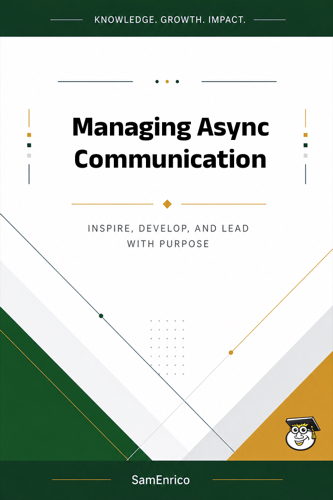
Managing Async Communication eBook
Reduces Slack and email interruptions with batch p
Reduces Slack and email interruptions with batch processing.
Formats
Free sample
Chapter 1: The Interruption Economy--–- The email arrived at 9:02 AM. By 9:05 AM, Sarah had already switched from her deep work on the quarterly forecast to answer it. At 9:17 AM, a Slack DM from her manager pinged: "Quick question when you have a sec." She replied immediately. At 9:31 AM, she returned to the forecast. At 9:44 AM, a calendar reminder for a 10:00 AM meeting popped up.
She spent the next 16 minutes preparing for the meeting instead of resuming the forecast. At 10:00 AM, she joined the meeting. At 10:45 AM, the meeting ended. At 10:52 AM, she checked email again. At 11:08 AM, she finally reopened the forecast document.
She had lost three hours and thirty-eight minutes of productive time. She had done exactly zero minutes of deep work. And she had no idea why she was exhausted.This is not a story about a disorganized employee. This is a story about a knowledge worker trapped in the Interruption Economy—a system where the currency is attention, the interest rate is cognitive debt, and bankruptcy is measured in burnout. Sarah is not the exception.
She is the rule. And if you are reading this book, so are you.The great paradox of modern communication tools is that they were designed to save time, yet they have become the single greatest consumers of it. Email promised to replace postal mail's five-day latency with five-second delivery. Slack promised to replace the disruption of the telephone with the gentleness of chat. Cloud documents promised to eliminate the chaos of emailed attachments.
Each innovation was rational. Each solved a real problem. But together, they have created a monster: a 24/7, always-on, notification-driven attention economy where the act of communicating has replaced the act of working.This chapter diagnoses the disease. Before we can prescribe a cure—and the batch processing methods in Part II of this book are that cure—we must understand the pathology. We must see clearly how interruptions destroy cognitive capacity, how context switching creates a hidden tax on every knowledge worker, and how the "time-zone lottery" rewards speed over thoughtfulness.
By the end of this chapter, you will not only recognize the Interruption Economy in your own work life. You will be angry about it. And that anger is the first step toward reclaiming your attention.The Hidden Tax You Didn't Know You Were Paying Let us begin with a simple question: How many times did you check Slack or email yesterday? If you are like most knowledge workers, the answer is somewhere between 50 and 150 times. That is not an exaggeration.
Research from Rescue Time, a productivity analytics firm, found that the average knowledge worker checks email every six minutes and Slack every five minutes. That is roughly twelve checks per hour, or ninety-six checks over an eight-hour workday. But here is the twist: most of those checks are not responses. They are glances. A notification appears.
You glance at the sender. You glance at the subject line. You decide it can wait. You glance away. That took three seconds.
Three seconds is nothing, right?Wrong. Three seconds is a trap.The cognitive cost of an interruption is not the interruption itself. It is the recovery. Psychologists have studied task switching for decades, and the findings are remarkably consistent: when you interrupt a task to attend to something else, your brain does not simply pause and resume like a video player. It must disengage from the first task, engage in a mental "goal shift" to the second task, perform the second task, then shift back and reconstruct the context of the first task.
That reconstruction process is expensive. In a landmark study published in the journal Psychological Science, researchers found that even brief interruptions of less than three seconds doubled the error rate on a subsequent task. Longer interruptions—the kind that involve actually reading and responding to a message—take an average of twenty-three minutes to fully recover from.Twenty-three minutes. Let that sink in.Every time you stop deep work to answer a Slack DM that could have waited, you lose nearly half an hour of productive capacity. Not because the DM took twenty-three minutes to write—it probably took thirty seconds.
But because your brain needs twenty-three minutes to rebuild the mental model of the deep work task you abandoned. The variables you were holding in working memory. The thread of logic you were following. The creative associations you were building. All of it dissipates.
And here is the cruelest part: you do not notice the loss. You feel busy. You feel responsive. You feel like you are working hard. But the hard work you are doing is shallow—responding, triaging, reacting.
The deep work that moves the needle for your business and your career is not happening.The Mathematics of Lost Workweeks Let us make this concrete with a simple calculation. Suppose you receive twenty interruptions per day. That is a conservative estimate for many knowledge workers—some receive twice that. Each interruption costs twenty-three minutes of recovery time, but let us be generous and assume you are exceptionally good at task switching. Let us assume your recovery time is only fifteen minutes per interruption.Twenty interruptions × fifteen minutes = 300 minutes = five hours lost per day.Over a five-day workweek: twenty-five hours lost.That is more than three full workdays lost every week to the recovery cost of interruptions.
And that calculation does not even include the time spent on the interruptions themselves—the minutes spent reading and responding to messages, which are also not deep work. Add those in, and you are easily losing four days per week. You are working five days but producing the equivalent of one.This is the hidden tax of the Interruption Economy. It is invisible because it is distributed. No single interruption feels costly.
No single notification seems like a big deal. But aggregated over a week, a month, a year, the cost is staggering. If you earn $100,000 per year, the interruption tax is costing your employer—and your career—roughly $80,000 in lost productive value. You are being paid for five days but delivering one. And the tragedy is that you are working just as hard as ever.
Harder, even. You are just working on the wrong things.Context Switching and the IQ Penalty The damage goes beyond lost time. Interruptions also degrade the quality of whatever cognitive work you manage to complete. This is known as the context switching penalty, and it has been measured in controlled experiments.In one notable study, researchers at the University of London asked participants to perform a cognitive task while also managing incoming emails. The participants who multitasked showed an average IQ drop of ten points.
Ten points is significant. It is the difference between scoring in the top 10% of the population and scoring in the top 30%. It is the difference between being considered "superior intelligence" and "normal range." In practical terms, a ten-point IQ drop means slower problem-solving, poorer pattern recognition, reduced creative thinking, and increased susceptibility to cognitive biases—especially the bias toward easy, shallow solutions over complex, correct ones.The mechanism behind this drop is straightforward but pernicious. Your brain has a limited pool of working memory.…
This is the end of the free sample. Get the eBook to keep going. Buy now
About this book
Details
- Author
- Salcedo Danette
- Publisher
- SamEnrico
- Language
- English
- Genre
- Non-Fiction, Self-Help, Communication
- Released
- 2026-06-10
- Pages (approx.)
- 144
- Available as
- eBook, Audiobook

Read better in the ZLOADR app
Your eBooks on your phone or tablet. Sign in with your SamEnrico account and start reading.
More by Salcedo Danette
 Resentment and Entitlement WorkbookSalcedo Danette$11.99
 Martin Van Buren Political ArchitectSalcedo Danette$11.99
 Vegan Iron Deficiency Recovery GuideSalcedo Danette$11.99
 The Martial Artist StretchSalcedo Danette$11.99
 Lost Kingdoms of the Sea: The Sunken Cities of Southeast AsiaSalcedo Danette$11.99
 Operation Pastorius: Hitler’s Secret Saboteurs in AmericaSalcedo Danette$11.99
 A Beginners Guide to Banzai skydiving (Volume 1)Salcedo Danette$11.99
 Understanding Crouzon SyndromeSalcedo Danette$17.99
 Petition Fee DeadlinesSalcedo Danette$12.99
 First Sales Script TemplatesSalcedo Danette$12.99
 Seasonal Style AdvisorSalcedo Danette$11.99
You may also like
 Hong Kong Handover 1997Dunn Johnnie$11.99
 Zumba For Postnatal Recovery CourseNeal Christian$11.99
 Zumba for BeginnersLadner Nikia$11.99
 YouTube Comment Mining GuideHumes Pandora$12.99
 Worry Box MeditationCarlin Rudy$11.99
 Workplace Stress MeditationNguyen Lynn$11.99
 Workplace Stress and Sleep RepairHawley Ivory$11.99
 Workplace Perfectionism CureDelaney Jeffry$11.99
 Workplace Injustice Anger GuideWallen Isabelle$11.99
 Work Addiction and Burnout LinkGreenwood Ester$11.99
 Women in Yoga and WellnessBeattie Galina$11.99
 Women in Stand Up ComedyChun Evangeline$11.99