
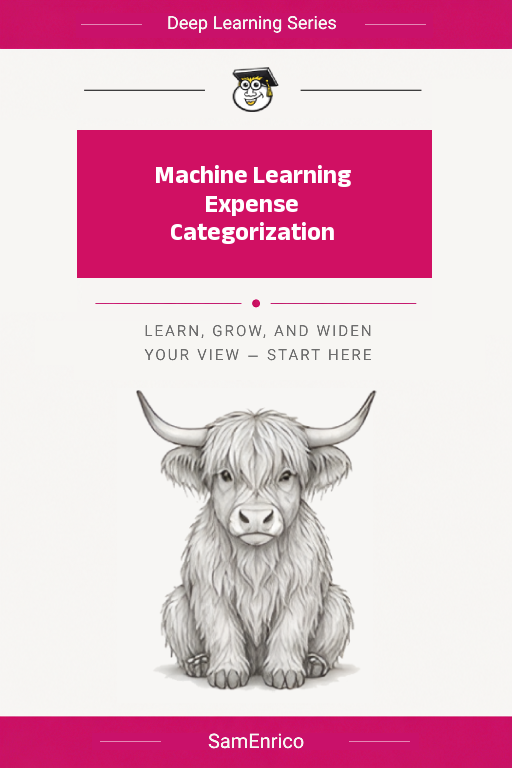
Machine Learning Expense Categorization eBook
Train AI to learn your business spending patterns
Train AI to learn your business spending patterns and auto-categorize expenses without manual rules.
Formats
Free sample
Chapter 1: The Rule Trap--–- The email arrived at 11:47 PM on a Tuesday. Sarah, the controller of a 45-person software company, had been staring at the same spreadsheet for four hours. The subject line read: "Audit Request – Expense Categorization Detail – Fiscal Year 2023." Attached was a list of 847 transactions from Amazon alone. Each one needed to be manually verified, recategorized if necessary, and explained. The problem was that her rule-based accounting system had been making assumptions for three years – and many of those assumptions were wrong.
A 47chargeforawirelessmousehadbeenmarked"Office Supplies"(correct).A47 charge for a wireless mouse had been marked "Office Supplies" (correct). A 47chargeforawirelessmousehadbeenmarked"Office Supplies"(correct).A499 charge for an AWS server had been marked "Books & Subscriptions" (very wrong). A $2,300 charge for a Mac Book Pro had been marked "Marketing – Digital Ads" (catastrophically wrong). Sarah was now responsible for explaining to an auditor why a laptop was classified as advertising.This is the Rule Trap. It is not a hypothetical.
It happens every day in thousands of businesses, from solo freelancers to Fortune 500 companies. And it happens because of a fundamental misunderstanding about how expense categorization should work.Most people believe that categorization is a problem of logic. If this, then that. If the vendor name contains "Uber," then category equals "Travel." If the amount is less than $25 and the merchant is "Starbucks," then category equals "Meals & Entertainment." These rules seem sensible. They seem precise.
They seem, for the first hundred or so entries, like a reasonable way to automate a tedious task.But here is the truth that no accounting software vendor will tell you: rule-based systems are mathematically guaranteed to fail as your business grows. Not because the rules are written poorly. Not because your team is incompetent. But because the number of possible edge cases grows exponentially while your ability to maintain rules grows only linearly. This is the Rule Paradox, and it is the central problem this book exists to solve.Before we build anything – before we write a single line of code or label a single transaction – we need to understand why rules fail, what replaces them, and how to think about expense categorization as a learning problem rather than a logic problem.
This chapter establishes the philosophical foundation for everything that follows. By the end, you will never write another brittle IF-THEN rule again.The Myth of Complete Coverage Let us start with a thought experiment. Imagine you are building a rule-based system for a new business. In month one, you have three vendors: Staples (office supplies), Uber (travel), and Adobe (software). You write three rules.
The system works perfectly. You feel smart.In month two, you add three more vendors: Grub Hub (meals), We Work (rent), and Quick Books (software – but wait, is that different from Adobe? Do you need separate categories for Saa S vs. perpetual licenses?). You now have six vendors, but the relationships between them are already getting messy.
Does Grub Hub count as "Meals" or "Meals & Entertainment"? Does it matter if the employee was alone versus with a client? Your rule set grows to eight rules to handle these distinctions.By month six, you have forty-seven vendors. Some vendors serve multiple purposes – you buy both office supplies and equipment from Staples. Some vendors change their merchant strings – "AMZN Mktp" becomes "Amazon Digital Services" becomes "Prime Video." Some employees use their corporate cards for personal expenses, which need to be flagged and reimbursed.
Your rule set is now at two hundred rules, and you are spending ten hours per week updating, debugging, and reconciling them.By month twelve, you have one hundred forty vendors and approximately five hundred rules. You have rules that conflict with each other (one says "Uber" is Travel, another says any transaction under $10 is Miscellaneous). You have rules that depend on the order of execution – a bug you discovered only after three hundred mis-categorized transactions. You have given up on handling edge cases entirely; you just fix them manually when they appear.This is not a failure of effort or intelligence. This is a mathematical inevitability.
The number of possible vendor-merchant-amount-time combinations is effectively infinite. Every new vendor introduces not one new case but dozens of edge cases depending on amount, frequency, time of day, and user behavior. A rule-based system requires a human to anticipate every possible combination and encode a response. A learning-based system requires a human to provide examples, and then generalizes to unseen combinations automatically.The Rule Paradox, stated formally, is this: the cost of maintaining a rule-based system grows faster than the cost of manually processing transactions. At some threshold – typically between two hundred and five hundred rules – you would be better off firing the rules and paying a human to do the work.
Most businesses cross this threshold without realizing it, bleeding hours and morale while believing they have "automated" their expense process.Why Accounting Software Won't Save You Every major accounting platform – Quick Books, Xero, Net Suite, SAP – offers rule-based categorization. They call it different things: "bank rules," "auto-add rules," "transaction matching." The user interface is always a variation of the same form: IF [condition] THEN [category]. These features are not solutions. They are traps dressed as convenience.The problem is not that the software is bad. The problem is that the underlying model – rule-based logic – cannot scale to real-world complexity.
The software vendors know this. They have known it for years. But they have no incentive to tell you, because the alternative requires machine learning, and machine learning is expensive to build, difficult to explain to non-technical customers, and risky to deploy without human oversight. So they give you rules, and they let you discover the limits on your own time.Let us examine why rules fail in practice, beyond the abstract combinatorial explosion. There are five specific failure modes that every rule-based system encounters.Failure Mode 1: Vendor String Variation.
The same vendor can appear dozens of different ways in your bank feed. "AMZN Mktp US" is Amazon. "Amazon.com" is Amazon. "Prime Video" is Amazon. "AWS" is Amazon.
"Amazon Digital Services" is Amazon. A rule that matches exactly on "AMZN Mktp US" will miss every other variation. A rule that uses wildcards or partial matching will accidentally catch false positives (does "Amazon" appear in any other vendor name?). You end up writing ten rules for one vendor, and then maintaining those rules as Amazon changes its merchant strings quarterly.Failure Mode 2: Split Purpose Vendors. Staples sells both office supplies (expense, category A) and equipment (asset, category B).
Amazon sells books (supplies), software (subscriptions), hardware (equipment), and gift cards (prepaids). Your rule for "Staples" cannot know which category to assign without additional information – amount, description, or employee input. So you either guess incorrectly (leading to audit risk) or you route every Staples transaction to a human (defeating the purpose of automation).Failure Mode 3: Temporal Drift. A vendor's behavior changes over time. A monthly subscription becomes annual.
A per-seat pricing model changes to usage-based. A vendor you used for marketing pivot to software. Your rules, written at a moment in time, become steadily less accurate. You discover this only when someone reviews the categorized data months later and…
This is the end of the free sample. Get the eBook to keep going. Buy now
About this book
Details
- Author
- Swain Frankie
- Publisher
- SamEnrico
- Language
- English
- Genre
- Non-Fiction, Business Brief, ML Accounting
- Released
- 2026-06-01
- Pages (approx.)
- 130
- Available as
- eBook, Audiobook

Read better in the ZLOADR app
Your eBooks on your phone or tablet. Sign in with your SamEnrico account and start reading.
More by Swain Frankie
 The Curcumin Brain ProtectionSwain Frankie$11.99
 Key Employee Loss Recruitment Fire Drill GuideSwain Frankie$11.99
 Uber EV vs Gas Cost AnalysisSwain Frankie$11.99
 The Career Fair Stress GuideSwain Frankie$11.99
 The Addiction Cycle Analysis GuideSwain Frankie$11.99
 Blocked Mergers Enforcement LogSwain Frankie$11.99
 Spouse Grief Music TherapySwain Frankie$11.99
 Keynote Calm Down PlanSwain Frankie$11.99
 Cannabis Use Disorder TeensSwain Frankie$11.99
 Chains of the Forgotten: The Unseen Architects of the Underground RailroadSwain Frankie$11.99
 The Golden Age of Axum: Africa's Trading TitansSwain Frankie$11.99
 The Complete Guide to the Weight Loss GrailSwain Frankie$11.99