
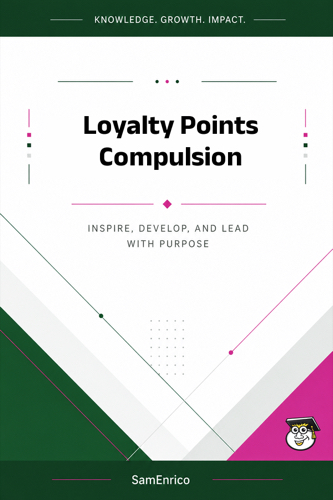
Non-FictionSelf-Help / Loyalty
Loyalty Points Compulsion eBook
Breaks the cycle of spending to earn rewards or st
by Engel Loree
Breaks the cycle of spending to earn rewards or status.
Formats
Free sample
Chapter 1: The $1,200 Free Vacation--The email arrived on a Tuesday morning, subject line glowing with promise: “Congratulations, Sarah! Your dream vacation is within reach.”Sarah Chen, a 38-year-old certified public accountant and self-described rational optimist, opened the email while waiting for her coffee to brew. She was, by any objective measure, good with money. She maxed out her 401(k) match every year. She had six months of emergency savings in a high-yield account.
She drove a reliable five-year-old Honda and clipped digital coupons for groceries. She was not the kind of person who got played.The email informed her that she had accumulated 185,000 loyalty points across three premium travel credit cards. According to the bank’s cheerful calculator, those points could be redeemed for a round-trip flight to Hawaii, four nights at a resort, and a $200 dining credit. The retail value, the email claimed, was $4,800. Her cost?
Zero. Free. Complimentary. A gift for being such a valued customer.Sarah felt a flush of pride. She had been working the points game for two years, carefully selecting which card to use at which merchant, timing her sign-up bonuses to overlap with planned purchases, and maintaining a spreadsheet that tracked her cents-per-point valuation across five different loyalty currencies.
She was not a shopper. She was an optimizer. And now, the system was paying her back.She booked the trip that afternoon. The flight required a connection through Dallas-Fort Worth with a three-hour layover, but that was fine—she could catch up on work emails. The resort was not the one she would have chosen with cash (she had her eye on a smaller boutique hotel), but the loyalty program only partnered with the large chain properties.
She booked it anyway. Four nights. Ocean view. Free.By the time she returned from Hawaii, something felt wrong. Not guilty—Sarah did not do guilt.
But curious. Accountant-curious. She sat down on a Sunday afternoon, pulled up her bank statements from the previous twenty-four months, and decided to calculate the true cost of her “free” vacation. What she found would change the way she thought about loyalty for the rest of her life.The First Line: Annual Fees Sarah started with the easiest number: the annual fees on her three premium travel cards.Card A: $550 per year. This was the flagship “luxury travel” card, which offered lounge access, a $300 annual travel credit, and priority boarding on one airline.
She had kept it for two years. Total: $1,100.Card B: $250 per year. This was the “mid-tier” card that earned bonus points on dining and groceries. She had used it for all her restaurant spending, convinced that the 3x points were paying for the fee. Two years: $500.Card C: $95 per year.
This was the “no-fuss” card that came with her bank account. She had almost forgotten about it, but the fee posted automatically every November. Two years: $190.Total annual fees: $1,790.But wait, Sarah thought. The cards offered offsetting credits. Card A had a $300 annual travel credit.
She had used it both years to reimburse herself for flights she would have booked anyway. So subtract $600. Card B offered a $100 hotel credit each year, but she had only used it once because the participating hotels were always overpriced. Subtract $100.Adjusted annual fees: $1,090.Sarah wrote that number at the top of a fresh spreadsheet cell. Then she kept going.The Second Line: Interest Charges Sarah had never carried a credit card balance in her adult life.
She was meticulous about paying the full statement balance every month. She considered interest to be a tax on the disorganized and the desperate.Then her transmission failed.The repair cost $3,800, and it came in the same month as her property tax bill and her daughter’s summer camp deposit. For the first time in a decade, Sarah carried a balance on her premium travel card—just for two months, just until her bonus came through. She paid $280 in interest.But as she sat with her spreadsheet, she realized something uncomfortable. That $280 in interest was not a freak accident.
It was causally connected to the points game. She had put the transmission repair on her premium travel card specifically because it earned 2x points on auto repairs (a category bonus she had researched six months earlier). If she had used her debit card or her low-interest emergency credit card, she would have paid less interest. But she had optimized for points instead of interest rates.She added $280 to the running total.Running total: $1,370.The Third Line: Overspending to Hit Tiers This was the line that frightened her. Sarah had never tracked this number before because she did not want to know it.
But now, with the spreadsheet open and her coffee growing cold, she forced herself to look.Loyalty programs do not just reward spending. They reward threshold spending. You get nothing at $4,999 and a bonus at $5,000. You are Silver at 24,999 miles and Gold at 25,000. The architecture of every loyalty program is designed to push you past a finish line that your rational brain knows is arbitrary but your emotional brain cannot ignore.Sarah scanned her credit card statements for the past two years, looking for purchases that she would not have made—or would have made differently—without the looming threshold.Item one: In November of last year, she was $400 short of a “spend $15,000 get 20,000 bonus points” promotion.
She bought a new blender she did not need ($180) and prepaid her internet bill for three months ($220). She used the blender twice. The internet prepayment locked her into a provider she had been planning to leave. Cost of the unnecessary spending: $400.Item two: In March, she was 1,200 miles away from “Gold” status on an airline she flew twice a year. She booked a “mileage run”—a round-trip flight to a city she had no intention of visiting, just to earn the miles.
The flight cost $260 plus $45 in parking. She sat in the airport for six hours and flew home. She has never used a Gold perk that materially improved her travel experience. Cost: $305.Item three: Her coffee shop loyalty card. Buy ten, get one free.
She estimates that she bought at least fifteen extra pastries over two years because she was “so close” to a free coffee. Average pastry: $4.50. Extra spending: $67.50.Item four: The hotel chain where she booked her “free” Hawaii vacation. She had stayed at that chain four times over two years, even when cheaper or nicer options were available, because she was collecting points. The average premium she paid per night was $35.
She stayed twelve nights. Cost: $420.Total overspending to hit tiers: $1,192.50.Running total: $2,562.50.Sarah leaned back in her chair. She had not even gotten to the time accounting yet.The Fourth Line: The Labor Illusion This was the line that broke her.Sarah had heard about the concept of “imputed labor costs” in her economics classes in college. The idea was simple: when you perform unpaid labor—cooking a meal instead of eating out, mowing your lawn instead of hiring a landscaper—you are saving money but spending time. If you value your time at a certain hourly rate, you can calculate whether the unpaid labor is actually worth it.She had never applied this concept to loyalty…
This is the end of the free sample. Get the eBook to keep going. Buy now
About this book
Details
- Author
- Engel Loree
- Publisher
- SamEnrico
- Language
- English
- Genre
- Non-Fiction, Self-Help / Loyalty
- Released
- 2026-06-07
- Pages (approx.)
- 128
- Available as
- eBook, Audiobook

Read better in the ZLOADR app
Your eBooks on your phone or tablet. Sign in with your SamEnrico account and start reading.
More by Engel Loree
 Caregiving For Parent With OsteoporosisEngel Loree$11.99
 Food Addiction Recovery for VegansEngel Loree$11.99
 Ayurvedic Spice Kitchen GuideEngel Loree$11.99
 Reciprocity Rule Influence GuideEngel Loree$11.99
 Trafficked at FourteenEngel Loree$11.99
 High Altitude BrainEngel Loree$11.99
 Safe Person SyndromeEngel Loree$11.99
 Basilisk: The Serpent King of the Black ForestEngel Loree$11.99
 Service Providers Guide to Auction ServicesEngel Loree$11.99
 How to Produce Telephone HeadsetsEngel Loree$11.99
 How to Produce Home Audio EquipmentEngel Loree$11.99
 Chinese Language Scholarship GuideEngel Loree$12.99
You may also like
 Hong Kong Handover 1997Dunn Johnnie$11.99
 Zumba For Postnatal Recovery CourseNeal Christian$11.99
 Zumba for BeginnersLadner Nikia$11.99
 YouTube Comment Mining GuideHumes Pandora$12.99
 Worry Box MeditationCarlin Rudy$11.99
 Workplace Stress MeditationNguyen Lynn$11.99
 Workplace Stress and Sleep RepairHawley Ivory$11.99
 Workplace Perfectionism CureDelaney Jeffry$11.99
 Workplace Injustice Anger GuideWallen Isabelle$11.99
 Work Addiction and Burnout LinkGreenwood Ester$11.99
 Women in Yoga and WellnessBeattie Galina$11.99
 Women in Stand Up ComedyChun Evangeline$11.99