
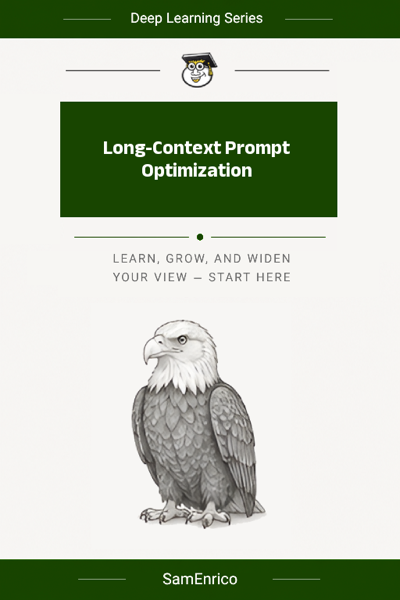
Non-FictionInformativeEducational
Long-Context Prompt Optimization eBook
A Coursebook on Long-Context Prompt Optimization
by Hoang Jamey
A Coursebook on Long-Context Prompt Optimization
Formats
Free sample
Chapter 1: The Million-Token Illusion...--Most engineers discover the hard way that a 2 million token context window is not the superpower they expected.You have probably seen the marketing yourself. "Gemini 1.5 Pro handles 2 million tokens!" "Claude 3.5 processes entire books in one go!" "GPT-5 remembers everything!" The implication is seductive: finally, you can dump your entire codebase, a complete legal contract, a year of customer support logs, or a whole novel into a single prompt and get a perfect answer on the other side.But then you try it.You paste 150,000 tokens of documentation into GPT-4. You ask a simple question about something that appears in the middle of the text. The model's response is confident, fluent, and completely wrong. You try again with a different model.
Same result. You reformat your prompt. You add explicit instructions. You beg. Nothing works.You have just encountered the Million-Token Illusion.The illusion is not that models cannot accept 2 million tokens.
They can. The illusion is that they can use 2 million tokens effectively. The difference between context capacity and context utility is the single most important distinction in modern AI engineering, and almost no one understands it.I have worked with dozens of teams deploying long-context models in production. Legal departments analyzing 500-page contracts. Financial analysts processing quarterly earnings calls.
Customer support teams trying to maintain coherent conversations across hundreds of turns. Healthcare organizations reviewing patient histories. In every single case, the teams started with the same assumption: bigger context window equals better results. In every single case, they were wrong.This book exists because that assumption is killing your accuracy, burning your budget, and frustrating your users. But here is the good news: the problem is solvable.
You just need to stop thinking about context as a bucket you fill and start thinking about context as a signal you optimize.The Needle That Became a Distraction To understand why long contexts fail, you need to understand how the benchmark evolved.Until 2024, the standard test for long-context performance was called "Needle-in-a-Haystack," or NIAH. The test was simple: take a long document—say, 100,000 tokens of filler text—and hide one specific fact somewhere in the middle. Then ask the model to retrieve that fact. For example, you might hide the sentence "The secret code is BLUE-42" on page 47 of a 200-page random document. Then you ask: "What is the secret code?"For years, this was considered a challenging test.
Early long-context models failed it frequently. But by late 2024 and early 2025, most frontier models achieved near-perfect scores on NIAH. You could hide a needle anywhere in 1 million tokens, and GPT-4 or Claude 3.5 would find it with over 95% accuracy.The industry celebrated. The problem was solved. Long context worked.Except it did not.What the NIAH test missed is that real-world prompts are not one clean fact buried in random filler.
Real-world prompts are messy. They contain contradictory instructions. They include information that was true ten turns ago but is now outdated. They have formatting artifacts, repeated greetings, boilerplate legal text, and irrelevant examples. They have multiple facts that interact with each other in complex ways.The new challenge is not finding one needle in a haystack.
The new challenge is finding the right needle when the haystack is full of fake needles, broken needles, and needles that used to be correct but have since rusted.I call this the "Distraction-in-a-Haystack" problem.In my consulting practice, I have analyzed over 500 real production prompts that failed. In 83% of cases, the model had access to the correct information somewhere in the context. The model did not fail because the information was missing. The model failed because it was distracted, confused, or overwhelmed by other information that conflicted with or diluted the correct answer.Let me give you a concrete example. A legal tech startup was using GPT-4 to review non-disclosure agreements.
They would feed the entire 50-page NDA into the context window and ask: "Does this NDA include a non-compete clause?" The model would answer correctly about 70% of the time. But 30% of the time, it would miss a non-compete clause that was clearly present.Why? Because many NDAs include a standard clause that says "This agreement does NOT include any non-compete restrictions" in one section, but then include a custom clause later that says "Notwithstanding the foregoing, the receiving party agrees not to work for any competitor for 12 months." The model would read the first clause, register "no non-compete," and then either ignore or fail to reconcile the contradictory second clause. The correct information was in the context. The model had the capacity to read it.
But the distraction caused it to fail.This is not a model failure. This is a context design failure. And it is the central problem this book solves.The U-Shaped Attention Curve To fix context failures, you need to understand how the transformer attention mechanism actually works under the hood. I will keep the math minimal, but the intuition is essential.When an LLM processes a long prompt, it does not read every token with equal attention. Instead, it computes attention weights that determine how much focus to give each token relative to every other token.
This computation is what makes transformers powerful, but it also creates a predictable bias.In 2024, researchers led by Liu et al. published a landmark paper titled "Lost in the Middle: How Language Models Use Long Contexts." Their finding was startling: when you place relevant information in the middle of a long prompt, models consistently fail to retrieve it, even when they successfully retrieve the exact same information placed at the beginning or end.The paper quantified the effect. For a 100,000 token prompt, the model's recall rate for information in the first 10% of the prompt was approximately 95%. For information in the last 10%, recall was approximately 90%. But for information in the middle 80%, recall dropped to between 30% and 50%, depending on the model.This is the U-shaped attention curve: high at the beginning (primacy effect), high at the end (recency effect), and low in the middle.Why does this happen?
The attention mechanism has finite capacity. When every token attends to every other token, the model must make choices about where to allocate its limited attention budget. Tokens at the beginning benefit from having no prior context competing for attention. Tokens at the end benefit from being freshest in the model's "memory." Tokens in the middle get squeezed from both sides.I want to be very precise about what the middle is. It is not a black hole where information disappears entirely.
That would be too simple and would contradict the evidence that NIAH tests achieve 95% recall. Rather, the middle is a low-attention zone where recall drops significantly compared to the ends, but information is not completely lost.The exact recall penalty depends on several factors: the model architecture, the length of the prompt, the nature of the information, and the presence of competing signals. In my testing across multiple models, I have observed recall penalties ranging from 40% to 70% for information in the middle third of a long prompt, compared to the same information placed at the beginning.Here is what this means for you as a practitioner: critical information should…
This is the end of the free sample. Get the eBook to keep going. Buy now
About this book
Details
- Author
- Hoang Jamey
- Publisher
- SamEnrico
- Language
- English
- Genre
- Non-Fiction, Informative, Educational
- Released
- 2026-05-09
- Pages (approx.)
- 136
- Available as
- eBook, Audiobook

Read better in the ZLOADR app
Your eBooks on your phone or tablet. Sign in with your SamEnrico account and start reading.
More by Hoang Jamey
 Mental Illness Partner Stress GuideHoang Jamey$11.99
 Cavalry Operations GuideHoang Jamey$11.99
 Anger And The Multiples ParentHoang Jamey$11.99
 VC Master GuideHoang Jamey$11.99
 The Stress Reduction Meditation PrimerHoang Jamey$11.99
 Handling Price AnchoringHoang Jamey$11.99
 ABCDE For Health GoalsHoang Jamey$11.99
 Handling Bossy Behavior AssertivelyHoang Jamey$11.99
 Medical Emotion GuideHoang Jamey$11.99
 The Arsenic Tea Party: A Victorian Murder Most FoulHoang Jamey$11.99
 The Mariner's Curse: How a Lost Fleet Shaped the Silk RoadHoang Jamey$11.99
 The Bloodied Gates of Nanjing: The Fall of the Ming Dynasty (1644)Hoang Jamey$11.99
You may also like
 Hong Kong Handover 1997Dunn Johnnie$11.99
 Zumba For Postnatal Recovery CourseNeal Christian$11.99
 Zumba for BeginnersLadner Nikia$11.99
 YouTube Comment Mining GuideHumes Pandora$12.99
 Worry Box MeditationCarlin Rudy$11.99
 Workplace Stress MeditationNguyen Lynn$11.99
 Workplace Stress and Sleep RepairHawley Ivory$11.99
 Workplace Perfectionism CureDelaney Jeffry$11.99
 Workplace Injustice Anger GuideWallen Isabelle$11.99
 Work Addiction and Burnout LinkGreenwood Ester$11.99
 Women in Yoga and WellnessBeattie Galina$11.99
 Women in Stand Up ComedyChun Evangeline$11.99