
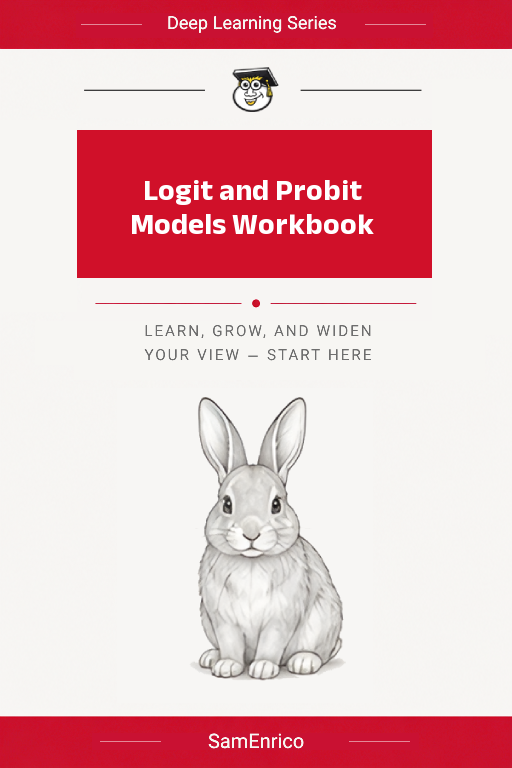
Non-FictionStudent's ShortcutDiscrete Choice
Logit and Probit Models Workbook
Estimate binary choice models for economics exam d
by Alves Janee
Estimate binary choice models for economics exam data using Excel's logistic regression. Predict probabilities and calculate marginal effects correctly.
Formats
About this book
Free sample
Chapter 1: The Straight-Line Trap--–- Every economics student learns to love the straight line. From supply and demand curves to ordinary least squares regression, the linear assumption is elegant, interpretable, and computationally convenient. It works beautifully when predicting continuous outcomes like income, crop yields, or housing prices. But when your outcome is a binary choice—pass or fail, buy or not buy, hire or reject—that straight line becomes a snare. It produces predictions that are mathematically impossible, standard errors that are systematically wrong, and policy recommendations that can be actively misleading.
This chapter will lead you through the wreckage of the Linear Probability Model. You will make the mistakes yourself, inside Excel, so that you never repeat them with real data. By the final page, you will understand precisely why the LPM is a trap, and why the remaining eleven chapters of this book exist to pull you out of it.The Illusion of a Quick Answer Imagine you are an economist at a regional development bank. Your team has collected data on 500 small businesses that applied for loans. Each business either received funding (1) or was denied (0).
You have information on their annual revenue, years in operation, number of employees, and credit score. Your task is to build a model that predicts which businesses will receive funding, and to identify which factors matter most for loan approval.You open Excel. You load the dataset. You run a linear regression. The output appears clean.
The coefficients have signs that match your intuition: higher revenue, longer operation history, more employees, and better credit scores all increase the predicted probability of approval. The R-squared is 0.38. The p-values are below 0.05. You feel a wave of satisfaction. You have an answer.But you have walked into a trap.The model you just estimated—the Linear Probability Model—is fundamentally flawed for binary outcomes.
Its flaws are not subtle technicalities. They are dramatic, visible, and logically devastating. And they emerge the moment you try to use your model for its intended purpose: predicting probabilities.What Happens When You Ignore the Boundaries of Probability Open a new…
This is the end of the free sample. Get the eBook to keep going. Buy now
Contents
- Chapter 1
- Chapter 2
- Chapter 3
- Chapter 4
- Chapter 5
- Chapter 6
- Chapter 7
- Chapter 8
- Chapter 9
- Chapter 10
- Chapter 11
- Chapter 12
Details
- Author
- Alves Janee
- Publisher
- SamEnrico
- Language
- English
- Genre
- Non-Fiction, Student's Shortcut, Discrete Choice
- Released
- 2026-06-01
- Pages (approx.)
- 151
- Available as
- eBook, Audiobook

Read better in the ZLOADR app
Your eBooks on your phone or tablet. Sign in with your SamEnrico account and start reading.
More by Alves Janee
 Financial Stress for Restaurant WorkersAlves Janee$11.99
 Catherine Great Postal ReformAlves Janee$11.99
 Counseling Student StressAlves Janee$11.99
 Mindfulness for Panic AttacksAlves Janee$11.99
 The Visionaries of Stone and Sand: The Architectural Genius of the Swahili CoastAlves Janee$11.99
 How to Produce Auto Racing Fan AccessoriesAlves Janee$11.99
 Exploring Rock PoolsAlves Janee$11.99
 How to Become a PourerAlves Janee$11.99
You may also like
 Hong Kong Handover 1997Dunn Johnnie$11.99
 Zumba For Postnatal Recovery CourseNeal Christian$11.99
 Zumba for BeginnersLadner Nikia$11.99
 YouTube Comment Mining GuideHumes Pandora$12.99
 Worry Box MeditationCarlin Rudy$11.99
 Workplace Stress MeditationNguyen Lynn$11.99
 Workplace Stress and Sleep RepairHawley Ivory$11.99
 Workplace Perfectionism CureDelaney Jeffry$11.99
 Workplace Injustice Anger GuideWallen Isabelle$11.99
 Work Addiction and Burnout LinkGreenwood Ester$11.99
 Women in Yoga and WellnessBeattie Galina$11.99
 Women in Stand Up ComedyChun Evangeline$11.99