
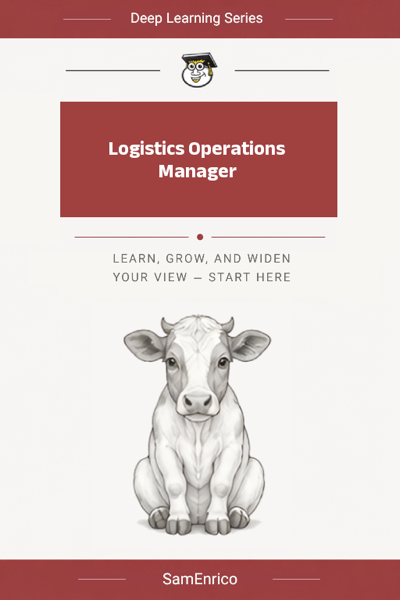
Non-FictionInformativeEducational
Logistics Operations Manager eBook
A Coursebook on Logistics Operations Manager
A Coursebook on Logistics Operations Manager
Formats
Free sample
Chapter 1: The Invisible Architecture– In 2010, a 24-year-old logistics coordinator named Maria sat in a fluorescent-lit office in Rotterdam, staring at a spreadsheet that would determine whether 14,000 Christmas gifts arrived on time. She had no direct reports. No corner office. No one outside her company knew her name. But for the next six weeks, she held in her hands the difference between a child’s joy and disappointment — and between her employer retaining or losing a $40 million retail contract.Maria was not an exception.
She was the rule. Across the world, millions of logistics operations managers, coordinators, analysts, and supervisors work in the invisible architecture that makes modern life possible. The phone you are reading this on traveled through at least 20 hands, across three continents, through two customs inspections, and over 12,000 miles before it reached you. Every step of that journey required someone — often several someones — to make decisions about routing, timing, cost, risk, and quality. That someone is a logistics operations manager.This book is about becoming that someone.
And more importantly, it is about understanding why that someone has become the most underestimated strategic role in the 21st-century corporation.The Great Misunderstanding Most people — including many business leaders — think logistics is about trucks. They imagine warehouses stacked with pallets, drivers drinking coffee at truck stops, and men with clipboards checking boxes. This is like saying medicine is about bandages. The physical objects are visible, even photogenic. But they are the symptoms, not the system.Logistics is the science and art of moving the right thing, to the right place, at the right time, in the right condition, in the right quantity, with the right documentation, to the right customer — while spending as little money as possible and taking as little risk as necessary.
These eight conditions — known in the industry as the “7 Rights” (some frameworks count seven, others eight; we use the eight-element version for completeness) — are deceptively simple. Each one hides a universe of trade-offs, calculations, and decisions.Consider the “right time.” What does that mean for a shipment of chemotherapy drugs to a rural hospital? It means literally every minute matters. What does it mean for a pallet of bricks to a construction site? It means “sometime this week” is probably fine.
The logistics manager must know the difference and act accordingly — not because someone tells them, but because they understand the underlying cost and consequence structures of the goods they move.From Tactical to Strategic To understand why logistics operations managers have become indispensable, we need a brief history lesson.Before World War II, logistics was a military term. Armies had logistics — moving food, ammunition, and fuel to the front. Businesses had “shipping departments.” These were overhead functions, cost centers, places where careers went to stagnate. If you were ambitious, you went into sales, finance, or marketing. If you weren’t, you ended up in shipping.The war changed everything.
The Allied victory in Europe was, in large part, a logistics victory. General Dwight D. Eisenhower famously said, “You will not find it difficult to prove that battles, campaigns, and even wars have been won or lost primarily because of logistics.” The Berlin Airlift of 1948-1949 proved that logistics could be a peacetime superpower: over 200,000 flights delivered 2.3 million tons of supplies, breaking a Soviet blockade without firing a shot.But business took another three decades to catch up. The transformation happened in three waves.Wave One: The Container Revolution (1956-1980) – Malcom Mc Lean, a trucking entrepreneur from North Carolina, realized that the most expensive part of shipping goods was not moving them but loading and unloading them. A ship might sit in port for a week while longshoremen manhandled barrels and crates.
Mc Lean’s solution was radical: put everything in standardized steel boxes that could be lifted by cranes and transferred directly between trucks, trains, and ships. The ISO shipping container reduced the cost of moving goods by 90% and made globalization physically possible. Before the container, sending a television from New Jersey to Texas cost as much as the television itself. After the container, it cost pocket change.Wave Two: The Information Revolution (1980-2010) – Computers and then the internet allowed logistics managers to see beyond their own four walls. The first Warehouse Management Systems (WMS) appeared in the 1980s.
Transportation Management Systems (TMS) followed in the 1990s. Suddenly, a logistics manager in Chicago could track a container in Singapore, reroute a truck in real time, and optimize an entire network rather than just a single leg. This was the era of “supply chain management” as an academic discipline and a corporate function.Wave Three: The Resilience Revolution (2020-Present) – The Covid-19 pandemic, the Suez Canal blockage, the Red Sea attacks, the Panama Canal drought, and the semiconductor shortages of 2020-2024 taught the world a brutal lesson: efficiency without resilience is fragility. For thirty years, companies had optimized their supply chains for cost and speed, squeezing out every ounce of inventory, consolidating suppliers, and running just-in-time (JIT) systems with zero slack. When a single factory in China shut down or a single shipping lane became contested, entire industries stopped.
The logistics operations manager was suddenly in the boardroom, not because they had become glamorous, but because the board had no choice. They were the only ones who understood how the physical world actually worked.The 7 Rights (Really, 8)Let us now unpack the definition that will anchor this entire book. Everything we cover in the following 11 chapters — transportation, warehousing, inventory, forecasting, technology, performance management, risk, sustainability, reverse logistics, and career development — exists to fulfill these conditions.Right Product – This sounds obvious, but it is not. A logistics manager must know not just what a product is, but what it requires. Is it hazardous?
Is it temperature-sensitive? Is it fragile? Is it counterfeit-prone? Is it regulated? The “right product” means the physical item that was ordered, not a substitute, not a damaged version, not a counterfeit.
This is why pharmaceutical logistics requires chain of custody documentation at every transfer: a fake pill can kill.Right Place – The product must arrive at the location the customer specified, not the location that is convenient for the shipper. This seems simple until you consider that addresses can be ambiguous (is “123 Main Street” in Eastborough or Westborough?), delivery points can be inaccessible (a 53-foot trailer cannot fit down a narrow European village street), and customers can change their minds mid-transit (redirecting a package from home to office). The logistics manager’s job is to predict and prevent place failures before they happen.Right Time – This is where most logistics failures occur. On-time delivery rates in the logistics industry average 85-95%, depending on the mode and region. That sounds good until you realize that a 5% failure rate means one in twenty customers is angry.
For e-commerce, on-time delivery is often the primary driver of customer satisfaction. For manufacturing, a late component can shut down an entire assembly line, costing thousands of dollars per minute. The right time is not always “as fast as possible” — sometimes the right time is “next Tuesday at 2 PM” — but it is always specific.Right Condition – The product must arrive undamaged and fully functional. Damage rates vary…
This is the end of the free sample. Get the eBook to keep going. Buy now
About this book
Details
- Author
- Wilt Germaine
- Publisher
- SamEnrico
- Language
- English
- Genre
- Non-Fiction, Informative, Educational
- Released
- 2026-05-09
- Pages (approx.)
- 146
- Available as
- eBook, Audiobook

Read better in the ZLOADR app
Your eBooks on your phone or tablet. Sign in with your SamEnrico account and start reading.
More by Wilt Germaine
 Meditation for Racing ThoughtsWilt Germaine$11.99
 Sugar Detox Symptoms ListWilt Germaine$11.99
 The Greenhouse Warmth GuideWilt Germaine$11.99
 Barbell Basics WorkbookWilt Germaine$11.99
 Parent Heart Attack Sudden DeathWilt Germaine$11.99
 The Silent Symphony: How a Defective Robot Composed a MasterpieceWilt Germaine$11.99
 The Dragon’s Heart: A Ballad of Fire and FateWilt Germaine$11.99
 Understanding Glucosidase Acid-1,4-alpha DeficiencyWilt Germaine$17.99
 How to Start a Cellular Network Operations Business (Beginners Guide)Wilt Germaine$11.99
 Bootstrap Econ ExcelWilt Germaine$12.99
 Employment Agreement Drafting TrapWilt Germaine$12.99
You may also like
 Hong Kong Handover 1997Dunn Johnnie$11.99
 Zumba For Postnatal Recovery CourseNeal Christian$11.99
 Zumba for BeginnersLadner Nikia$11.99
 YouTube Comment Mining GuideHumes Pandora$12.99
 Worry Box MeditationCarlin Rudy$11.99
 Workplace Stress MeditationNguyen Lynn$11.99
 Workplace Stress and Sleep RepairHawley Ivory$11.99
 Workplace Perfectionism CureDelaney Jeffry$11.99
 Workplace Injustice Anger GuideWallen Isabelle$11.99
 Work Addiction and Burnout LinkGreenwood Ester$11.99
 Women in Yoga and WellnessBeattie Galina$11.99
 Women in Stand Up ComedyChun Evangeline$11.99