
Non-FictionSelf-HelpMath Memory
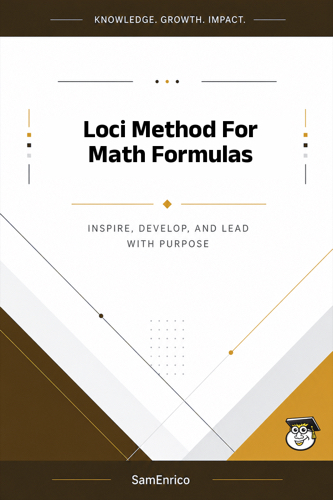
Loci Method For Math Formulas eBook
Places equations along familiar route.
by Godwin Bud
Places equations along familiar route.
Formats
Free sample
Chapter 1: The Blank Page Panic--The formula sat at the top of the page like a sentence in a language you never learned. You had stared at it for forty-five minutes last night. You wrote it fifteen times on a scrap piece of paper. You said it aloud while brushing your teeth, hoping the toothpaste foam would somehow glue it into your memory. And now, sitting in the exam hall with the clock ticking, the place where that formula should live in your brain is just a hollow ache behind your eyes.You are not stupid.
You did not fail because you are bad at math. You failed because your brain was never designed to remember abstract symbols repeated in isolation. And no one ever told you that.This is the Blank Page Panic. It has nothing to do with intelligence and everything to do with how the human memory system actually works versus how we have been taught to use it. Before this book gives you a single technique, before you build your first memory palace or encode your first Greek letter, you need to understand something that most math textbooks will never tell you: the reason you forget formulas is not a personal failing.
It is an evolutionary feature that you have been fighting instead of leveraging.The problem is not your memory. The problem is the method.The Forgetting Curve That Math Never Told You About In 1885, a German psychologist named Hermann Ebbinghaus did something both tedious and brilliant. He memorized lists of nonsense syllables three-letter combinations with no meaning, like ZOF and KEB and WUX and then tested himself at various intervals to see how quickly he forgot them. What he discovered became the foundation of modern memory research. The Ebbinghaus Forgetting Curve shows that within one hour of learning something meaningless, your brain discards approximately fifty percent of it.
Within twenty-four hours, you have lost seventy percent. Within one week, unless you have done something deliberate to stop the bleeding, you are down to about twenty percent retention.Here is what that means for math students. You sit down on a Tuesday night with a quadratic formula. You repeat it ten times. You understand it perfectly at 9:00 PM.
By 10:00 PM, you have already forgotten half of it. By Wednesday morning, you have lost seventy percent. By the following Tuesday, before your exam, you are essentially starting over from scratch. This is not because you are lazy or because math is too hard. This is because your brain treats the quadratic formula the same way it treats ZOF and KEB as a string of meaningless symbols with no emotional content, no spatial location, and no story.But here is the crucial distinction that changes everything.
Ebbinghaus also discovered that meaningful information declines much more slowly. A fact connected to a story, an image, a location, or an emotion can persist for days or weeks with minimal review. The problem is that math formulas, as presented in most textbooks, are engineered to be maximally forgettable. They are abstract, symbolic, dense, and disconnected from anything your brain naturally wants to hold onto.The Evolutionary Mismatch That Explains Everything Your brain evolved over hundreds of thousands of years on the African savanna. Your distant ancestors did not need to remember the quadratic formula.
They needed to remember which path led to water, which berry bush had thorns, and which direction the lions came from last season. As a result, the human memory system is spectacularly good at spatial navigation, visual recognition, and narrative sequencing. You can walk through a forest one time and remember the route for years. You can see a face once and recognize it decades later. You can hear a story and retell it with surprising accuracy even if you heard it only once.But you cannot remember a list of ten random formulas for forty-eight hours without extraordinary effort.This is called evolutionary mismatch.
Your brain is running ancient hardware designed for a hunter-gatherer environment, but you are asking it to perform modern symbolic computation. The problem is not that your hardware is broken. The problem is that you are using it wrong. You are trying to force symbolic information into a memory system that was never built for symbols. And then, when it fails, you blame yourself.Consider this experiment from cognitive psychology.
Researchers asked subjects to remember two different types of information. The first type was a list of twenty random words. The second type was the layout of a small village they had walked through once. After one week, subjects remembered fewer than twenty percent of the random words. But they remembered over ninety percent of the village layout, including details like which house had a red door and which path led to the well.
Same brains. Same time interval. Radically different results because different memory systems were engaged.Math formulas belong in the first category, but they can be moved into the second.The Method of Loci: An Ancient Solution to a Modern Problem The Method of Loci, also known as the Memory Palace technique, is over two thousand years old. Greek and Roman orators used it to memorize speeches that lasted hours. The poet Simonides of Ceos is traditionally credited with discovering the technique around 500 BCE when he stepped outside a banquet hall moments before it collapsed.
The bodies were so disfigured that relatives could not identify them, but Simonides realized he could remember where each guest had been sitting. From this observation, he deduced that human memory is powerfully tied to spatial location.The method is deceptively simple. You choose a familiar location your home, your daily commute, your school. You mentally walk through that location and identify specific stations or loci (the plural of locus). The front door.
The sofa. The kitchen sink. The refrigerator. The back door. Then, you convert the information you want to remember into vivid, action-based images.
Finally, you place those images at your stations. When you need to recall the information, you mentally walk your route and observe what you placed there.Roman orators used this method to remember speeches that lasted two hours or more. Medieval scholars used it to memorize entire books. Modern memory champions use it to remember the order of ten shuffled decks of cards or the digits of pi to ten thousand places. And you can use it to remember math formulas.But here is what most books about the Method of Loci will not tell you.
The standard technique works brilliantly for lists of words, playing cards, or speech points. However, math formulas are different. A formula is not a list. It is a dense, two-dimensional arrangement of symbols with internal relationships, operators, and sometimes Greek letters that look like alien hieroglyphics. You cannot simply place a formula at a locus the same way you place a loaf of bread at the front door.
The formula needs to be encoded, translated, and anchored in a way that preserves its mathematical structure.That is what this book exists to solve.Why Math Formulas Are Uniquely Difficult to Remember Before we build the solution, we need to understand exactly why formulas are…
This is the end of the free sample. Get the eBook to keep going. Buy now
About this book
Details
- Author
- Godwin Bud
- Publisher
- SamEnrico
- Language
- English
- Genre
- Non-Fiction, Self-Help, Math Memory
- Released
- 2026-06-06
- Pages (approx.)
- 143
- Available as
- eBook, Audiobook

Read better in the ZLOADR app
Your eBooks on your phone or tablet. Sign in with your SamEnrico account and start reading.
More by Godwin Bud
 Calendar Blocking for ProfessionalsGodwin Bud$11.99
 Emotional Master GuideGodwin Bud$11.99
 Body Scan Mindfulness CourseGodwin Bud$11.99
 Disputing Should StatementsGodwin Bud$11.99
 Polish Factory Worker To ManagerGodwin Bud$11.99
 Atomic Habits For RestrictionGodwin Bud$11.99
 Alarm System BypassGodwin Bud$11.99
 The Fire That Stole the Formula: Canada's Prohibition-Era Arson ConspiracyGodwin Bud$11.99
 The 100-Meter Lie: The Untold Story of Ben Johnson and the 1988 Seoul OlympicsGodwin Bud$11.99
 How to Start a Potting Soil Mixtures of Natural Soil, Sand, Clays and Minerals Business (Beginners GGodwin Bud$11.99
 A Collector's Handbook to the Simca Aronde OcèaneGodwin Bud$11.99
 US LLC for Non Resident Amazon SellersGodwin Bud$12.99
You may also like
 Hong Kong Handover 1997Dunn Johnnie$11.99
 Zumba For Postnatal Recovery CourseNeal Christian$11.99
 Zumba for BeginnersLadner Nikia$11.99
 YouTube Comment Mining GuideHumes Pandora$12.99
 Worry Box MeditationCarlin Rudy$11.99
 Workplace Stress MeditationNguyen Lynn$11.99
 Workplace Stress and Sleep RepairHawley Ivory$11.99
 Workplace Perfectionism CureDelaney Jeffry$11.99
 Workplace Injustice Anger GuideWallen Isabelle$11.99
 Work Addiction and Burnout LinkGreenwood Ester$11.99
 Women in Yoga and WellnessBeattie Galina$11.99
 Women in Stand Up ComedyChun Evangeline$11.99