
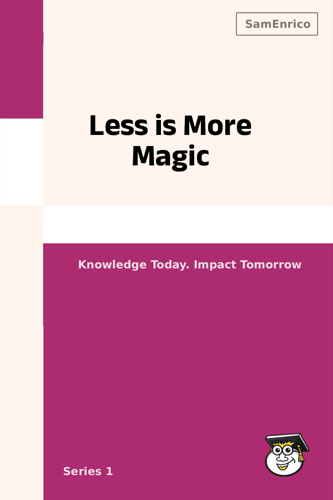
Less is More Magic eBook
How subtraction and limitation produce surprisingl
How subtraction and limitation produce surprisingly magical results.
Formats
Free sample
Chapter 1: The Misaligned Brick...--–- You are about to make a mistake. You don’t know it yet, but in the next seventy-two hours, you will face a problem—a cluttered desk, a too-long to-do list, a meeting that could have been an email, a conversation with a child who needs your attention while your phone buzzes with something that feels urgent but is not. And when you face that problem, your brain will do what it has been trained to do. It will reach for more.More time. More money.
More help. More rules. More features. More words. More stuff.And the problem will not get better.
It will get heavier.This is not a character flaw. It is not laziness or stupidity or a lack of discipline. It is a design flaw in the human operating system, and it has a name: addition dominance. We are biologically and culturally wired to add when we should subtract. We pile bricks onto an unstable structure when the solution is to remove one brick.
We add tasks to an overflowing calendar when the solution is to delete five. We add features to a failing product when the solution is to strip it down to what actually works.This book is about the opposite move. It is about the strange, surprising, almost magical power of taking things away.But before we get to the magic, we have to understand the trap. And the trap begins with a pile of Legos.The Experiment That Changed Everything In 2018, a behavioral scientist named Leidy Klotz ran a simple experiment that should have been boring. It was not.
It was a bomb.Klotz gave two groups of people an unstable Lego structure. The structure was a small tower with a single glaring flaw: one brick at the base was misaligned, making the whole thing wobble. The task was simple: make the structure stable. Group A was allowed to add bricks. That was it.
They could only add. Group B was allowed to add bricks or remove them. They had the full toolkit.Here is what happened.Group A, the add-only group, did exactly what you would expect. They added bricks. They added bricks to the left.
They added bricks to the right. They added bricks on top of the misaligned base. They built little buttresses and counterweights. They turned a wobbly tower into a sprawling, complicated, Frankenstein monster of a structure. And eventually, after enough bricks were added, it became stable.
Not elegant. Not simple. But stable.Group B had the option to remove. And here is the shock: they almost never did.Even when the solution was obvious—even when removing the single misaligned brick at the base would have instantly solved the problem in less than one second—the participants in Group B almost always chose to add. They added bricks around the problem.
They added bricks on top of the problem. They added bricks as if the misaligned brick were sacred and could not be touched.Klotz ran the experiment again. Same result. He ran it with different puzzles. Same result.
He ran it with experts—engineers, architects, designers—and the experts were just as bad as everyone else. They knew that removal was an option. They could see the misaligned brick. And they still added.This is addition dominance. It is the default setting of the human brain.Why Your Brain Chooses More Let us be clear about what is happening here.
This is not a simple preference. This is a cognitive bias—a systematic error in thinking that affects every decision you make, from what you put in your shopping cart to how you manage your team to how you raise your children.The bias has three roots.First, removal is invisible. When you add a brick to the Lego tower, everyone can see it. You get credit. You look busy, productive, engaged.
When you remove a brick, nothing happens. The tower looks almost the same. You have to explain that you fixed something, and even then, people are not sure they believe you. In a world that rewards visible effort, subtraction is career suicide.Second, removal feels like loss. Behavioral economists have known for decades that humans are loss-averse.
The pain of losing ten dollars is about twice as powerful as the pleasure of finding ten dollars. When you remove a brick, your brain registers it as a loss—even if that brick was causing the wobble. Even if you are better off without it. The primitive parts of your nervous system do not understand subtraction as improvement. They understand subtraction as threat.Third, we have been trained since childhood to add.
Think about the last time you saw a child solve a problem. If they had a wobbly tower, they added bricks. If they had a drawing that felt incomplete, they added more crayon. And what did you say? You said, “Good job!
You worked so hard!” You did not say, “Excellent removal strategy, honey.” Schools reward addition. Grades reward addition. Sports reward addition. The child who runs more drills, studies more hours, adds more extracurriculars—that child gets the applause.By the time you reach adulthood, addition is not just a habit. It is a moral virtue.
We call people who add “ambitious,” “driven,” “hardworking.” We call people who subtract “lazy,” “minimalist” (said with a sneer), “not a team player.”This is the gospel of addition. And it is a lie.The Cost of Addition Addiction Let us get concrete. You are living inside the Lego experiment right now. Here is how it shows up.Your email inbox has 847 messages. The solution, you think, is to add a better system.
More folders. More filters. More rules. You spend an afternoon building a complicated architecture of labels and automation. Two weeks later, you have 1,203 messages.
You added a system to a problem that required deletion.Your team at work is missing deadlines. The solution, you think, is to add more meetings. A weekly status meeting becomes two weekly meetings becomes a daily standup becomes a mid-day check-in becomes a post-mortem for why you are having so many meetings. You add coordination to a problem that required subtraction of the lowest-value projects.Your child is overwhelmed with homework, piano, soccer, and tutoring. The solution, you think, is to add better time management.
A new app. A color-coded calendar. A reward chart. You add structure to a problem that required removing two activities entirely.Your living room is cluttered. The solution, you think, is to add better storage.
More shelves. More bins. More organization systems. You add containers to a problem that required throwing things away.In every case, you are Group B with the misaligned Lego brick. The solution is right there.
Remove the brick. Delete the emails. Cancel the meeting. Quit the activity. Throw away the thing.
But you cannot do it. Your brain will not let you.And here is the cruelest part: adding does not just fail to solve the problem. It makes the problem worse.Every brick you add to the Lego tower makes it heavier, more complicated, harder to understand, harder to fix. Every email folder…
This is the end of the free sample. Get the eBook to keep going. Buy now
About this book
Details
- Author
- Andrus Marlys
- Publisher
- SamEnrico
- Language
- English
- Genre
- Non-Fiction, Self-Help, Magic
- Released
- 2026-06-07
- Pages (approx.)
- 135
- Available as
- eBook, Audiobook

Read better in the ZLOADR app
Your eBooks on your phone or tablet. Sign in with your SamEnrico account and start reading.
More by Andrus Marlys
 Star Counting PracticeAndrus Marlys$11.99
 Hotel Booking Africa ExitAndrus Marlys$11.99
 The Reformation in Poland GuideAndrus Marlys$11.99
 High Conflict Divorce HealingAndrus Marlys$11.99
 The Vanishing of the Blue Parrot: A Caribbean MysteryAndrus Marlys$11.99
 How to Start a Chassis for Powered Invalid Carriage Business (Beginners Guide)Andrus Marlys$11.99
 Animal BehavioristAndrus Marlys$11.99
 JEE Error Analysis and Weakness FixAndrus Marlys$12.99
 Admin VA Day to Day GuideAndrus Marlys$12.99
 Understanding Pierre Robin Syndrome Skeletal Dysplasia PolydactylyAndrus Marlys$17.99
You may also like
 Hong Kong Handover 1997Dunn Johnnie$11.99
 Zumba For Postnatal Recovery CourseNeal Christian$11.99
 Zumba for BeginnersLadner Nikia$11.99
 YouTube Comment Mining GuideHumes Pandora$12.99
 Worry Box MeditationCarlin Rudy$11.99
 Workplace Stress MeditationNguyen Lynn$11.99
 Workplace Stress and Sleep RepairHawley Ivory$11.99
 Workplace Perfectionism CureDelaney Jeffry$11.99
 Workplace Injustice Anger GuideWallen Isabelle$11.99
 Work Addiction and Burnout LinkGreenwood Ester$11.99
 Women in Yoga and WellnessBeattie Galina$11.99
 Women in Stand Up ComedyChun Evangeline$11.99