
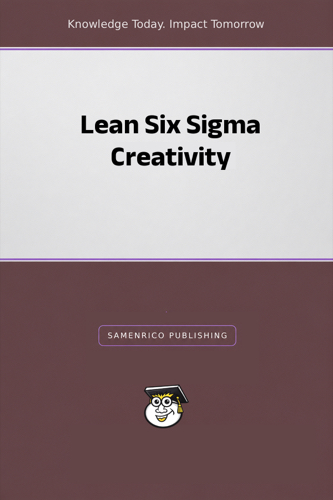
Non-FictionSelf-HelpLean Six Sigma
Lean Six Sigma Creativity eBook
Combine waste reduction with creative problem solv
Combine waste reduction with creative problem solving for breakthrough improvements.
Formats
Free sample
Chapter 1: The Efficiency Trap--–- It was 3:47 on a Tuesday afternoon when Sarah, a Six Sigma Black Belt with fourteen years of experience, realized she had become the very thing she once despised. She had just rejected a team member's proposal to completely redesign their customer intake process because the idea didn't fit neatly into her DMAIC template. The proposal was radical, untested, and frankly a little messy. It was also, she later admitted to herself in the parking garage, probably brilliant. But she had killed it with data.
She had buried it under control charts and p-values and the weight of her own expertise. That night, she sat in her car for twenty minutes before starting the engine, wondering when exactly "process improvement" had become "process imprisonment."This book is for every Sarah. For every improvement professional who has felt the quiet suffocation of their own methodology. For every team leader who knows that the next breakthrough is hiding somewhere just outside the spreadsheets. For every executive who has invested millions in Lean Six Sigma only to watch their organization become ruthlessly efficient at doing exactly what it has always done, only faster.The problem is not Lean Six Sigma.
The problem is how we have been taught to use it.For more than three decades, Lean Six Sigma has been the undisputed heavyweight champion of operational improvement. It has saved billions of dollars, eliminated countless tons of waste, and brought statistical rigor to industries that once ran on gut feeling and tribal knowledge. Six Sigma alone, pioneered by Motorola and evangelized by Jack Welch at General Electric, is credited with generating more than $2 billion in savings during its first five years of corporate adoption. Lean thinking, born from the Toyota Production System, transformed manufacturing and then jumped the tracks to healthcare, software, logistics, and government. Together, they form a powerhouse that has improved processes on every continent except perhaps Antarctica—though someone has probably charted the variation in penguin feeding times by now.And yet.Walk into almost any organization that has embraced Lean Six Sigma, and you will hear a strange, persistent whisper beneath the triumphant hum of reduced defects and improved cycle times.
It is the whisper of missed opportunities. Of incremental improvements that never quite became breakthroughs. Of problems solved elegantly on paper that somehow feel hollow in practice. Of smart people who have stopped asking "what if" because they are too busy measuring "what is."The whisper says: We have become excellent at optimizing things that should not exist at all.This chapter confronts the central myth that has crippled Lean Six Sigma for a generation: the belief that process discipline and creative imagination are natural enemies. It is a myth repeated so often in corporate hallways, strategy meetings, and certification courses that it has hardened into scripture.
"Structure kills creativity." "Process is the enemy of innovation." "You can have efficiency or imagination, but not both."These statements are not merely wrong. They are dangerously, expensively wrong.The False War Between Structure and Freedom Let us begin with a simple observation that will thread through every page of this book: every creative act in human history has occurred within constraints. The poet is constrained by meter and rhyme. The architect is constrained by physics and budget. The composer is constrained by twelve notes and the limitations of the human ear.
The painter is constrained by pigment, canvas, and the stubborn reality that purple does not actually exist in nature. Constraint is not the opposite of creativity. Constraint is its engine.Consider the case of the Apollo 13 mission. When an oxygen tank exploded two hundred thousand miles from Earth, the astronauts faced a problem with no precedent. They had a square carbon dioxide filter that needed to fit into a round hole.
The engineers on the ground had hours, not days. They were constrained by time, by materials, by the physical laws of space, and by the terrifying reality that failure meant death. That is a Lean Six Sigma nightmare: zero margin for error, no opportunity for iteration, and a problem that had never been solved before.The solution? They dumped everything on the table—hoses, duct tape, suit connectors, plastic bags, flight manuals—and asked a single question: "What do we have that can do what we need?" They combined a suit hose with a plastic bag and a piece of cardboard from a flight manual cover. They used duct tape to hold it together.
It was ugly. It was unorthodox. It was the opposite of a controlled, repeatable process. And it saved their lives.Here is what the Lean Six Sigma skeptic will say: "See? Creativity requires breaking the rules."Here is what this book will teach you: The rules that matter stayed in place.
Gravity still worked. The spacecraft still had to maintain pressure. The astronauts still needed to breathe. The constraints that were essential remained. The constraints that were imaginary—"we must use the approved filter," "we must follow standard procedures," "we cannot modify equipment without authorization"—were discarded.
The engineers did not abandon structure. They abandoned the wrong structure.This distinction—between essential constraints and imaginary ones—is the foundational insight of Lean Six Sigma Creativity.The Hidden Creative Cycle Within DMAICNow let us speak directly to the Lean Six Sigma practitioners reading this book. You know DMAIC. You have likely memorized it, taught it, defended it to skeptical stakeholders. Define, Measure, Analyze, Improve, Control.
The five phases of problem-solving nirvana.But somewhere along the way, you may have noticed something troubling. DMAIC, as typically taught, is a convergent process. It narrows. It focuses. It drives toward a single root cause, a single optimal solution, a single control plan.
Convergence is powerful—until it becomes a trap. Until you have converged so tightly that you cannot see the divergent possibility hiding just outside your fishbone diagram.What if DMAIC is not a convergent process at all? What if it is actually a creative cycle in disguise, a sequence of mental states that mirrors exactly how artists, scientists, and inventors have always worked?Let us reframe the five phases not as operational steps but as creative postures:Define is not about writing a project charter. Define is about curiosity. It is the moment when you ask, "What is really happening here?" and refuse to accept the first answer.
The creative Define phase is hungry, open, and slightly uncomfortable. It tolerates ambiguity. It chases the strange detail that doesn't fit. It is the painter staring at a blank canvas, not yet knowing what will emerge.Measure is not about collecting sample sizes and calculating sigma levels. Measure is about observation.
It is the discipline of seeing what is actually there, not what you expected to see. The creative Measure phase is the scientist recording data without prejudice, the novelist listening to how people actually speak, the chef tasting the broth at every stage. It is the patient work of noticing.Analyze is not about hypothesis tests and regression models. Analyze is about insight. It is the spark when disparate pieces suddenly click together.
The creative Analyze phase is Archimedes in his bath, Kekulé dreaming of a snake biting its tail, the moment when…
This is the end of the free sample. Get the eBook to keep going. Buy now
About this book
Details
- Author
- Gainey Arcelia
- Publisher
- SamEnrico
- Language
- English
- Genre
- Non-Fiction, Self-Help, Lean Six Sigma
- Released
- 2026-06-08
- Pages (approx.)
- 117
- Available as
- eBook, Audiobook

Read better in the ZLOADR app
Your eBooks on your phone or tablet. Sign in with your SamEnrico account and start reading.
More by Gainey Arcelia
 Confronting Avoidance BehaviorsGainey Arcelia$11.99
 The Mediterranean Diet for HeartGainey Arcelia$11.99
 Age Related Dismissal AngerGainey Arcelia$11.99
 Name Letter Effect InfluenceGainey Arcelia$11.99
 The Queen of Hearts: How a Singaporean Scammer Stole Millions Through LoveGainey Arcelia$11.99
 How to Start a Camelid Raising and Breeding Business (Beginners Guide)Gainey Arcelia$11.99
 VAT and Real EstateGainey Arcelia$12.99
 YC African Startup Team GuideGainey Arcelia$12.99
 Data Center ManagementGainey Arcelia$11.99
You may also like
 Hong Kong Handover 1997Dunn Johnnie$11.99
 Zumba For Postnatal Recovery CourseNeal Christian$11.99
 Zumba for BeginnersLadner Nikia$11.99
 YouTube Comment Mining GuideHumes Pandora$12.99
 Worry Box MeditationCarlin Rudy$11.99
 Workplace Stress MeditationNguyen Lynn$11.99
 Workplace Stress and Sleep RepairHawley Ivory$11.99
 Workplace Perfectionism CureDelaney Jeffry$11.99
 Workplace Injustice Anger GuideWallen Isabelle$11.99
 Work Addiction and Burnout LinkGreenwood Ester$11.99
 Women in Yoga and WellnessBeattie Galina$11.99
 Women in Stand Up ComedyChun Evangeline$11.99