
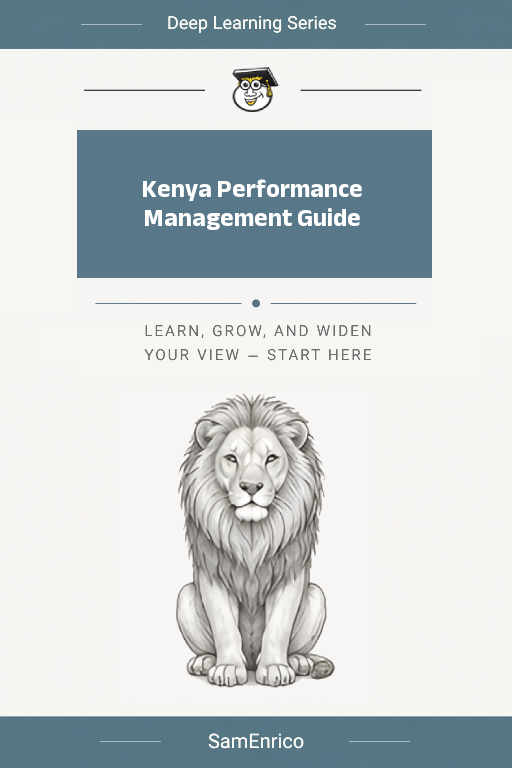
Non-FictionBusiness BriefPerformance Management
Kenya Performance Management Guide eBook
Set KPIs for Kenyan remote workers with weekly che
by Simms Isaiah
Set KPIs for Kenyan remote workers with weekly check ins not daily monitoring. Trust based management aligned with Kenyan workplace culture improves retention.
Formats
Free sample
Chapter 1: The Good Morning Trap--–- The Whats App message arrived at 7:32 AM, as it did every weekday. "Good morning, team. Hope you're all well. Kindly share your daily plan for today." Mercy, a senior accountant at a Nairobi-based fintech, had received this message from her manager 187 times in the past nine months. She had replied 187 times.
She had also updated her timesheet 187 times, logged into the monitoring software 187 times, and taken three random screen-capture verification calls. She had also, quietly and without drama, updated her CV 47 times. On the 188th day, she handed in her resignation.Her exit interview was brief. "Why are you leaving?" the HR manager asked. Mercy paused, then said something that should be printed on every manager's wall: "I spent more time proving I was working than actually working.
I wasn't tired from my job. I was tired from explaining my job."Mercy was not lazy. She was not hiding. She was not stealing time. She was one of the top performers in her department, consistently delivering audit-ready financial reports ahead of deadlines, often catching errors that others missed.
But her manager, a well-intentioned man named George who had been promoted because he was good at spreadsheets and terrible at trust, had one unshakeable belief: if he could not see his team, they were not working.George is not a villain. He is a product of a system. And that system is broken.The Invisible Cage of Daily Check-Ins Let us name what George was doing, because naming is the first step to killing. George was running what management researchers call a "high-frequency monitoring regime." Every day, every employee, every morning, without exception, the same demand: prove you are working.On the surface, this seems reasonable. George would tell you he was just staying connected.
He would tell you he cared about his team. He would tell you that in the old days, when everyone was in the office, he could just walk over and see what people were doing. Now that everyone was remote, he had to find another way. The daily "good morning" text was his way.But here is the truth that George could not see: the daily check-in was not a connection. It was a cage.Mercy felt it.
Every morning, her phone buzzed with the same question, and every morning, she felt a small wave of irritation followed by a larger wave of resignation. She would type her plan: "9-10 AM, reconcile accounts. 10-11 AM, review expense reports. 11-12 PM, prepare client financial summaries." She would hit send. She would then do exactly what she had written, because she was a professional.
But something had died. The joy of problem-solving, the satisfaction of catching an error, the pride in a clean balance sheet—all of it was now buried under the weight of proving that she deserved to exist on George's team.This is not a Mercy problem. This is a George problem. And if you are reading this book, you might be a George. That is not an accusation.
It is an invitation.The Great Kenyan Remote Work Migration To understand why George's daily check-ins are destroying his team, we need to understand how Kenyan work changed in the span of three years.Before 2020, remote work in Kenya was a niche arrangement. A few tech companies allowed it. A few freelancers lived by it. But the vast majority of formal employment meant showing up to an office, sitting at a desk, and being visible. The management philosophy was simple: presence equals productivity.
If you were at your desk, you were working. If you were not at your desk, you were not working. This was not a sophisticated system, but it was a predictable one.Then COVID-19 arrived. Overnight, millions of Kenyan workers were sent home. Offices closed.
Desks sat empty. Managers like George panicked. How could they manage what they could not see? The answer, for many, was digital surveillance. Daily check-in texts.
Video call random checks. Screen-capture software. Timesheet submissions. The monitoring that had been implicit in the office became explicit, exhaustive, and exhausting.But something else happened during those lockdowns. A generation of Kenyan workers discovered that they could work perfectly well from home.
They discovered that the daily commute to Nairobi from Thika, Kiambu, or Machakos was not a necessity but a tax on their time and sanity. They discovered that they could deliver the same outputs—often better outputs, because they were less tired, less stressed, and less interrupted—from a spare room in Kisumu, a corner of the kitchen in Eldoret, or a desk under a mango tree in rural Murang'a.At the same time, a parallel disruption was unfolding in Kenyan higher education. The "Strike Age" era—a period of repeated, prolonged university lecturer strikes—produced a generation of graduates who had never experienced a stable, fully present classroom. These digital natives learned to succeed despite disrupted attendance. They completed assignments without lectures.
They studied without teachers. They graduated without the luxury of constant supervision. And then they entered the workforce with a quiet certainty: they did not need to be watched to work.The collision of these two forces—the pandemic-enforced remote work experiment and the Strike Age generation's self-sufficiency—created a new Kenyan workforce. These workers value output over face time. They measure themselves by what they accomplish, not by how long they appear busy.
And they reject, sometimes explicitly and sometimes by quietly resigning, the colonial-era management hangover that says "if I cannot see you, you are stealing time."Why Your Grandfather's Management Style Died with the Typewriter Let us be honest about where daily check-ins come from. They come from a management model designed for factories and offices in an era when work was physical, measurable, and visible. In a factory, you could see who was at their station. In an office, you could see who was at their desk. Visibility was a reasonable proxy for productivity because the work itself was visible.But remote knowledge work is not factory work.
You cannot see someone solving a complex accounting problem. You cannot see someone writing code. You cannot see someone strategizing a marketing campaign. The work happens inside heads, not on surfaces. And yet, managers like George keep trying to apply factory-era management to knowledge-era work.The result is what researcher Jerry Useem calls "performance theatre"—employees performing the appearance of work rather than the substance.
When Mercy wrote her daily plan every morning, she was performing. When she clicked into the monitoring software, she was performing. When she sat through random verification calls, she was performing. She was not working. She was proving that she could describe working.
Those are different activities, and only one of them creates value.The daily check-in forces employees to spend time on the meta-work of describing work rather than the actual work of doing work. If Mercy spent ten minutes every morning writing her plan, that is fifty minutes a week, forty hours a year—a full work week spent just proving she was going to work. Multiply that by a team of ten, and George was burning a full person-year of productivity every…
This is the end of the free sample. Get the eBook to keep going. Buy now
About this book
Details
- Author
- Simms Isaiah
- Publisher
- SamEnrico
- Language
- English
- Genre
- Non-Fiction, Business Brief, Performance Management
- Released
- 2026-05-30
- Pages (approx.)
- 146
- Available as
- eBook, Audiobook

Read better in the ZLOADR app
Your eBooks on your phone or tablet. Sign in with your SamEnrico account and start reading.
More by Simms Isaiah
 Vendor Data Leak NotificationSimms Isaiah$11.99
 Nikki HaleySimms Isaiah$11.99
 Low Libido Self Esteem GuideSimms Isaiah$11.99
 The Microbiome ResetSimms Isaiah$11.99
 TM for Kids and TeensSimms Isaiah$11.99
 Counter Reformation Index Librorum GuideSimms Isaiah$11.99Counter Reformation Index Librorum GuideSimms Isaiah$11.99
 Acupuncture For Hearing LossSimms Isaiah$11.99
 Nightmare Cheat SheetSimms Isaiah$11.99
 Support Team Burnout FixSimms Isaiah$11.99
 The Phantom Fleet: The Unsinkable Ghost Ships of WWIISimms Isaiah$11.99
 The Night the Strip Stood Still: How Las Vegas United After ChaosSimms Isaiah$11.99
You may also like
 Hong Kong Handover 1997Dunn Johnnie$11.99
 Zumba For Postnatal Recovery CourseNeal Christian$11.99
 Zumba for BeginnersLadner Nikia$11.99
 YouTube Comment Mining GuideHumes Pandora$12.99
 Worry Box MeditationCarlin Rudy$11.99
 Workplace Stress MeditationNguyen Lynn$11.99
 Workplace Stress and Sleep RepairHawley Ivory$11.99
 Workplace Perfectionism CureDelaney Jeffry$11.99
 Workplace Injustice Anger GuideWallen Isabelle$11.99
 Work Addiction and Burnout LinkGreenwood Ester$11.99
 Women in Yoga and WellnessBeattie Galina$11.99
 Women in Stand Up ComedyChun Evangeline$11.99