
Non-FictionInformativeEducational
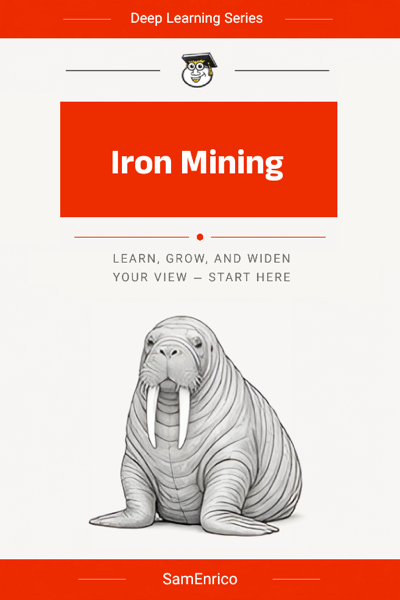
Iron Mining eBook
A Coursebook on Iron Mining
A Coursebook on Iron Mining
Formats
Free sample
Chapter 1: The Rust-Colored Key--–- Before there were skyscrapers, before there were cars, before there were wind turbines or electric vehicle batteries or the smartphone in your hand, there was a rust-colored rock. It lay buried beneath ancient seabeds, compressed into bands of iron and silica over two billion years ago, waiting. It did not know it was waiting for humans. It did not know that one day, a single tonne of its kind would build the frame of a bridge, the rails of a railway, the hull of a ship. But waiting is what rocks do best.That rock is iron ore.
And the story of how it moves from the earth to the steel mill to every corner of your life is the story of modern civilization itself.If you live in a city, you are surrounded by iron. The elevator that carries you to your apartment runs on steel cables. The subway train that takes you to work rolls on steel rails. The office tower you enter is a skeleton of steel beams wrapped in glass and concrete. The car you drive is two tonnes of stamped steel.
Even the renewable energy future we are all counting on—the wind turbine, the hydroelectric dam, the transmission tower—is built on a foundation of iron and steel. There is no green transition without iron mining. There is no modern life without it.And yet, most people have never seen an iron mine. Most people could not tell you how iron ore becomes steel, or why some rocks are worth billions while others are worthless overburden. This book is for those people.
It is for the student who wants to understand the single most important commodity you have never thought about. It is for the engineer who needs to grasp the entire value chain, from exploration to ironmaking. It is for the investor who wants to know which assets will survive the coming carbon crunch. And it is for the curious reader who simply wants to understand the hidden backbone of their world.A World Built on Rust Let us start with a number: 1.8 billion tonnes. That is how much iron ore the world mined in 2024.
If you loaded that much ore onto freight trains, the line of railcars would wrap around the Earth more than three times. If you stacked it into a cube, it would rise twenty-five kilometers into the sky, three times the cruising altitude of a commercial jet.But the number alone does not capture the importance. The importance is this: without iron ore, you cannot make steel. Without steel, you cannot build a hospital, a bridge, a power plant, a factory, a ship, a train, or a car. Steel is the second most consumed material on Earth after water.
And the world produces more than 1.9 billion tonnes of crude steel every year—enough to give every person on the planet a quarter of a tonne of steel annually.Where does all that steel go? Roughly half goes into construction: buildings, bridges, tunnels, railways, ports, airports. Another sixteen percent goes into mechanical equipment: factories, farm machinery, industrial tools. Twelve percent goes into automotive manufacturing. The rest is spread across ships, trains, appliances, energy infrastructure, and packaging.
Every single tonne of that steel began as iron ore, blasted from the earth in a handful of countries, then shipped across oceans to steel mills that transform it into the fabric of modern life.But here is the paradox: the industry that builds the world also has the potential to tear it apart. Iron and steel production account for approximately nine percent of global carbon dioxide emissions—more than all the cars, trucks, and airplanes on the planet combined. For every tonne of steel produced using the traditional blast furnace route, roughly two tonnes of CO₂ are released into the atmosphere. The industry is simultaneously indispensable and unsustainable.That contradiction is the central drama of modern iron mining. The world needs more steel to build housing for a growing population, infrastructure for renewable energy, and transportation for developing economies.
But the world also needs to decarbonize, and fast. The solution will not come from using less steel—global demand is projected to rise another thirty percent by 2050. It will come from changing how we produce it. And that change begins at the mine.The Two Parallel Worlds of Ironmaking Before we go any further, we need to understand a fundamental split in the industry. The ironmaking world is not one world.
It is two parallel worlds, running side by side, with different technologies, different economics, and different futures.The first world is the world of the blast furnace, or BF. This is the older technology, the workhorse of the industry, and it still accounts for roughly sixty-five percent of global iron production. In a blast furnace, iron ore (in the form of sinter, pellets, or lump ore) is loaded from the top along with coke (a high-carbon fuel made from metallurgical coal) and limestone flux. Hot air is blasted in from the bottom. The coke burns, producing carbon monoxide, which strips oxygen from the iron ore, leaving liquid pig iron at the bottom of the furnace.
That pig iron is then sent to a basic oxygen furnace to become steel.The blast furnace route is mature, efficient at massive scale, and relatively low-cost—provided you have access to cheap coking coal. But it is also intensely carbon-intensive. Approximately seventy percent of the CO₂ emissions from the BF-BOF route come from the chemical reaction itself, not from the energy used to heat the furnace. You cannot simply replace coal with electricity and solve the problem. You have to change the chemistry.The second world is the world of direct reduction, or DRI.
In this process, iron ore is reduced to iron in a solid state—never melted—using a mixture of hydrogen and carbon monoxide as the reducing agent. The product is a spongy, porous solid called Direct Reduced Iron, which is then fed into an electric arc furnace to become steel. Because DRI uses reducing gases rather than solid coke, it can be decarbonized by shifting from natural gas (which produces CO₂) to green hydrogen (which produces only water vapor).Today, DRI accounts for only about thirty-five percent of global iron production. But that share is growing rapidly, especially in Europe and North America, where carbon prices and decarbonization mandates are forcing the retirement of blast furnaces. By 2040, analysts expect DRI to account for more than half of global iron production—though the shift will be highly uneven.
China and India, which are still building new blast furnaces to meet surging domestic demand, will continue to rely on the BF route for decades. Europe, by contrast, is closing blast furnaces and building DRI plants as fast as capital allows.This bifurcation—the split between a shrinking but still dominant BF world and a growing but still niche DRI world—is the single most important trend in iron mining today. And it has profound implications for every chapter of this book. The ore that is valuable for a blast furnace is not necessarily valuable for a DRI plant. The pellet that performs…
This is the end of the free sample. Get the eBook to keep going. Buy now
About this book
Details
- Author
- Bankston Gonzalo
- Publisher
- SamEnrico
- Language
- English
- Genre
- Non-Fiction, Informative, Educational
- Released
- 2026-05-04
- Pages (approx.)
- 150
- Available as
- eBook, Audiobook

Read better in the ZLOADR app
Your eBooks on your phone or tablet. Sign in with your SamEnrico account and start reading.
More by Bankston Gonzalo
 Pomodoro for Photography EditingBankston Gonzalo$11.99
 Affirmations For ResilienceBankston Gonzalo$11.99
 The Shipwreck Decay StudyBankston Gonzalo$11.99
 Cooperative Legal ComplianceBankston Gonzalo$11.99
 The Assertiveness for Teens GuideBankston Gonzalo$11.99
 The London Mob: How the American Mafia Infiltrated Post-War BritainBankston Gonzalo$11.99
 Understanding Ophthalmoplegia Myalgia Tubular AggregatesBankston Gonzalo$17.99
 Manufacturing Pricing Cost Pass ThroughBankston Gonzalo$12.99
 Career Changer Developer RoadmapBankston Gonzalo$12.99
 How to Become a Shade-cloth FinisherBankston Gonzalo$11.99
You may also like
 Hong Kong Handover 1997Dunn Johnnie$11.99
 Zumba For Postnatal Recovery CourseNeal Christian$11.99
 Zumba for BeginnersLadner Nikia$11.99
 YouTube Comment Mining GuideHumes Pandora$12.99
 Worry Box MeditationCarlin Rudy$11.99
 Workplace Stress MeditationNguyen Lynn$11.99
 Workplace Stress and Sleep RepairHawley Ivory$11.99
 Workplace Perfectionism CureDelaney Jeffry$11.99
 Workplace Injustice Anger GuideWallen Isabelle$11.99
 Work Addiction and Burnout LinkGreenwood Ester$11.99
 Women in Yoga and WellnessBeattie Galina$11.99
 Women in Stand Up ComedyChun Evangeline$11.99