
Non-FictionProfessional's Cheat SheetFAQs
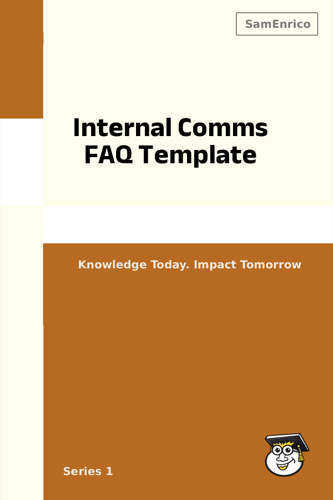
Internal Comms FAQ Template eBook
Build living documents for recurring employee ques
by Stark Sydney
Build living documents for recurring employee questions.
Formats
Free sample
Chapter 1: The Zombie Audit--–- Every organization has one. It sits in a forgotten corner of the intranet, buried under four layers of navigation. The last updated timestamp reads fourteen months ago. The language reads like it was translated from legalese by a committee of sleep-deprived compliance officers. And yet, someone—usually a well-meaning intern or a well-intentioned HR business partner—proudly calls this the "FAQ."This is the Zombie FAQ.It is not merely useless.
It is actively dangerous. Because when an employee who is already anxious about their parental leave, their bonus eligibility, or their hybrid work schedule clicks on this document and finds information that is outdated, contradictory, or utterly incomprehensible, they learn a single devastating lesson: The FAQ lies.From that moment forward, they will never consult the FAQ again. Instead, they will do what every rational human being does when the system fails them. They will escalate. They will message their manager on Slack at 9:47 PM.
They will email HR with a question that has already been answered somewhere in the organization—just not in a place they could find. They will post in the #general channel, creating noise for hundreds of colleagues. And when enough employees do this enough times, the entire communication ecosystem collapses into a slow, grinding crisis of redundancy, frustration, and burnout.This book exists because that collapse is preventable. And the tool that prevents it is not a new software platform, a new org chart, or a new mandate from leadership. It is something far simpler and far more powerful: the Living FAQ.The Living FAQ is not a document.
It is a signal. Specifically, it signals three things to the workforce: We are paying attention. We respect your time. And we are willing to say we don't know. These three signals, when transmitted consistently and credibly, transform the FAQ from a liability into an asset, from a graveyard of outdated policies into a radar system that reveals exactly where leadership communication has failed.This chapter will walk you through the forensic examination of your own Zombie FAQ, introduce the concept of the "Clarity Gap Radar," and show you, through the case study of Eventbrite, what becomes possible when an organization treats its FAQ as a living product rather than a static artifact.The Three Symptoms of the Zombie FAQBefore you can build a Living FAQ, you must diagnose the corpse you currently have.
The Zombie FAQ manifests through three telltale symptoms. Your organization's FAQ may exhibit one, two, or—most commonly—all three.Symptom One: Temporal Decay The first symptom is the easiest to measure and the most embarrassing to admit. Open your organization's primary FAQ right now. Find the last updated date. If you cannot find one, that is itself a symptom.
If you find one and it is more than ninety days old, your FAQ is clinically deceased.Temporal decay occurs when answers refer to events, policies, or people that no longer exist. A benefits FAQ that still lists the previous healthcare vendor. A remote work policy that still references "temporary COVID protocols" from 2022. An org chart FAQ that shows a leadership team that has since turned over twice. Each of these outdated answers is a tiny betrayal.
The employee who reads them does not think, Oh, someone forgot to update this. They think, This organization does not care enough to tell me the truth.Temporal decay is insidious because it accumulates slowly. No single person is responsible for the entire FAQ. The person who wrote the answer about the healthcare vendor left eighteen months ago. The person who approved the remote work policy is now in a different role.
The person who maintains the intranet has never even opened the FAQ folder. And so the document decays, piece by piece, until it becomes what one internal comms leader at a Fortune 500 company called "the digital equivalent of an abandoned storage unit—full of stuff that mattered once and now just takes up space."Symptom Two: Linguistic Necrosis The second symptom is harder to measure but immediately obvious to any human reader. Linguistic necrosis is the gradual replacement of clear, human language with corporate jargon, undefined acronyms, and passive-constructions that seem designed to obscure rather than illuminate.Consider this actual answer from a real company's FAQ, anonymized to protect the guilty:"Eligibility for the discretionary annual incentive compensation program is contingent upon active employment status as of the payment date and satisfaction of performance metrics as determined by management in its sole discretion, subject to the terms and conditions of the applicable plan document, which may be amended or terminated at any time without prior notice."This sentence contains forty-seven words. It has three subordinate clauses. It uses the phrase "sole discretion" as a shield.
It tells the employee almost nothing useful while appearing to say something official. A human translation of this sentence—what the employee actually needs to know—is twelve words: "You must be employed and have met your goals on the day bonuses are paid."Linguistic necrosis is not malice. It is the predictable outcome of a document that has been written by committee, reviewed by legal, approved by compliance, and never once tested on an actual employee. Each stakeholder adds a layer of qualification, a hedge against liability, a phrase that protects the organization at the expense of the reader's understanding. The result is prose that is defensible but unreadable.The telltale sign of linguistic necrosis is the acronym test.
Scan your FAQ for any acronym that is not defined on first use. If you find "EVP," "STI," "LTI," "RSU," "COBRA," "FMLA," or any of the thousand other alphabet-soup terms that populate corporate life, and those acronyms are not immediately explained, your FAQ is necrotic. You are writing for insiders. You are excluding everyone else.Symptom Three: Navigational Burial The third symptom is the most frustrating because it is the most preventable. Navigational burial occurs when the FAQ exists but cannot be found.
It is buried under four clicks, hidden behind an intranet login that requires two-factor authentication, or—most commonly—stored in a Share Point folder with a name like "HR_Policies_Final_v3_FINAL_approved.docx."The test for navigational burial is simple and brutal. Find a new employee—someone who has been with the organization for less than thirty days. Ask them to locate the FAQ on hybrid work policy. Time them. If they cannot find it in under sixty seconds, your FAQ is buried.Navigational burial is not a technical problem.
It is a political problem. Someone, at some point, decided that the FAQ should live in the HR portal rather than the company homepage. Someone else decided that the intranet search should prioritize news articles over policy documents. A third person decided that the FAQ should not be linked from Slack because they worried it would "create clutter." Each of these decisions, made in isolation and with good intentions, collectively ensures that the one document employees need most is the one document they cannot find.When employees cannot find the FAQ, they do not blame the intranet architecture. They blame themselves.
They think, I must be bad at searching. Or they blame leadership: They must be hiding something. Either way, the…
This is the end of the free sample. Get the eBook to keep going. Buy now
About this book
Details
- Author
- Stark Sydney
- Publisher
- SamEnrico
- Language
- English
- Genre
- Non-Fiction, Professional's Cheat Sheet, FAQs
- Released
- 2026-06-09
- Pages (approx.)
- 140
- Available as
- eBook, Audiobook

Read better in the ZLOADR app
Your eBooks on your phone or tablet. Sign in with your SamEnrico account and start reading.
More by Stark Sydney
 Forgiving The Unforgivable WorkbookStark Sydney$11.99
 Anger in Remote TeamsStark Sydney$11.99
 Breaking Work Addiction CycleStark Sydney$11.99
 The Monster Under Bed DreamStark Sydney$11.99
 The Fall of Tiffany & Co.: The $1 Billion Scandal That Rocked High JewelryStark Sydney$11.99
 Understanding Split Hand Split Foot Mandibular HypoplasiaStark Sydney$17.99
 How to Start a Chutney Business (Beginners Guide)Stark Sydney$11.99
 East Africa Cooperative Models GuideStark Sydney$12.99
 Micro Breaks for Nervous System ResetStark Sydney$12.99
 From Freelancer to AgencyStark Sydney$11.99
You may also like
 Hong Kong Handover 1997Dunn Johnnie$11.99
 Zumba For Postnatal Recovery CourseNeal Christian$11.99
 Zumba for BeginnersLadner Nikia$11.99
 YouTube Comment Mining GuideHumes Pandora$12.99
 Worry Box MeditationCarlin Rudy$11.99
 Workplace Stress MeditationNguyen Lynn$11.99
 Workplace Stress and Sleep RepairHawley Ivory$11.99
 Workplace Perfectionism CureDelaney Jeffry$11.99
 Workplace Injustice Anger GuideWallen Isabelle$11.99
 Work Addiction and Burnout LinkGreenwood Ester$11.99
 Women in Yoga and WellnessBeattie Galina$11.99
 Women in Stand Up ComedyChun Evangeline$11.99