
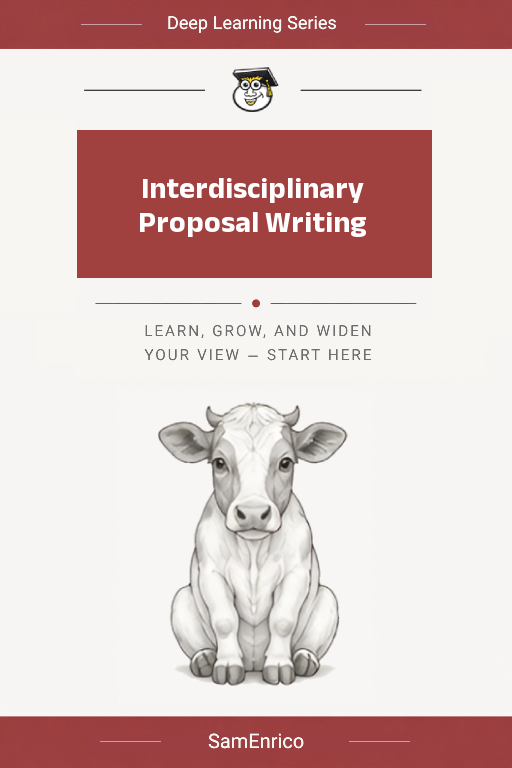
Non-FictionStudent's ShortcutInterdisciplinaryCross Field
Interdisciplinary Proposal Writing eBook
Write research proposals that bridge multiple disc
by Ware Jeffry
Write research proposals that bridge multiple disciplines addressing different reviewer expectations and terminology.
Formats
Free sample
Chapter 1: The Kitchen Sink--–- Every year, thousands of research proposals land on the desks of program officers with a single, fatal similarity. They list three disciplines, four methods, seven co-investigators, and exactly zero evidence that any of them have ever spoken to one another. These are called "kitchen sink" proposals—because the authors have thrown in everything except the logic that holds it together. And they are rejected at rates that would be scandalous in any other profession. This book exists because you will write one of these proposals, or you will review one, or—if you are very lucky—you will learn to write the other kind entirely.The truth is that funding agencies are demanding interdisciplinary research with increasing urgency.
The National Science Foundation has made "Convergence Research" a explicit priority. The National Institutes of Health regularly issues requests for proposals that require teams to span at least three institutes. Wellcome Trust funds only projects that demonstrate "genuine cross-disciplinary collaboration." The European Union's Horizon program has built its entire framework around "interdisciplinary missions" rather than single-discipline silos. On paper, this is a golden age for researchers who want to work across boundaries.But here is the quiet catastrophe that no funding agency likes to discuss: most interdisciplinary proposals are terrible. Not flawed.
Not needing revision. Terrible in a fundamental, structural way that no amount of editing can fix. They are terrible because the authors have mistaken adjacency for integration. They have assumed that putting a biologist and a sociologist on the same title page produces biology-sociology research. They have confused a multidisciplinary author list with an interdisciplinary research design.
And they have done all of this because no one ever taught them the difference.This chapter is going to teach you that difference. More importantly, it is going to give you two diagnostic tools that will prevent you from ever writing a kitchen sink proposal again. The first tool is the Necessity Test, which asks whether your research question genuinely requires multiple disciplines or whether you are simply performing interdisciplinarity for its own sake. The second is the Integration Depth Index, which measures how deeply your disciplines actually interact—from mere cooperation on one end to genuine transformation on the other. By the end of this chapter, you will be able to look at any proposal and tell, within sixty seconds, whether it is a real interdisciplinary project or just a kitchen sink dressed up in fancy jargon.But before we get to the tools, we need to understand why kitchen sink proposals exist in the first place.
And to understand that, we need to talk about how you were trained.The Silo Problem Graduate school is a machine for producing disciplinary depth. This is its great strength and its great weakness. You enter with broad curiosity about the world, and you emerge as someone who can recite the precise statistical assumptions of a mixed-effects model or identify the subtle differences between Foucauldian and Deleuzian notions of power. You learn to think like a biologist, or a sociologist, or an engineer. You do not learn to think like anything else.This is not an accident.
The entire structure of academic reward—publication in discipline-specific journals, tenure review by discipline-specific committees, funding from discipline-specific study sections—reinforces the message that depth is virtue and breadth is distraction. Your advisor told you to read deeply in your field. Your dissertation committee asked if you had covered the canonical texts in your discipline. Your first job talk succeeded because you demonstrated command of your field's methods, not because you showed how your field might learn from another.The result is that when you sit down to write an interdisciplinary proposal, you are working against every instinct your training has built. You naturally want to write the proposal that would impress your dissertation advisor.
You naturally default to the methods you know. You naturally assume that your discipline's definition of "rigor" is the only definition that matters. And then you paste another section written by a collaborator from another discipline, and you call it interdisciplinary.This is not a moral failing. It is a structural one. You cannot write an integrated proposal when your cognitive architecture is siloed.
And the first step toward integration is recognizing that your training has given you a disability, not a superpower, when it comes to interdisciplinary work.Consider a typical kitchen sink proposal. It opens with a broad problem that everyone agrees is important—say, climate change adaptation in coastal cities. The authors list three disciplines: atmospheric science, civil engineering, and urban planning. The proposal includes an atmospheric science section on climate modeling, a civil engineering section on infrastructure resilience, and an urban planning section on zoning policy. Each section is well-written, rigorous, and entirely independent of the others.
The modeling section does not inform the engineering section. The engineering section does not constrain the planning section. The planning section does not generate questions for the modeling section. They simply exist alongside one another, like strangers sharing a bus.A reviewer reading this proposal—and I have read hundreds of them—will recognize the problem immediately. The authors have identified a multi-disciplinary problem, yes.
But they have not designed an interdisciplinary solution. They have designed three single-disciplinary solutions and stapled them together. The proposal will be rejected, usually with a comment like "lacks integration" or "the team appears to be working in parallel rather than collaboratively." And the authors will be confused, because they did everything right according to their training. They assembled a team. They wrote good sections.
They cited the right literature. What more could anyone want?The answer is that they could want the thing that is hardest to produce: evidence that the disciplines have actually changed one another.The Necessity Test: Is This Really Interdisciplinary?Before you write a single word of an interdisciplinary proposal, you must answer a question that most researchers never ask: does this project actually need to be interdisciplinary? The answer is not always yes, and pretending otherwise is a fast path to rejection.The Necessity Test is simple. Take your central research question and ask: can this question be adequately answered within a single discipline? If the answer is yes, then you should not write an interdisciplinary proposal.
You should write the best single-discipline proposal you can, because funders will rightly wonder why you are complicating a question that does not require complication.This sounds obvious, but in practice it is rarely applied. Researchers have learned that interdisciplinarity is fashionable, so they retroactively declare their projects interdisciplinary even when the research question could be answered within their home field. A psychologist studying memory might decide to call their work "cognitive neuroscience" because they plan to measure brain activity. But if the research question is fundamentally about memory processes, and the brain measurement simply adds a new dependent variable without changing the question, then the project is not genuinely interdisciplinary. It is psychology with a neuroscience accessory.The Necessity Test forces you to be honest about whether your question genuinely requires multiple disciplinary perspectives.
A question passes the test only if all of the following conditions are met:First, the question cannot be fully specified…
This is the end of the free sample. Get the eBook to keep going. Buy now
About this book
Details
- Author
- Ware Jeffry
- Publisher
- SamEnrico
- Language
- English
- Genre
- Non-Fiction, Student's Shortcut, Interdisciplinary, Cross Field
- Released
- 2026-06-01
- Pages (approx.)
- 158
- Available as
- eBook, Audiobook

Read better in the ZLOADR app
Your eBooks on your phone or tablet. Sign in with your SamEnrico account and start reading.
More by Ware Jeffry
 Belgian Detective PerspectiveWare Jeffry$11.99
 LBO Waterfall WaterfallWare Jeffry$11.99
 Exit Strategy Matrix GuideWare Jeffry$11.99
 Mindfulness for Workplace BurnoutWare Jeffry$11.99
 Bariatric Surgery Duodenal Switch GuideWare Jeffry$11.99
 Silicon Samurai: How Masayoshi Son Built a $100B Empire from ScratchWare Jeffry$11.99
 The Viking Voyagers and the Seeds of Evolution: Medieval Mariners Who Shaped Darwin's WorldWare Jeffry$11.99
 Understanding Cayler SyndromeWare Jeffry$17.99
 AI Financial Data Quality ScorecardWare Jeffry$12.99
 10 Ways to Use Chaunk (Recipe Book)Ware Jeffry$11.99
 EGSE HW EngineerWare Jeffry$11.99EGSE HW EngineerWare Jeffry$11.99
You may also like
 Hong Kong Handover 1997Dunn Johnnie$11.99
 Zumba For Postnatal Recovery CourseNeal Christian$11.99
 Zumba for BeginnersLadner Nikia$11.99
 YouTube Comment Mining GuideHumes Pandora$12.99
 Worry Box MeditationCarlin Rudy$11.99
 Workplace Stress MeditationNguyen Lynn$11.99
 Workplace Stress and Sleep RepairHawley Ivory$11.99
 Workplace Perfectionism CureDelaney Jeffry$11.99
 Workplace Injustice Anger GuideWallen Isabelle$11.99
 Work Addiction and Burnout LinkGreenwood Ester$11.99
 Women in Yoga and WellnessBeattie Galina$11.99
 Women in Stand Up ComedyChun Evangeline$11.99