
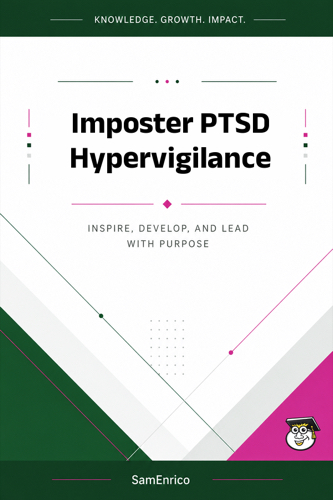
Imposter PTSD Hypervigilance eBook
Heal the trauma response that makes you constantly
Heal the trauma response that makes you constantly scan for evidence of your incompetence.
Formats
Free sample
Chapter 1: The Silent Alarm--–- The email arrives at 9:47 AM on a Tuesday. It is three sentences long. The subject line reads: "Quick question." Your boss’s name is in the sender field. That is all.In the next thirty seconds, your heart rate doubles. Your palms dampen.
Your stomach clenches. You do not open the email. Instead, you stare at it. You scan the subject line again. "Quick question." You run through every possible mistake you have made in the last week.
The typo in the report? The deadline you met but perhaps did not exceed expectations on? The meeting where you hesitated? By the time you open the email—which turns out to be a simple request for a file you already have—you have already lived through three imaginary firings, two imaginary arguments, and one imaginary public shaming.You close the email. You send the file.
You exhale. But the dread does not leave. It settles into your chest like a stone. And you think: Why am I like this?If that scene feels familiar, you are not alone. But more importantly, you are not crazy.
You are not weak. You are not "too sensitive." You are experiencing something very specific, very physiological, and very treatable. You are experiencing the Silent Alarm—a hypervigilant trauma response that has been mislabeled as imposter syndrome.This chapter is about naming that alarm. About understanding why your brain treats a three-sentence email like a predator in the tall grass. About the difference between garden-variety imposter thoughts and the kind of chronic, body-level dread that runs your life.
And about the first step toward retraining your nervous system to stop scanning for danger that is not there.The Difference Between a Thought and a Somatic Event Most books about imposter syndrome start in the same place: your thoughts. They tell you that you are having irrational beliefs about your competence. They give you worksheets to challenge those beliefs. They ask you to list your accomplishments, to compare your internal experience to others' external presentations, to "fake it until you make it."If you are reading this book, you have probably tried those things. And you have probably discovered that they do not work—or they work for a few hours before the dread comes back.Here is why.For the person with standard, situational imposter syndrome, the feeling of fraudulence is a thought.
It sounds like: "I don't think I belong here." That thought can be countered with evidence: "But you got the job. You have the degree. You have done this before." The thought passes. The person moves on.For the person with chronic, trauma-linked imposter hypervigilance, the feeling of fraudulence is a somatic event. It is not a thought at all.
It is a full-body alarm that arrives before any thinking happens. It sounds like: chest tightness, racing heart, shallow breath, frozen shoulders, hollow stomach, burning face. The thought "I am a fraud" is not the cause of the feeling. It is the story you tell yourself after the feeling arrives, trying to make sense of why your body just went into emergency mode over an email.This distinction is everything.When you try to use cognitive restructuring—challenging the thought "I am a fraud" with evidence of competence—you are fighting the wrong battle. The thought is not the problem.
The thought is a symptom. The problem is a nervous system that has learned to treat ambiguity, novelty, silence, and authority figures as threats to your survival.You cannot logic your way out of a physiological alarm. You cannot argue with a racing heart. You cannot reason with sweaty palms. You have to retrain the alarm itself.The Fraud Detector: Your Brain's Overactive Security System Imagine for a moment that you have a home security system.
It is supposed to go off when someone breaks a window or forces a door. That is its job. You want it to do that.Now imagine that your security system has been recalibrated to go off every time a leaf touches the window. Every time the mailman walks past. Every time the wind blows.
The alarm is still technically working—it is detecting motion, after all—but it is detecting the wrong things. It is treating harmless stimuli as existential threats.That is your Fraud Detector.The Fraud Detector is a neural mechanism—a network of connections between your amygdala (threat detection), your insula (body awareness), and your prefrontal cortex (meaning-making)—that has been trained, usually through repeated childhood experiences, to scan for evidence of incompetence and treat that evidence as a survival threat.When the Fraud Detector is working correctly, it helps you notice when you have genuinely made a mistake that needs correction. That is useful. When it is overactive, it treats a typo like a crime, a hesitation like a confession, a vague email like a verdict.The problem is not that you care about doing good work. The problem is that your brain has confused quality control with life or death.Why 70% of People Feel Like Frauds But Only Some Suffer Let us be clear: imposter feelings are normal.
The original research by Pauline Clance and Suzanne Imes in 1978 found that a staggering number of high-achieving women experienced what they called the Impostor Phenomenon. Subsequent research has shown that up to 70 percent of people—across genders, industries, and levels of seniority—report feeling like frauds at some point in their careers.But there is a difference between feeling like a fraud and being debilitated by that feeling.The person with standard imposter syndrome thinks: "I don't belong here. I'm going to be found out." They feel anxious. They might over-prepare. But they still submit the report.
They still take the promotion. They still speak in the meeting. The feeling is uncomfortable, but it does not stop them.The person with imposter hypervigilance experiences something different. They do not just think they might be found out. They scan for the moment of exposure constantly.
They re-read emails five times before sending. They check Slack obsessively after every message. They cannot relax after a success because they are already waiting for the other shoe to drop. They experience physical symptoms—insomnia, digestive issues, chronic tension, brain fog—not because they are anxious about work, but because their nervous system is in a low-grade state of emergency all the time.This is not imposter syndrome. This is a trauma response wearing imposter syndrome's clothes.The Four Clues That You Are Dealing with Hypervigilance, Not Imposter Syndrome How do you know which category you fall into?
Here are four clues. If you recognize yourself in three or more, this book is for you.Clue One: You Cannot Relax After Success.Standard imposter syndrome feels like anxiety before a task. Imposter hypervigilance feels like dread after a success. You finish a big project. You get praise from your boss.
You should feel good. Instead, you feel worse. Because now you have set the bar higher. Now they expect more. Now you have more to lose.
Your brain takes a win and turns it into a new threat.Clue Two: Your Body Reacts Before Your Mind Does.You…
This is the end of the free sample. Get the eBook to keep going. Buy now
About this book
Details
- Author
- Martindale Drucilla
- Publisher
- SamEnrico
- Language
- English
- Genre
- Non-Fiction, Self-Help, Trauma
- Released
- 2026-06-10
- Pages (approx.)
- 146
- Available as
- eBook, Audiobook

Read better in the ZLOADR app
Your eBooks on your phone or tablet. Sign in with your SamEnrico account and start reading.
More by Martindale Drucilla
 Breaking Opioid Dependency GuideMartindale Drucilla$11.99
 Rwandan Church SurvivorMartindale Drucilla$11.99
 LTC Insurance For Couples GuideMartindale Drucilla$11.99
 Gift Buying StrategyMartindale Drucilla$11.99
 All Nighters Memory DamageMartindale Drucilla$11.99
 The Sack of Rome 1527Martindale Drucilla$11.99
 Ceremonial Feast Leadership GuideMartindale Drucilla$11.99
 First Responder PTSD PreventionMartindale Drucilla$11.99
 The Last Letter: Agatha Christie’s Vanishing ActMartindale Drucilla$11.99
 The Iron Duke’s Gambit: Wellington’s Masterstroke at SalamancaMartindale Drucilla$11.99
 Echoes from the Dawn: Africa’s Cosmic Pioneers and the Birth of the UniverseMartindale Drucilla$11.99
 Growing Platystemon (Creamcups)Martindale Drucilla$11.99
You may also like
 Hong Kong Handover 1997Dunn Johnnie$11.99
 Zumba For Postnatal Recovery CourseNeal Christian$11.99
 Zumba for BeginnersLadner Nikia$11.99
 YouTube Comment Mining GuideHumes Pandora$12.99
 Worry Box MeditationCarlin Rudy$11.99
 Workplace Stress MeditationNguyen Lynn$11.99
 Workplace Stress and Sleep RepairHawley Ivory$11.99
 Workplace Perfectionism CureDelaney Jeffry$11.99
 Workplace Injustice Anger GuideWallen Isabelle$11.99
 Work Addiction and Burnout LinkGreenwood Ester$11.99
 Women in Yoga and WellnessBeattie Galina$11.99
 Women in Stand Up ComedyChun Evangeline$11.99