
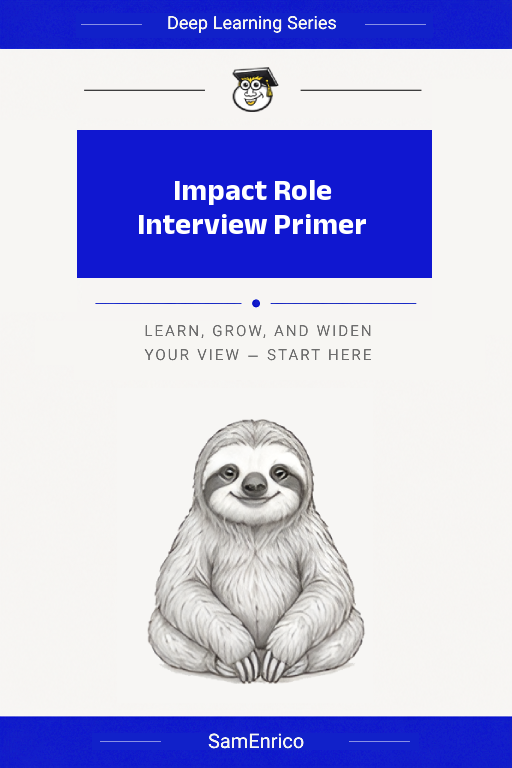
Non-FictionNon-Obvious CareerInterview Strategy
Impact Role Interview Primer eBook
Ace nonprofit interviews using mission alignment l
Ace nonprofit interviews using mission alignment language, volunteer story examples, and board member references including salary negotiation for foundation roles.
Formats
Free sample
Chapter 1: The Passion Trap--Almost every candidate walks into a nonprofit interview carrying the same ticking time bomb. They believe – genuinely, earnestly, and completely – that their passion is their greatest asset. “I just want to help people,” they say, with a tremor in their voice. “This cause means everything to me.”And then they don’t get the job.Not because their passion was fake. Not because they lacked skills.
But because they walked into a mission-driven organization carrying a for-profit assumption: that caring deeply is enough. In the corporate world, enthusiasm can compensate for a lack of specific vocabulary. In the nonprofit sector, misplaced passion is a liability. It signals inexperience. It signals that you think of the organization as a charity rather than an economic engine.
And it signals – worst of all – that you haven’t done your homework.This chapter is going to shatter that assumption. By the time you finish reading, you will understand why “I want to help people” is the fastest way to lose a nonprofit interview. More importantly, you will learn what to say instead – and why the organizations that change the world actually think about success very differently than you’ve been told.The Three Filters You Never Knew Existed Let’s start with a thought experiment. Imagine you’re a hiring manager at a food bank. You have two candidates in front of you.Candidate A has ten years of corporate logistics experience.
She managed a supply chain that moved $50 million worth of goods across three states. She never missed a delivery deadline. In her interview, she says: “I’ve always wanted to work in the nonprofit sector. I just really want to help people who are food insecure. I have a lot of passion for this mission.”Candidate B has three years of experience as a program coordinator at a small shelter.
He’s never managed a budget over $200,000. In his interview, he says: “Your annual report shows that last year, you distributed 4.2 million meals, but your spoilage rate increased from 3% to 7%. I used to run logistics for a regional food bank, and I’d like to walk you through a five-point plan to get that spoilage rate back down to 3% within six months.”Who gets hired?If you said Candidate B, you’re right – not because he has more experience, but because he demonstrated that he understands how the organization measures success. He spoke their language. He used data from their own report.
He didn’t say “I want to help people” – he said “I can solve your specific problem.”This is the central insight of this entire book: Nonprofit hiring managers don’t evaluate candidates based on passion alone. They filter every applicant through three distinct lenses – what this book calls the Triangle of Trust. These three filters determine whether you get a first interview, a second interview, or a job offer. And most candidates fail at least two of them without even knowing they exist.The Triangle of Trust is not a metaphor. It is a practical framework that you can audit yourself against today.
The three sides are:Side One: The Mission Filter – Do you think like an insider? This is not about agreeing with the mission. It is about demonstrating that you understand impact metrics, program efficacy, and the difference between activity and outcomes.Side Two: The Service Filter – Do you act like someone who gives time voluntarily? Nonprofits know that paid staff can fake passion. Volunteers almost never do.
Your history of unpaid service – however small – is the single most trusted form of evidence you can offer.Side Three: The Governance Filter – Do influential people trust you? For senior roles, board members are the hidden interview panel. A reference from a board member carries ten times the weight of a staff reference. For entry-level roles, this filter is optional – but understanding it now will accelerate your career later.Here is what most candidates get wrong: They assume the Mission Filter is about agreeing with the mission. It is not.
It is about understanding how the organization measures its own success. And that understanding requires a vocabulary that most corporate refugees simply don’t have.The “Why Nonprofit?” Trap (And Why It Destroys Careers)Let me tell you about a candidate I’ll call Sarah. Sarah was brilliant – a former marketing director at a Fortune 500 company who had raised millions for corporate sponsorships. She wanted to pivot into development at a human rights foundation. She had the skills.
She had the network. And she had what she thought was a perfect answer to the most common nonprofit interview question: “Why do you want to work here?”She said: “Because I’ve always cared deeply about human rights. I’ve followed your work for years. I just really want to use my skills to help people who can’t help themselves.”She did not get the job.The candidate who did get the job was a grants manager with half her salary history and a fraction of her experience. His answer to the same question was: “Because your last impact report showed that your litigation strategy reduced wrongful detentions by 22% last year.
In my current role, I manage grants for a legal aid organization, and I’ve developed a reporting system that cuts compliance time by 40%. I want to bring that efficiency to your team so you can litigate more cases with the same budget.”What’s the difference? Sarah spoke about passion. The winning candidate spoke about data, efficiency, and contribution to measurable outcomes.This is the “Why Nonprofit?” trap. It feels right to say “I want to help people.” But in a mission-driven context, that answer signals that you haven’t done your homework.
It signals that you think of the organization as a cause rather than a business. And it signals – most dangerously – that you are looking for emotional fulfillment rather than a job.Nonprofits are not charities. They are three-trillion-dollar economic engines that employ millions of people. They have budgets, strategic plans, key performance indicators, and compliance requirements. The people who run them are not saints – they are operators.
And operators hire other operators, not volunteers.The correct answer to “Why do you want to work here?” is never about what you want. It is always about what you can contribute to their specific, measurable, documented goals. You prove you understand the Mission Filter not by declaring your alignment with the cause, but by demonstrating that you have read their annual report, understood their challenges, and can articulate how your skills address those challenges in quantifiable terms.The Service Filter: Why Your Volunteer History Matters More Than Your Resume Now let’s talk about the second side of the Triangle of Trust – the one that makes corporate candidates furious. The Service Filter is the simple, brutal reality that nonprofits trust people who have given time voluntarily more than they trust people who have only ever been paid for their labor.Why? Because paid staff can fake passion.
Volunteers almost never do. When someone spends their Saturday sorting cans at a food bank with no expectation of compensation, they send a signal that cannot…
This is the end of the free sample. Get the eBook to keep going. Buy now
About this book
Details
- Author
- Billingsley Deandrea
- Publisher
- SamEnrico
- Language
- English
- Genre
- Non-Fiction, Non-Obvious Career, Interview Strategy
- Released
- 2026-05-29
- Pages (approx.)
- 145
- Available as
- eBook, Audiobook

Read better in the ZLOADR app
Your eBooks on your phone or tablet. Sign in with your SamEnrico account and start reading.
More by Billingsley Deandrea
 Margaret Court Record 24Billingsley Deandrea$11.99
 Male Workplace EsteemBillingsley Deandrea$11.99
 Scholarship Retention Pressure GuideBillingsley Deandrea$11.99
 Green Beret Afghanistan VillagesBillingsley Deandrea$11.99
 Equifax Credit Freeze GuideBillingsley Deandrea$11.99
 The Steam that Shaped a Nation: The Forgotten Genius of Josiah Willard GibbsBillingsley Deandrea$11.99
 The Bannik’s Last Warning: A Slavic Ghost’s Forgotten ProphecyBillingsley Deandrea$11.99
 Core Data EngineerBillingsley Deandrea$11.99
 ESL Vocabulary Building GuideBillingsley Deandrea$12.99
 Understanding Gardner's SyndromeBillingsley Deandrea$17.99
 How to Become a Kiln OperatorBillingsley Deandrea$11.99
You may also like
 Hong Kong Handover 1997Dunn Johnnie$11.99
 Zumba For Postnatal Recovery CourseNeal Christian$11.99
 Zumba for BeginnersLadner Nikia$11.99
 YouTube Comment Mining GuideHumes Pandora$12.99
 Worry Box MeditationCarlin Rudy$11.99
 Workplace Stress MeditationNguyen Lynn$11.99
 Workplace Stress and Sleep RepairHawley Ivory$11.99
 Workplace Perfectionism CureDelaney Jeffry$11.99
 Workplace Injustice Anger GuideWallen Isabelle$11.99
 Work Addiction and Burnout LinkGreenwood Ester$11.99
 Women in Yoga and WellnessBeattie Galina$11.99
 Women in Stand Up ComedyChun Evangeline$11.99