
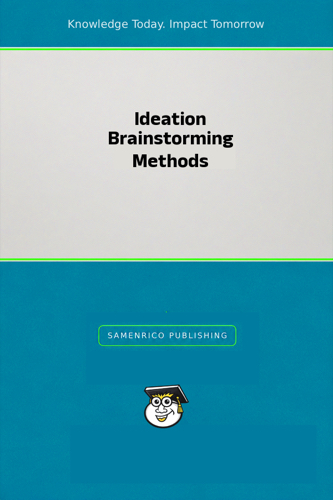
Ideation Brainstorming Methods eBook
Teaches quantity over quality, building on others'
Teaches quantity over quality, building on others' ideas, and deferring judgment.
Formats
Free sample
Chapter 1: The Edison Lie...--–- The man who allegedly invented the lightbulb did not, in fact, invent the lightbulb. He did not work alone. He did not experience a sudden, dramatic moment of inspiration. And the story you have been told about creativity—the one where a solitary genius sits in a quiet room until a thunderbolt strikes—is not just misleading. It is actively making you worse at generating ideas.This chapter dismantles the single most damaging myth about innovation: the belief that breakthroughs come from isolated "lightbulb moments." In its place, you will learn the real engine of creativity—a messy, social, volume-driven process that has been hidden behind the romanticized stories we tell about geniuses.
By the end of this chapter, you will understand why the first fifty ideas you generate are statistically worthless, why your instinct to judge ideas early is biologically hardwired but professionally disastrous, and how to completely redefine what success looks like in an ideation session. You will also run your first "Tempo 30" exercise—thirty ideas in thirty minutes—and discover firsthand that quantity is not the enemy of quality. Quantity is the only path to quality.The Invention That Wasn't: What Really Happened at Menlo Park On New Year's Eve 1879, Thomas Edison staged a public demonstration of his new electric light at his laboratory in Menlo Park, New Jersey. The crowd that gathered in the freezing cold saw a small bulb glow with a steady, warm light for several hours. Newspapers across the country ran breathless headlines: "Edison Invents the Lightbulb." The lone genius had done it again.Here is what the newspapers did not report.Edison employed more than twenty assistants at Menlo Park—machinists, glassblowers, chemists, and mathematicians.
He did not work alone in a quiet attic. He worked in a large, noisy, collaborative workshop where ideas were shouted across benches, failures were documented on shared chalkboards, and no single person could claim sole credit for any breakthrough. The lightbulb itself was the product of hundreds of failed experiments conducted by multiple people over several years. The successful filament—carbonized bamboo—was not Edison's idea at all. It came from a British inventor named Joseph Swan, who had been working on the same problem simultaneously and had actually demonstrated a working lamp the year before.
Edison did not invent the lightbulb. He perfected it, scaled it, and—most importantly—built an entire electrical system around it. And he did that by generating an astonishing volume of failed attempts. His laboratory notebooks record over three thousand separate experiments testing different materials for the filament alone. Three thousand.
Most failed. The ones that worked only worked after thousands of failures had already happened.The "lone genius" story was a public relations invention. Edison understood that newspapers would not print headlines about a collaborative workshop where twenty people tried three thousand things and most of them broke. They wanted a hero. So Edison gave them one.
And ever since, we have been trying to replicate the wrong model of creativity.The Psychology of the "Aha" Myth Why does the lone genius story persist? Because it feels true. Almost everyone who has ever had a creative breakthrough remembers the moment of insight as sudden and dramatic. You are in the shower, or walking the dog, or driving to work, and suddenly—out of nowhere—the solution appears. It feels like magic.
It feels like a gift from the unconscious mind. And because it feels that way, we assume that creativity works that way for everyone.The research says otherwise.Cognitive scientists have studied the "insight experience" for decades, using puzzles, brain imaging, and laboratory experiments. What they have discovered is that the sudden feeling of insight is almost always preceded by long periods of unconscious processing. Your brain works on the problem in the background, making connections, discarding dead ends, combining fragments of memory and perception. The "aha" moment is not the moment of creation.
It is the moment when the solution finally crosses a threshold into conscious awareness. The real work happened invisibly, over time, and almost always involved exposure to a large volume of related information, failed attempts, and alternative approaches.This is why the lone genius myth is actively harmful. When you believe that creativity should feel like a sudden thunderbolt, you will give up on any problem that does not yield to that feeling. You will assume that if the answer is not coming quickly, you must not be creative enough. You will stop generating ideas after the first ten or twenty, because none of them feel like breakthroughs.
And you will never discover that breakthroughs almost never appear in the first ten or twenty ideas. They appear in the second hundred.The 50/50 Rule: Why Your First Ideas Are Your Worst Here is a truth that every professional creative knows and almost every amateur resists: the first fifty ideas you generate are garbage. Not some of them. Not most of them. All of them.This is not an opinion.
It is a statistical reality that has been observed in hundreds of ideation sessions across industries. Researchers have analyzed thousands of brainstorming transcripts and found a consistent pattern. The first ten to fifteen ideas are the most obvious—the things that anyone with basic knowledge of the problem would suggest. Ideas eleven through thirty are slightly less obvious but still heavily influenced by social norms and conventional thinking. Ideas thirty-one through fifty start to show some novelty, but they are usually variations on earlier themes.
Breakthrough ideas—the ones that are genuinely new, genuinely surprising, and genuinely valuable—almost never appear before idea number fifty. The most common breakthrough range is between ideas seventy and one hundred fifty.Why? Because your brain is a pattern-matching machine. When you encounter a problem, your brain immediately searches its memory for similar problems and the solutions that worked before. Those solutions are easy to retrieve, feel correct, and come to mind first.
But they are also, by definition, not creative. Creativity requires your brain to abandon those well-worn pathways and forge new connections. And that takes time, persistence, and volume. You have to exhaust the obvious before you can reach the novel. You have to write down the first fifty bad ideas so that your brain finally gives up on them and starts searching in more interesting places.This is the single most important concept in this entire book.
Commit it to memory: The first fifty ideas are garbage. That is not a problem. That is the point.The Collaboration Equation: Why Groups Beat Individuals (When They Follow the Rules)If lone geniuses do not exist and first ideas are always obvious, then how do breakthroughs actually happen? The answer is collaboration—but not the kind of collaboration that happens in most meetings. Most meetings are creativity killers.
They are structured around hierarchy, politeness, and the fear of looking stupid. People wait their turn to speak. They self-edit before opening their mouths. They nod along to the boss's mediocre idea and then go back to their desks and do what they were going to do anyway. That is not collaboration.
That is a ritual.Real creative collaboration has three specific characteristics, all of which run counter to how most organizations operate.First…
This is the end of the free sample. Get the eBook to keep going. Buy now
About this book
Details
- Author
- Kowalski Shena
- Publisher
- SamEnrico
- Language
- English
- Genre
- Non-Fiction, Self-Help, Ideation
- Released
- 2026-06-08
- Pages (approx.)
- 130
- Available as
- eBook, Audiobook

Read better in the ZLOADR app
Your eBooks on your phone or tablet. Sign in with your SamEnrico account and start reading.
More by Kowalski Shena
 Postpartum Weight Loss Realistic GuideKowalski Shena$11.99
 Lost Child DreamsKowalski Shena$11.99
 ABCDE Method Priority SystemKowalski Shena$11.99
 Bipolar Dark TherapyKowalski Shena$11.99
 Transcendental Meditation for Remote WorkersKowalski Shena$11.99
 Tea Bag Microplastic GuideKowalski Shena$11.99
 Sheppard Case Coroner DisputeKowalski Shena$11.99
 Dream Recall Enhancement CourseKowalski Shena$11.99
 The Great Balloon Race: How a Tiny Town Saved the World’s First Space RaceKowalski Shena$11.99
 The Last Blockbuster: When Video Stores Refused to DieKowalski Shena$11.99
 Frozen Ambition: The Forgotten Arctic Voyages of Juan PizarroKowalski Shena$11.99
 The Dancer's Guide to Two-stepKowalski Shena$11.99
You may also like
 Hong Kong Handover 1997Dunn Johnnie$11.99
 Zumba For Postnatal Recovery CourseNeal Christian$11.99
 Zumba for BeginnersLadner Nikia$11.99
 YouTube Comment Mining GuideHumes Pandora$12.99
 Worry Box MeditationCarlin Rudy$11.99
 Workplace Stress MeditationNguyen Lynn$11.99
 Workplace Stress and Sleep RepairHawley Ivory$11.99
 Workplace Perfectionism CureDelaney Jeffry$11.99
 Workplace Injustice Anger GuideWallen Isabelle$11.99
 Work Addiction and Burnout LinkGreenwood Ester$11.99
 Women in Yoga and WellnessBeattie Galina$11.99
 Women in Stand Up ComedyChun Evangeline$11.99