
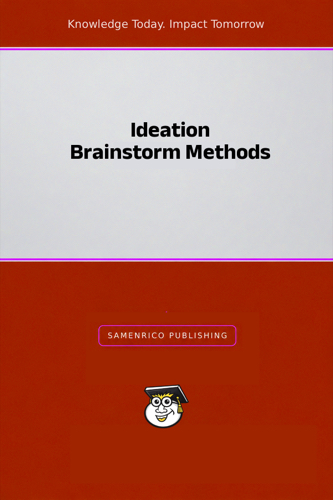
Ideation Brainstorm Methods eBook
Generate many potential solutions without judgment
Generate many potential solutions without judgment.
Formats
Free sample
Chapter 1: The Inner Assassin--–- Every creative person I have ever met shares one secret shame. They do not talk about it in meetings. They do not put it on their Linked In profiles. But late at night, staring at a blank page or replaying a silent brainstorming session, they whisper the same confession: I am my own worst enemy.Not the boss who shoots down ideas. Not the colleague who dominates every conversation.
Not the budget cuts or the impossible deadlines. The real enemy lives inside your skull, and it has been there since long before you ever joined a team or opened a laptop. That enemy is your brain’s default setting: the relentless, automatic, almost addictive drive to judge, critique, and eliminate.This chapter is about meeting that enemy face to face. It is about understanding why your brain attacks your own ideas before they are fully born, why silence feels safer than speaking, and why the most creative people you admire are not necessarily smarter than you—they have simply learned to temporarily disarm the assassin in their heads.If you have ever sat in a brainstorming session with nothing to say, or generated one idea and immediately thought “that will never work,” or watched someone else propose something wild and felt a flash of envy at their confidence, you have experienced the Inner Assassin at work. The good news is that the assassin is not you.
It is a neurological survival mechanism that can be understood, managed, and—for short, powerful bursts—turned off.The Anatomy of an Assassination Let us walk through a scene that has played out millions of times in conference rooms, coffee shops, and home offices around the world.A facilitator says, “We need new ideas for solving our customer retention problem. No judgment. Just generate anything that comes to mind.”You have a thought. It is fuzzy, incomplete, maybe a little strange. Something about a loyalty program shaped like a video game.
Or a handwritten letter from the CEO. Or maybe just a tiny tweak to the existing process.Before you can even form the words, another voice in your head speaks: That is stupid. They will laugh. Someone has already thought of that. It will never work.
The budget would never allow it. We tried something like that three years ago and it failed.The thought vanishes. Your mouth stays closed. Thirty seconds later, someone else says almost the exact same idea, and the room erupts in enthusiasm. You feel a hollow ache in your chest.
Not jealousy exactly. Something worse. The quiet recognition that you just killed your own idea before anyone else had the chance to hear it.This is not a character flaw. It is not a lack of confidence. It is not even a choice.
It is the default operation of a brain that evolved to keep you alive on the savannah, not to help you innovate in a boardroom.The Prefrontal Executive Editor Deep inside your brain, just behind your forehead, lies the prefrontal cortex. Neuroscientists sometimes call it the “executive center” because it handles planning, decision-making, social reasoning, and impulse control. It is the part of your brain that stops you from saying something offensive at a dinner party, that calculates whether you can afford that purchase, that compares your performance to your colleagues.Here is the critical insight: the prefrontal cortex is always on. It never takes a vacation. It never says, “Oh, we are brainstorming now, I will step aside.” It evaluates, compares, and judges every single thought that rises into conscious awareness.
This is not a bug. It is a feature. For most of human history, this constant evaluation kept you alive. That rustling in the bushes? The prefrontal cortex says: Could be wind.
Could be a predator. Do not assume it is safe. Prepare for the worst.In a survival context, judging first and asking questions later is a winning strategy. In a creativity context, it is a catastrophe.When you generate a novel idea, it is by definition unfinished, unpolished, and unfamiliar. Your prefrontal cortex looks at that raw, messy thought and flags it as a threat.
The same neural pathways that once warned you about predators now warn you about looking foolish in front of your peers. Social rejection, evolutionary speaking, was a death sentence. Being cast out from the tribe meant starvation or being eaten by something with larger teeth. So your brain learned: Better to stay quiet than to risk rejection.The Inner Assassin is not being mean. It is being protective.
It is trying to keep you safe inside the tribe. The tragedy is that the tribe you are trying to stay safe inside does not exist anymore. Your colleagues are not going to banish you to the wilderness for suggesting a weird idea. But your brain does not know that. It is running ancient software in a modern world.The Amygdala Hijack Let us go a layer deeper.
Below the prefrontal cortex, buried deeper in the brain, sits the amygdala. This almond-shaped cluster of neurons is your brain’s alarm system. It detects threats in milliseconds—far faster than your conscious mind can process. When the amygdala fires, it triggers a cascade of stress hormones: cortisol, adrenaline, norepinephrine. Your heart rate increases.
Blood flow shifts away from your higher cognitive functions toward your muscles. Your peripheral vision narrows. Your breathing becomes shallow.This is the fight-or-flight response. It is designed for predators, not for sticky notes.Here is what happens during a brainstorming session when the amygdala fires: blood flow to your creative centers (the default mode network, the temporal lobes, the hippocampus) actually decreases. Your brain literally has less fuel for imagination because it is saving energy for running or fighting.
You are not just feeling less creative. You are physiologically less creative.And what triggers the amygdala? Judgment. Your own judgment of your ideas. The anticipated judgment of others.
A critical comment from a colleague. A raised eyebrow. A silence that feels like disapproval. In a traditional brainstorming session, the amygdala is firing constantly. People are not “blocked.” They are flooded with stress hormones.This is why “just relax and be creative” is such useless advice.
You cannot relax your way out of a biological threat response any more than you can decide not to flinch when someone throws a ball at your face.The Reticular Activating System and the Filter of Possibility There is one more neurological mechanism to understand: the reticular activating system, or RAS. This is a bundle of nerves at the base of your brain that acts as a filter for sensory information. Every second, your senses are bombarded with millions of pieces of data. The RAS decides what to bring to your conscious attention and what to ignore.Here is the crucial point for ideation: the RAS filters based on what you have told it is important. If you are constantly judging ideas as “bad,” “unrealistic,” or “stupid,” your RAS learns to filter out those kinds of thoughts before they ever reach conscious awareness.
You do not even see the strange connections, the wild possibilities, the unconventional solutions. They are eliminated at the pre-conscious…
This is the end of the free sample. Get the eBook to keep going. Buy now
About this book
Details
- Author
- Emanuel Christiane
- Publisher
- SamEnrico
- Language
- English
- Genre
- Non-Fiction, Self-Help, Ideation
- Released
- 2026-06-06
- Pages (approx.)
- 154
- Available as
- eBook, Audiobook

Read better in the ZLOADR app
Your eBooks on your phone or tablet. Sign in with your SamEnrico account and start reading.
More by Emanuel Christiane
 Saying No at Work GuideEmanuel Christiane$11.99
 Banking Job Loss RecoveryEmanuel Christiane$11.99
 Carson Nature Poetry Prose GuideEmanuel Christiane$11.99
 The Difficult Conversation GuideEmanuel Christiane$11.99
 West Side Story JetsEmanuel Christiane$11.99
 Remote Onboarding CommunicationEmanuel Christiane$11.99
 Creative Risk Taking GuideEmanuel Christiane$11.99
 The Visionary and the Void: How Ridley Scott Defied Hollywood's OddsEmanuel Christiane$11.99
 The Silent Rebellion: The Women Who Defied the Olympics (1928)Emanuel Christiane$11.99
 A Collector's Handbook to the Sunbeam Imp SportEmanuel Christiane$11.99
 How to Produce Other FurnitureEmanuel Christiane$11.99
 How to Produce Communication EquipmentEmanuel Christiane$11.99
You may also like
 Remote Brainwriting TechniqueArmstead Drema$11.99
 Brainstorming For Non ArtistsWilbanks Eartha$11.99
 Rapid Ideation Session GuideGriswold Sammie$11.99
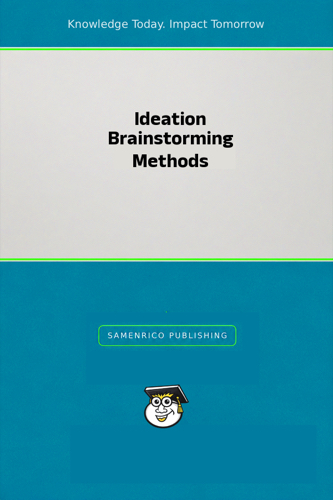 Ideation Brainstorming MethodsKowalski Shena$11.99
 SCAMPER Business GuideBreedlove Jarrod$11.99
 Daily Idea Generation RoutineEaston Madelaine$11.99
 Ideation Techniques for DesignCurrier Lura$11.99
 Group Brainstorming AlternativesWolf Stanton$11.99