
Non-FictionSelf-HelpImagery Technique
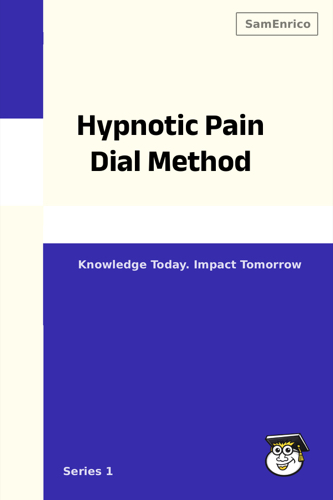
Hypnotic Pain Dial Method eBook
Turn down an imaginary volume knob from 10 to 0 gr
Turn down an imaginary volume knob from 10 to 0 gradually.
Formats
Free sample
Chapter 1: The Broken Telephone...--–- Imagine for a moment that you are standing in a crowded room. Across from you, a friend cups their hands around their mouth and shouts a single sentence. You strain to hear, but the room is loud—chairs scraping, voices overlapping, a coffee machine hissing in the corner. You catch every third word. You nod anyway.
Then you turn to the person next to you and repeat what you think you heard. By the time that sentence reaches the fifth person in the chain, it has transformed completely. "The sky is blue" becomes "The spy is due." A simple fact becomes a false alarm.This is the children's game of Telephone. It is amusing when played among friends. It is devastating when played inside your own nervous system.Every day, for millions of people living with chronic or acute pain, an internal game of Telephone is playing out at lightning speed.
A perfectly neutral event occurs somewhere in your body—a joint shifts, a muscle tightens, a nerve ending brushes against an inflamed tendon. That event generates a tiny burst of electrical and chemical activity called nociception. Nociception is not pain. Nociception is raw data. It is the whisper at the beginning of the telephone chain.By the time that whisper reaches your conscious brain, it has been shouted, distorted, amplified, filtered through fear, colored by memory, and tagged with meaning.
What arrives is not the original signal. What arrives is pain. And for many people, that pain arrives at volume ten—even when the original event was a two.This chapter is about that broken telephone. It is about the radical, liberating discovery that pain is not a measurement of tissue damage. Pain is an interpretation—a conclusion your brain reaches after processing multiple streams of information.
And if pain is an interpretation, then you are not a passive victim of your body. You are the interpreter. You hold the volume knob. You simply did not know you were holding it.The Old Model: The Telephone Wire For most of human history, medicine operated under a simple, intuitive, and completely wrong model of pain. Let us call it the Telephone Wire Model.In this model, your body is a telephone.
Your injured body part is the mouthpiece. Your brain is the earpiece. And your nerves are the copper wire connecting them. When you stub your toe, the theory goes, the injury creates a signal that travels up the wire, rings a bell in your brain, and—ding—you feel pain. The louder the bell, the worse the injury.
No signal, no pain. Simple.This model feels true because it matches common sense. Stub your toe, and it hurts. Break your leg, and it hurts more. Therefore, pain equals damage.But common sense is not always correct.
The telephone wire model collapses under the weight of three simple facts that every pain researcher learns on their first day in the lab.Fact One: You can have massive tissue damage and feel no pain.Soldiers on battlefields have been shot through the arm and continued firing their weapons, unaware of the injury until the adrenaline faded. Athletes have finished championship games with torn ligaments, broken bones, and ruptured discs—then collapsed on the sideline asking, "What happened?" Women have given birth without anesthesia while reporting manageable, even transcendent, levels of discomfort. The signal was present. The wire was intact. But the brain chose not to ring the bell.Fact Two: You can have no tissue damage and feel excruciating pain.Phantom limb pain is the most striking example.
A person whose leg has been amputated—there is no leg, no tissue, no injury to report—can experience burning, stabbing, crushing pain in the missing limb. The telephone wire is cut. The mouthpiece is gone. Yet the brain rings the bell at volume nine. Chronic back pain follows a similar pattern: MRIs of people with debilitating back pain often show no structural abnormality whatsoever.
Their spines are, by every objective measure, normal. But their brains have learned to play pain anyway.Fact Three: The same injury produces wildly different pain levels depending on context.Stub your toe on a beautiful morning while walking toward a surprise party in your honor. You wince, limp for ten seconds, and forget it. Stub the same toe on the same piece of furniture at 2:00 AM while rushing a sick child to the bathroom. The pain feels catastrophic.
The toe did not change. The signal did not change. The context changed. Your brain added fear, urgency, and sleep deprivation to the calculation, and the volume knob shot from four to nine.The telephone wire model cannot explain these facts. A more sophisticated model is required.The New Model: The Brain as a Mixing Console In the 1960s and 1970s, researchers including Ronald Melzack and Patrick Wall proposed a revolutionary idea called the Gate Control Theory of Pain.
The theory suggested that the spinal cord contains a "gate" that can open or close, allowing pain signals to pass through or blocking them. This was a major advance because it acknowledged that the body could modulate signals before they reached the brain.But gate control, for all its brilliance, still treated the brain as a passive receiver. The real revolution came decades later when neuroimaging allowed scientists to watch the brain process pain in real time. What they discovered upended everything.The brain does not receive pain. The brain constructs pain.Let me repeat that because it is the single most important sentence in this entire book: The brain constructs pain.
It does not wait for a signal to arrive. It does not simply react. It actively, creatively, and continuously generates the experience of pain using multiple sources of information.The best metaphor for this process—and the metaphor that will guide us through every subsequent chapter—is the sound mixing console.Imagine a professional recording studio. On the console, there are dozens of sliders, knobs, faders, and switches. A sound engineer sits before this console, listening to raw audio from multiple sources: a vocal microphone, a guitar pickup, a drum overhead, a bass DI box.
Each raw signal enters the console. Then the engineer makes decisions. Should the vocal be louder? Should the guitar have more reverb? Should the bass be panned left or right?
The raw audio is not the song. The engineer's mix is the song.Your brain is the sound engineer. Your body is the source of raw audio. And pain is the final mix.Here is what your brain listens to before it decides how loud to play the pain:1. Nociception (Raw Data)This is the only input that the old telephone wire model acknowledged.
Nociception is the electrochemical signal generated when specialized nerve endings (nociceptors) detect potentially harmful stimuli: extreme temperature, pressure, inflammation, or tissue damage. Nociception is the whisper. It is not pain.2. Past Experience (Memory)Your brain maintains an enormous library of past pain experiences. Have you been burned before?
Have you had a bad injection? Have you watched a parent suffer with back pain? Every past experience becomes a preset on your brain's console.…
This is the end of the free sample. Get the eBook to keep going. Buy now
About this book
Details
- Author
- Lassiter Nadene
- Publisher
- SamEnrico
- Language
- English
- Genre
- Non-Fiction, Self-Help, Imagery Technique
- Released
- 2026-06-06
- Pages (approx.)
- 132
- Available as
- eBook, Audiobook

Read better in the ZLOADR app
Your eBooks on your phone or tablet. Sign in with your SamEnrico account and start reading.
More by Lassiter Nadene
 Low Self Esteem In DysthymiaLassiter Nadene$11.99
 Senator International Relations RoleLassiter Nadene$11.99
 Kidnap Crisis Media Blackout ManualLassiter Nadene$11.99
 Country of Origin Marking GuideLassiter Nadene$11.99
 The Lost Symphony of the Sphinx: When Music Built a CivilizationLassiter Nadene$11.99
 The Silk Road's Last Emperor: Tang Taizong's Forgotten LegacyLassiter Nadene$11.99
 Understanding Congenital MegacolonLassiter Nadene$17.99
 How to Become a Cellar SupervisorLassiter Nadene$11.99
 Sustainability Supply Chain TrendLassiter Nadene$12.99
 Heriot Watt University DubaiLassiter Nadene$12.99
 Revenue OfficerLassiter Nadene$11.99
You may also like
 Hong Kong Handover 1997Dunn Johnnie$11.99
 Zumba For Postnatal Recovery CourseNeal Christian$11.99
 Zumba for BeginnersLadner Nikia$11.99
 YouTube Comment Mining GuideHumes Pandora$12.99
 Worry Box MeditationCarlin Rudy$11.99
 Workplace Stress MeditationNguyen Lynn$11.99
 Workplace Stress and Sleep RepairHawley Ivory$11.99
 Workplace Perfectionism CureDelaney Jeffry$11.99
 Workplace Injustice Anger GuideWallen Isabelle$11.99
 Work Addiction and Burnout LinkGreenwood Ester$11.99
 Women in Yoga and WellnessBeattie Galina$11.99
 Women in Stand Up ComedyChun Evangeline$11.99