
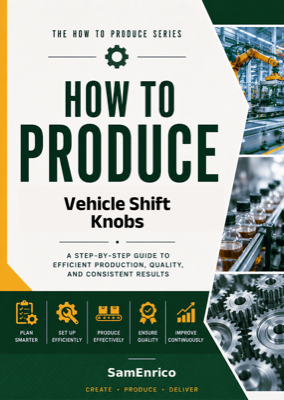
Non-FictionInformativeEducational
How to Produce Vehicle Shift Knobs eBook
This publication, published by SamEnrico, covers H
by Wick Evan
This publication, published by SamEnrico, covers How to Produce Vehicle Shift Knobs
Formats
Free sample
Chapter 1: The Material World--–- The first time I held a shift knob that felt truly alive, I was sitting in a junkyard 1991 BMW 318i, the steering wheel sticky with decades of evaporated sweat, the seats torn to foam. The gearshift was topped with something aftermarket—a bulbous black sphere of worn Delrin, cold from the morning shade. I twisted it off in two seconds (someone had forgotten the set screw) and palmed it like a pool ball. It was 147 grams of improbable perfection. That single piece of machined plastic taught me something no spec sheet could: materials have personalities.
Delrin feels stoic and self-satisfied. Aluminum is an overeager extrovert, always broadcasting temperature. Wood is a nostalgic liar, pretending it belongs in a machine. Leather is a compromiser, beautiful but needy. And cheap ABS plastic is a hollow fraud, humming with resonant misery at 4,000 RPM.This chapter is not a dry catalog of material properties.
You can find tensile strength charts anywhere. What you need—what separates a knob you tolerate from a knob you love—is a framework for matching material personality to driving experience, production method, and business margin. By the end of this chapter, you will understand exactly which material to choose for your first product, your first prototype, and your first premium offering. You will also understand why the wrong material will kill your reputation before you sell your tenth unit.The Great Material Mistake Every beginner makes the same error: they choose a material because it looks good on Instagram or because it was cheap at the hardware store. I made this mistake three times.
My first knob was turned from a scrap of cherry wood on a borrowed lathe. It was beautiful for exactly six weeks. Then the summer heat arrived. The wood expanded, the brass insert I had epoxied in place spun freely, and the finish checked into a web of fine cracks. My second knob was cast from polyester resin in a silicone mold.
It looked like liquid glass. It also shattered during a 3rd-to-2nd downshift, leaving me holding a ring of sharp shards while the threaded insert rolled under the passenger seat. My third mistake was PLA—the darling of desktop 3D printing. I printed a hexagonal knob with recessed shift pattern, sanded it smooth, painted it with automotive clear coat, and installed it in my own car. On a 90-degree day, after an hour of driving, the PLA softened like warm cheese.
The set screws pulled through the plastic. The knob tilted sideways on the lever like a drunk leaning on a lamppost.These failures were not bad luck. They were predictable consequences of ignoring the relationship between material properties and the automotive environment. A shift knob lives in one of the most hostile microclimates on a passenger vehicle. In summer, dashboard temperatures exceed 80 degrees Celsius (176 Fahrenheit).
In winter, the same interior can drop below freezing. Ultraviolet light streams through the windshield, degrading polymers. Human hands deposit oils, acids, and sweat. The shift lever transmits vibrations from the transmission directly into the knob's attachment point. And the driver grips the knob with forces ranging from a featherlight touch to a desperate two-handed yank when the transmission refuses to engage reverse.Your material choice must survive all of this while feeling good, looking good, and remaining securely attached.
There is no perfect material—only trade-offs. This chapter will help you navigate those trade-offs with your eyes open.Thermoplastics: The Workhorses Let us begin with the most common category: thermoplastics. These materials soften when heated and harden when cooled, a reversible process that makes them ideal for injection molding and 3D printing. They range from cheap and brittle to expensive and nearly indestructible.ABS (Acrylonitrile Butadiene Styrene)ABS is the plastic of LEGO bricks, automotive dashboards, and cheap OEM shift knobs. It strikes a reasonable balance between cost, durability, and ease of processing.
ABS has decent UV resistance (though it will fade and chalk after years of sun exposure), good impact strength, and a glass transition temperature around 105 degrees Celsius—high enough to survive a car interior on all but the most extreme days. The problem with ABS is its personality: it feels like plastic. Not cheap plastic, necessarily, but plastic nonetheless. It lacks the dense, cold authority of metal and the warm confidence of Delrin. ABS knobs often incorporate rubber over-molding to improve grip and perceived quality.
If you are producing a budget-friendly knob for mass-market sale, ABS with a soft-touch over-mold is a defensible choice. Just do not expect anyone to call it luxurious.Delrin (POM – Polyoxymethylene)Delrin is the material that made me fall in love with shift knobs in that junkyard BMW. Chemically, it is polyoxymethylene, a semi-crystalline thermoplastic with exceptional stiffness, low friction, and remarkable dimensional stability. Delrin feels dense and cool to the touch—not as cold as metal, but noticeably more substantial than ABS. Its natural color is an opaque white or black, but it accepts dyes well.
The material machines beautifully on a lathe, producing fine chips rather than messy strings. It does not require painting or coating; a polished Delrin knob has a satin luster that ages gracefully.The practical advantages of Delrin are substantial. Its coefficient of friction is low, which means it glides against the palm rather than grabbing skin. This is either a virtue or a vice depending on your preference—some drivers want tacky grip, others want smooth rotation. Delrin is self-lubricating, so it will never develop the sticky residue that plagues old rubber or soft-touch coatings.
It resists most automotive chemicals, including gasoline, oil, and brake fluid. The glass transition temperature is approximately 175 degrees Celsius, far above anything experienced in a parked car.The downsides? Delrin is more expensive than ABS, roughly three to five times the cost per kilogram. It can be difficult to glue or bond (though you should not need to if designed properly). And its natural finish is matte-to-satin, not glossy—if you want a high-gloss show car finish, Delrin will disappoint you.For the majority of aftermarket shift knob producers, Delrin represents the optimal balance of cost, durability, feel, and manufacturability.
It is forgiving enough for a garage workshop with a lathe, consistent enough for injection molding at scale, and reputable enough to command 50–50–50–100 per unit.Nylon (PA6, PA12, PA66)Nylon (polyamide) is the overachiever of thermoplastics. It is stronger than ABS, more heat-resistant than Delrin, and can be reinforced with glass fibers for extreme durability. However, nylon is hygroscopic—it absorbs moisture from the air, which causes dimensional changes. A nylon knob left in a humid garage may swell enough to affect fit. Nylon also requires more careful drying before processing than other thermoplastics.For shift knobs, nylon is most commonly encountered in two forms: injection-molded OEM knobs (where glass-filled nylon provides structural rigidity at low cost) and 3D-printed SLS nylon (where laser-sintered powder produces complex geometries impossible with machining).
SLS nylon has a slightly grainy, matte finish that some drivers love for grip. It is nearly indestructible and can be dyed to various colors after printing.If you plan to use 3D printing for production (not just prototyping), SLS nylon is…
This is the end of the free sample. Get the eBook to keep going. Buy now
About this book
Details
- Author
- Wick Evan
- Publisher
- SamEnrico
- Language
- English
- Genre
- Non-Fiction, Informative, Educational
- Released
- 2026-06-02
- Pages (approx.)
- 137
- Available as
- eBook, Audiobook

Read better in the ZLOADR app
Your eBooks on your phone or tablet. Sign in with your SamEnrico account and start reading.
More by Wick Evan
 Overcoming Loneliness After TraumaWick Evan$11.99
 UH 60 Black HawkWick Evan$11.99
 Dwayne Betts Education InitiativeWick Evan$11.99
 Fear of Failure for TeachersWick Evan$11.99
 Daily Decompression for ProfessionalsWick Evan$11.99
 Client Interruption HandlingWick Evan$11.99
 Body Scan for NumbnessWick Evan$11.99
 Bedtime Forgiveness MeditationWick Evan$11.99
 The Tokyo Torso Murders: Japan's First Serial Killer Mystery (1880s)Wick Evan$11.99
 The Silk Road Merchants of the Horn: Aksum's Golden Trade DynastyWick Evan$11.99
 A Collector's Handbook to the Lotus Esprit IWick Evan$11.99
 Service Providers Guide to Computer AnimatorsWick Evan$11.99
You may also like
 Hong Kong Handover 1997Dunn Johnnie$11.99
 Zumba For Postnatal Recovery CourseNeal Christian$11.99
 Zumba for BeginnersLadner Nikia$11.99
 YouTube Comment Mining GuideHumes Pandora$12.99
 Worry Box MeditationCarlin Rudy$11.99
 Workplace Stress MeditationNguyen Lynn$11.99
 Workplace Stress and Sleep RepairHawley Ivory$11.99
 Workplace Perfectionism CureDelaney Jeffry$11.99
 Workplace Injustice Anger GuideWallen Isabelle$11.99
 Work Addiction and Burnout LinkGreenwood Ester$11.99
 Women in Yoga and WellnessBeattie Galina$11.99
 Women in Stand Up ComedyChun Evangeline$11.99