
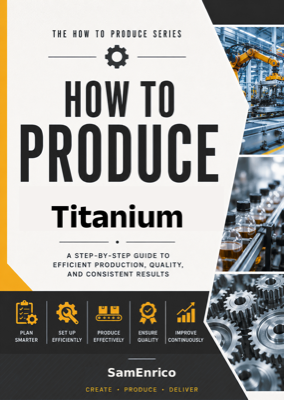
Non-FictionInformativeEducational
How to Produce Titanium eBook
This publication, published by SamEnrico, covers H
This publication, published by SamEnrico, covers How to Produce Titanium
Formats
Free sample
Chapter 1: The Hidden Metal...--Think of the most advanced machines ever built. A jet engine thrusting an aircraft through the stratosphere at Mach 0.85. A replacement hip joint that will outlive the patient who receives it. A deep-sea submersible descending to the crushing darkness of the Mariana Trench. A Formula 1 car cornering at 5G’s, its suspension arms enduring forces that would snap steel.
An i Phone 15 Pro, carried in a pocket, its frame gleaming with a subtle, premium luster.Now ask yourself: what single material makes all of these possible?The answer is titanium. And you have almost certainly never thought about it.That is about to change. Because the story of titanium is not just a story about a metal. It is a story about chemistry, geopolitics, manufacturing, and the hidden supply chains that run the modern world. It is a story about a 1940s invention that still dominates production today.
It is a story about why certain things cost what they cost. And it is a story about a looming crisis: we are running out of titanium supply, and we do not have a plan to replace it.But before we can understand the crisis, we must understand the metal itself. And before we can understand how to produce it, we must understand why anyone would bother to produce it at all. Because producing titanium is extraordinarily difficult. It is expensive.
It is energy-intensive. It is dangerous. And yet, we produce more than 200,000 tons of it every year, and demand is accelerating.Why?Titanium's Unique Value Proposition Let us start with the numbers that matter. Titanium has a density of approximately 4.5 grams per cubic centimeter. Steel has a density of approximately 7.9 grams per cubic centimeter.
This means that for the same volume, titanium weighs roughly 45% less than steel. But here is the critical part: titanium can be alloyed to achieve a yield strength comparable to many steels, ranging from 300 MPa for commercially pure grades to over 1,200 MPa for advanced beta alloys. This combination—low density and high strength—gives titanium one of the highest strength-to-weight ratios of any metallic element.A small caveat is necessary here, because absolute claims invite challenge. Certain specialty metals, most notably beryllium and some magnesium alloys, achieve marginally higher specific strength in narrow applications. Beryllium, however, is toxic, brittle, and catastrophically expensive.
Magnesium alloys, while lightweight, corrode readily and lack high-temperature capability. Titanium occupies the sweet spot: strong, light, corrosion-resistant, non-toxic, and capable of operating from cryogenic temperatures up to approximately 600°C (1,100°F). No other metal combines these properties.But strength-to-weight ratio is only the beginning. Titanium possesses an extraordinary resistance to corrosion that sets it apart from almost all other engineering materials. In marine environments, stainless steel will eventually suffer pitting corrosion, crevice corrosion, and stress corrosion cracking.
Chloride ions attack the passive oxide layer on stainless steel, particularly in stagnant conditions or at elevated temperatures. Titanium is fundamentally different.The reason lies in its oxide layer. When exposed to oxygen, titanium instantly forms a thin, adherent, and remarkably stable layer of titanium dioxide (Ti O₂). This layer, only a few nanometers thick, is chemically inert across a wide p H range. It resists attack by seawater, chlorine, bleach, nitric acid, and many other aggressive chemicals that would rapidly consume stainless steel or cause carbon steel to disappear entirely.
In fact, titanium is one of the few metals that can withstand exposure to boiling seawater—a punishing environment that quickly destroys most materials.The third critical property is biocompatibility. The human body is a hostile environment for most metals. Corrosion releases ions that can provoke immune responses, inflammation, or toxicity. Stainless steel implants may release nickel or chromium ions, triggering allergic reactions in susceptible patients. Cobalt-chrome alloys, while strong, can release cobalt ions that have been linked to adverse local tissue reactions.
Titanium, by contrast, is almost perfectly inert in the body.The titanium dioxide layer that protects the metal in industrial environments also protects it inside the human body. The body does not recognize titanium as a foreign material. Moreover, the oxide layer has a chemical structure that is isoelectric with bone mineral, meaning it actively promotes bone growth directly onto the implant surface. This phenomenon is called osseointegration, and it was discovered by Professor Per-Ingvar Brånemark in the 1950s. Today, osseointegration is the foundation of modern orthopedic and dental implantology.
Titanium screws in a dental implant bond directly to living bone. Titanium hip stems do not loosen over decades of use. Titanium spinal cages fuse with vertebral bone, creating permanent stability.These three properties—high strength-to-weight ratio, exceptional corrosion resistance, and complete biocompatibility—make titanium indispensable across a surprisingly wide range of industries.The Global Titanium Market: Who Uses It and Why The global titanium market is valued at approximately $9.4 billion annually, and it has been growing at a compound annual rate of 5-7% for the past decade. But where does that money go? Understanding consumption patterns reveals why titanium matters to different industries—and why supply disruptions would be so painful.Aerospace consumes roughly 50% of all titanium produced globally.
This is the sector that made titanium famous, and it remains the largest driver of demand. Jet engine fan blades are perhaps the most visible application. A modern high-bypass turbofan engine, like the General Electric GE9X that powers the Boeing 777X, has fan blades that are 3D printed or forged from titanium alloys. The reasons are straightforward: at the front of the engine, rotating blades experience enormous centrifugal forces. A steel blade would be heavier, requiring a stronger and heavier hub, leading to a cascade of weight penalties.
A titanium blade is lighter, reducing the load on the entire rotating assembly and improving fuel efficiency by every kilogram saved.Airframes—the structural body of an aircraft—also consume substantial titanium. The Boeing 787 Dreamliner is approximately 15% titanium by weight, used in critical structures including landing gear components, wing boxes, engine pylons, and fuselage frames. The Lockheed Martin SR-71 Blackbird, the fastest air-breathing manned aircraft ever built, was constructed almost entirely of titanium because its skin temperature during Mach 3 flight exceeded 315°C (600°F)—above the temperature where aluminum loses strength and below the weight where steel becomes impractical. Military aircraft generally use more titanium than commercial aircraft; the F-22 Raptor is approximately 40% titanium by weight.Medical implants represent the second largest market segment, though much smaller than aerospace. Orthopedic implants—hip stems, knee components, shoulder replacements, spinal cages—are predominantly manufactured from titanium alloys, specifically Ti-6Al-4V ELI (Extra Low Interstitial).
Dental implants, numbering in the millions annually, are almost exclusively pure titanium or Ti-6Al-4V. The global medical titanium market is estimated at $1.5-2 billion annually and is growing steadily as populations age and developing nations gain access to advanced surgical care.Chemical processing equipment accounts for another significant segment. Heat exchangers, pressure vessels, reactors, and piping used in aggressive chemical environments are often constructed from commercially pure titanium (Grade 2). Chlor-alkali plants, which produce chlorine and caustic soda, rely on titanium for their anodes and process equipment because chlorine gas is extremely corrosive. Seawater desalination plants use titanium heat exchangers to avoid the pitting and crevice corrosion that would…
This is the end of the free sample. Get the eBook to keep going. Buy now
About this book
Details
- Author
- Zamora Peggie
- Publisher
- SamEnrico
- Language
- English
- Genre
- Non-Fiction, Informative, Educational
- Released
- 2026-05-11
- Pages (approx.)
- 151
- Available as
- eBook, Audiobook

Read better in the ZLOADR app
Your eBooks on your phone or tablet. Sign in with your SamEnrico account and start reading.
More by Zamora Peggie
 Parent Teacher Conference PrepZamora Peggie$11.99
 Sleep Deprivation Therapy GuideZamora Peggie$11.99
 Detox Comfort Medication ManualZamora Peggie$11.99
 Self Esteem After Office BullyingZamora Peggie$11.99
 Reduce Vulnerability DBTZamora Peggie$11.99
 Anger For New ParentsZamora Peggie$11.99
 Weight Loss Master GuideZamora Peggie$11.99
 Blue Zone Family Care GuideZamora Peggie$11.99
 Apollo of the Antipodes: Sir Edmund Hillary’s Symphony of ExplorationZamora Peggie$11.99
 The Silk Road's Shadow: How a 19th-Century Opium Baron Laundered MillionsZamora Peggie$11.99
 Service Providers Guide to Water & Smoke Damage RestorationZamora Peggie$11.99
 How to Produce Hunting Dog EquipmentZamora Peggie$11.99
You may also like
 Hong Kong Handover 1997Dunn Johnnie$11.99
 Zumba For Postnatal Recovery CourseNeal Christian$11.99
 Zumba for BeginnersLadner Nikia$11.99
 YouTube Comment Mining GuideHumes Pandora$12.99
 Worry Box MeditationCarlin Rudy$11.99
 Workplace Stress MeditationNguyen Lynn$11.99
 Workplace Stress and Sleep RepairHawley Ivory$11.99
 Workplace Perfectionism CureDelaney Jeffry$11.99
 Workplace Injustice Anger GuideWallen Isabelle$11.99
 Work Addiction and Burnout LinkGreenwood Ester$11.99
 Women in Yoga and WellnessBeattie Galina$11.99
 Women in Stand Up ComedyChun Evangeline$11.99