
Non-FictionInformativeEducational
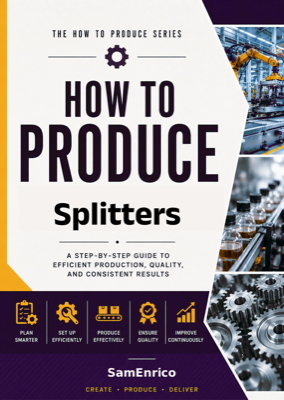
How to Produce Splitters
This publication, published by SamEnrico, covers H
This publication, published by SamEnrico, covers How to Produce Splitters
Formats
About this book
Free sample
Chapter 1: Light’s Invisible Hand...--The first lesson any engineer learns about passive optical splitters is that they are the silent, invisible workforce of the modern internet. Unlike routers that shout, amplifiers that roar, or switches that clatter with decisive clicks, a splitter does nothing more dramatic than divide light. Yet without this quiet, passive act—without the ability to take a single beam of photons and carve it into two, sixteen, or sixty-four identical streams—the fiber-optic networks that deliver streaming video, cloud computing, and global telecommunications would collapse under their own weight. This chapter reveals why understanding the production of these humble components is not merely a technical exercise but a strategic necessity for anyone building or maintaining high-speed networks.The journey begins with a seemingly simple question: What exactly is an optical splitter, and why does it matter so much? At its most fundamental level, an optical splitter is a passive device—meaning it requires no external power, no moving parts, and no active control circuitry—that takes one input optical signal and divides it among multiple output ports.
This division is not a democratic act of equal sharing in every case; some splitters intentionally create asymmetric distributions, such as 90% of the light to one port and 10% to another. But regardless of the ratio, the underlying physics remains the same: the splitter manipulates the path of light through transparent materials to create multiple copies of the original signal.The applications are everywhere in modern telecommunications. Consider a typical Passive Optical Network (PON) deployment in a suburban neighborhood. A single fiber optic cable emerges from the service provider's central office, carrying a high-power optical signal. That one fiber must serve 32 or 64 separate homes.
Without a splitter, the only alternative would be running 32 individual fibers all the way back to the central office—an economically impossible proposition that would require massive underground conduits and exponentially more expensive electronics. Instead, a 1×32 splitter mounted in a weatherproof enclosure on a utility pole divides the signal once, close to the homes, and 32 individual fibers carry the signal the final few…
This is the end of the free sample. Get the eBook to keep going. Buy now
Contents
- Chapter 1
- Chapter 2
- Chapter 3
- Chapter 4
- Chapter 5
- Chapter 6
- Chapter 7
- Chapter 8
- Chapter 9
- Chapter 10
- Chapter 11
- Chapter 12
Details
- Author
- Grice Saundra
- Publisher
- SamEnrico
- Language
- English
- Genre
- Non-Fiction, Informative, Educational
- Released
- 2026-05-11
- Pages (approx.)
- 140
- Available as
- eBook, Audiobook

Read better in the ZLOADR app
Your eBooks on your phone or tablet. Sign in with your SamEnrico account and start reading.
More by Grice Saundra
 Anniversary Loss RitualsGrice Saundra$11.99
 Racism Childhood Self EsteemGrice Saundra$11.99
 Paleo Bone Broth ProtocolGrice Saundra$11.99
 Smart Home Memory SupportGrice Saundra$11.99
 Nightmare Rescripting For Suicidal IdeationGrice Saundra$11.99
 Study Abroad Preparation GuideGrice Saundra$11.99
 Hangry Triggers GuideGrice Saundra$11.99
 Eyewitness Reform LegislationGrice Saundra$11.99
 The Black Powder Letters: Siege of Constantinople's Walls (1453)Grice Saundra$11.99
 Riding the Storm: The Untold Story of Africa's Big Wave PioneersGrice Saundra$11.99
 Understanding Transverse MyelitisGrice Saundra$11.99
 Eu Domain Corporate Trustee GuideGrice Saundra$12.99
You may also like
 Hong Kong Handover 1997Dunn Johnnie$11.99
 Zumba For Postnatal Recovery CourseNeal Christian$11.99
 Zumba for BeginnersLadner Nikia$11.99
 YouTube Comment Mining GuideHumes Pandora$12.99
 Worry Box MeditationCarlin Rudy$11.99
 Workplace Stress MeditationNguyen Lynn$11.99
 Workplace Stress and Sleep RepairHawley Ivory$11.99
 Workplace Perfectionism CureDelaney Jeffry$11.99
 Workplace Injustice Anger GuideWallen Isabelle$11.99
 Work Addiction and Burnout LinkGreenwood Ester$11.99
 Women in Yoga and WellnessBeattie Galina$11.99
 Women in Stand Up ComedyChun Evangeline$11.99