
Non-FictionInformativeEducational
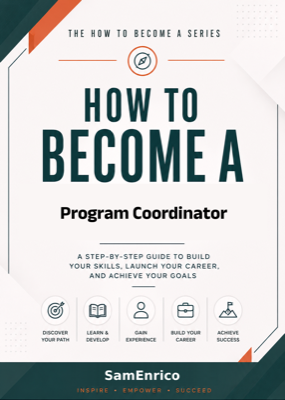
How to Become a Program Coordinator eBook
How to Become a Program Coordinator
How to Become a Program Coordinator
Formats
Free sample
Chapter 1: The Invisible Glue--–- Every organization has a role that holds everything together without anyone noticing. When this role functions perfectly, meetings start on time, documents appear when needed, stakeholders feel informed, and projects somehow stay on track. No one celebrates the person who made it happen because no one sees the work. When this role fails, chaos erupts instantly. Meetings run late or never happen.
Critical information gets lost. Deadlines slip. Stakeholders complain. And suddenly everyone wants to know who dropped the ball.This is the paradox of the Program Coordinator. You succeed by becoming invisible.
You fail by becoming visible. And yet, despite this thankless dynamic, the role is one of the most valuable—and most misunderstood—positions in modern organizations.If you are reading this book, you have likely already felt the pull toward coordination. Perhaps you are an executive assistant who realized you enjoy tracking projects more than scheduling travel. Maybe you are a team lead who keeps ending up as the person who reminds everyone about deadlines. Or you could be a recent graduate who has been told that "program coordination is a good starting point," but no one can explain what that actually means.Welcome to the club of accidental coordinators.
Most people in this role did not plan for it. They fell into it sideways, discovered they had a knack for it, and then spent years trying to explain what they do to friends and family. ("So you're like a secretary?" No. "Oh, you're a project manager?" Not exactly. "You organize things?" Closer, but still missing the point.)This chapter will decode the role that no one explains.
You will learn why the Program Coordinator is not a junior Project Manager, how programs differ from projects and portfolios, the three common archetypes of coordination work, and why your accidental path to this role is actually your greatest strength.The Misunderstood Role That Runs Everything Walk into any corporate office, university department, or non-profit organization. Ask ten people what a Program Coordinator does. You will receive ten different answers, most of them wrong.In corporate settings, Program Coordinators are often mistaken for administrative assistants. People assume they book travel, order lunch, and file paperwork. In universities, they are seen as event planners or registration clerks.
In non-profits, they are treated as grant writers or volunteer schedulers. Each of these assumptions captures a tiny piece of the role while missing the entire picture.The truth is more interesting and far more important. The Program Coordinator is the operational nexus of complex work. You are the single point where schedules, budgets, communications, risks, dependencies, and stakeholder expectations converge. You do not own the strategy, but you make strategy executable.
You do not write the code, build the product, or deliver the service, but nothing gets delivered without your coordination.Consider what happens when a Program Coordinator disappears for two weeks. Not a planned vacation with handoffs and coverage, but an unexpected absence. The first sign of trouble is usually small: a meeting invitation never gets sent, a status report goes unpublished, a stakeholder asks a question that no one answers. Within a few days, project managers start stepping on each other's toes because no one is tracking dependencies. Within a week, the program manager is drowning in administrative work instead of leading strategy.
Within two weeks, the steering committee is demanding answers about why communication has broken down.The coordinator was the glue. When the glue vanishes, everything falls apart. Yet when the glue is present and working, no one notices it at all.This invisibility is the coordinator's greatest challenge and your greatest opportunity. The challenge is that your work will go unrecognized unless you learn to document and communicate your value. The opportunity is that you will see everything.
While project managers focus narrowly on their own projects, and executives focus broadly on strategy, and team members focus deeply on tasks, you see the connections between them all. You see how Project A's delay will affect Project B's testing window. You see how a budget cut to one workstream will create a resource bottleneck elsewhere. You see how a stakeholder who was excluded from early meetings is now quietly undermining the program.This systemic visibility is a superpower. It allows you to identify problems before they become crises, to connect people who should be talking to each other, and to translate between different levels of the organization.
No one else has this view. No one else can do what you do.Why "Junior Project Manager" Is the Wrong Label The most common and most damaging misconception about the Program Coordinator is that it is an entry-level or junior version of a Project Manager. This misconception leads to three predictable failures.First, organizations hire for the wrong skills. They look for candidates with Project Management Professional certification, detailed knowledge of Gantt charts, and experience managing budgets. Then they wonder why the new hire struggles with stakeholder communication, cross-team facilitation, and the political navigation that coordination actually requires.Second, coordinators are evaluated against the wrong metrics.
They are judged on whether projects finish on time and on budget—project manager metrics—rather than on whether information flows smoothly, dependencies are tracked, and stakeholders feel informed.Third, talented coordinators leave the role feeling like failures because they cannot meet expectations that were never appropriate for their position. They assume they are bad at their jobs when the real problem is that their jobs were defined incorrectly.To understand why Program Coordinator is not a junior Project Manager, you must first understand the difference between projects, programs, and portfolios. These three concepts are often confused, yet they require fundamentally different skills and produce fundamentally different outcomes.A project is a temporary endeavor with a defined start and end date, undertaken to create a unique product, service, or result. Building a new website is a project. Organizing a one-time conference is a project.
Implementing a new software system in a single department is a project. The Project Manager is responsible for delivering the project on time, on budget, and according to scope. Success is measured by the triple constraint: time, cost, and quality.A program is a group of related projects managed in a coordinated way to obtain benefits and control not available by managing them individually. Implementing an electronic health records system across an entire hospital network is a program. It includes projects for software installation, data migration, staff training, compliance documentation, and patient portal launch.
The Program Manager focuses on benefits realization—ensuring that all these projects together produce outcomes that no single project could achieve alone. The Program Coordinator manages the operational glue between projects: dependencies, shared resources, common risks, integrated reporting, and stakeholder communications.A portfolio is a collection of programs and projects, as well as other work, that are grouped together to facilitate effective management and strategic alignment. A hospital's entire IT investment portfolio might include the electronic health records program, a cybersecurity project, a patient portal enhancement project, and a data center upgrade. The Portfolio Manager ensures that the overall mix of investments aligns with organizational strategy and delivers the best possible return.Here is…
This is the end of the free sample. Get the eBook to keep going. Buy now
About this book
Details
- Author
- Huynh Adriana
- Publisher
- SamEnrico
- Language
- English
- ISBN
- 9781505931358
- Genre
- Non-Fiction, Informative, Educational
- Released
- 2026-06-02
- Pages (approx.)
- 142
- Available as
- eBook, Paperback, Audiobook

Read better in the ZLOADR app
Your eBooks on your phone or tablet. Sign in with your SamEnrico account and start reading.
More by Huynh Adriana
 Step Seven Humility Prayer GuideHuynh Adriana$11.99
 Aspartic Acid for HGHHuynh Adriana$11.99
 Morning Mirror Self Talk PracticeHuynh Adriana$11.99
 Goal Sunk Cost Letting GoHuynh Adriana$11.99
 Uber Comfort Rides GuideHuynh Adriana$11.99
 Grief and Anger After Parent LossHuynh Adriana$11.99
 Freelance Rate NegotiationHuynh Adriana$11.99
 Daniel Dennett BiographyHuynh Adriana$11.99
 The Harmonic Crown: Florence Price and the Symphony of Black BrillianceHuynh Adriana$11.99
 The Silent Killer: How a Saudi Cyberattack Unleashed a Medical NightmareHuynh Adriana$11.99
 How to Produce Wood Stain SealerHuynh Adriana$11.99
 How to Produce Memorial UrnsHuynh Adriana$11.99
You may also like
 Hong Kong Handover 1997Dunn Johnnie$11.99
 Zumba For Postnatal Recovery CourseNeal Christian$11.99
 Zumba for BeginnersLadner Nikia$11.99
 YouTube Comment Mining GuideHumes Pandora$12.99
 Worry Box MeditationCarlin Rudy$11.99
 Workplace Stress MeditationNguyen Lynn$11.99
 Workplace Stress and Sleep RepairHawley Ivory$11.99
 Workplace Perfectionism CureDelaney Jeffry$11.99
 Workplace Injustice Anger GuideWallen Isabelle$11.99
 Work Addiction and Burnout LinkGreenwood Ester$11.99
 Women in Yoga and WellnessBeattie Galina$11.99
 Women in Stand Up ComedyChun Evangeline$11.99