
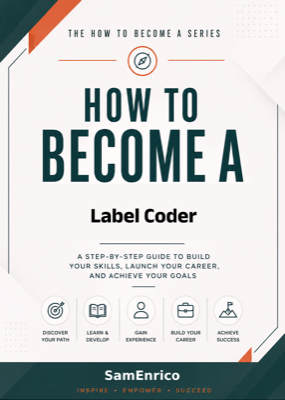
Non-FictionInformativeEducational
How to Become a Label Coder Audiobook
How to Become a Label Coder
How to Become a Label Coder
Formats
Free sample
Chapter 1: The Invisible Goldmine...--–- The email arrived at 11:47 PM on a Tuesday. Maria, a 38-year-old former call center supervisor in Detroit, had been laid off six weeks earlier when her company replaced her team with an AI chatbot. She was scrolling through job boards, half-asleep, when she saw a posting that read: “Remote Label Coder – No Experience Required – 25–25–25–45/hour.” She almost deleted it. It sounded fake. But something made her click.The job description was strange.
It talked about “teaching self-driving cars to see,” “helping chatbots understand sarcasm,” and “building the brain of artificial intelligence.” Maria had never written a line of code in her life. She didn’t have a college degree. But she had spent fifteen years listening to angry customers, deciphering what they really meant beneath the yelling, and noting down exactly what went wrong. That skill—attention to detail, pattern recognition, and patience—turned out to be worth more than she ever imagined.Three months later, Maria was making $38 per hour labeling medical transcripts, working from her kitchen table, earning more than she had as a supervisor. She wasn’t a programmer or an engineer.
She was something else entirely. She was a label coder.And she was part of a hidden goldmine that most people don’t even know exists.The Great Misunderstanding: What Most People Get Wrong About AIWhen most people think of artificial intelligence, they imagine robots, complex algorithms, or genius programmers typing arcane code in darkened rooms. Hollywood has trained us to see AI as magical—a brain in a box that simply awakens one day and knows everything. The reality is far less glamorous, far more human, and far more accessible.Here is the truth that tech companies don’t advertise: Artificial intelligence is not smart. Not really.
Every AI system you have ever used—from Google Translate to Chat GPT to the face recognition that unlocks your phone—is essentially a very fast pattern-matching machine. It has seen millions of examples of something (a cat, a sentence, a voice command), and it has learned to guess what comes next based on those examples. But here is the catch: those millions of examples don’t exist in nature. They don’t come pre-packaged. Someone has to create them.That someone is you.The technical term for this process is data annotation, but the industry increasingly calls it label coding.
The name matters because it changes how you think about the work. “Data annotation” sounds like something a librarian would…
This is the end of the free sample. Get the Audiobook to keep going. Buy now
About this book
Details
- Author
- Cardoza Marlys
- Publisher
- SamEnrico
- Language
- English
- ISBN
- 9781505750898
- Genre
- Non-Fiction, Informative, Educational
- Released
- 2026-05-11
- Pages (approx.)
- 150
- Available as
- eBook, Paperback, Audiobook

Listen in the VoxFlicks app
Audiobooks and audio dramas wherever you go. Sign in with your SamEnrico account and press play.
More by Cardoza Marlys
 Morning Workout DemographicsCardoza Marlys$11.99
 Dolphin Swim JoyCardoza Marlys$11.99
 African Union OAU BirthCardoza Marlys$11.99
 Weight Loss Affirmation GuideCardoza Marlys$11.99
 The Gacy Victim Families StatementsCardoza Marlys$11.99
 The Dragon’s Heart: A Ballad of Fire and FleshCardoza Marlys$11.99
 Understanding Müller–barth–menger SyndromeCardoza Marlys$17.99
 Radio OperatorCardoza Marlys$11.99
 AI Video Tools ComparisonCardoza Marlys$12.99
 Remote Manager Emotional IntelligenceCardoza Marlys$12.99
You may also like
 Hong Kong Handover 1997Dunn Johnnie$11.99
 Zumba For Postnatal Recovery CourseNeal Christian$11.99
 Zumba for BeginnersLadner Nikia$11.99
 YouTube Comment Mining GuideHumes Pandora$12.99
 Worry Box MeditationCarlin Rudy$11.99
 Workplace Stress MeditationNguyen Lynn$11.99
 Workplace Stress and Sleep RepairHawley Ivory$11.99
 Workplace Perfectionism CureDelaney Jeffry$11.99
 Workplace Injustice Anger GuideWallen Isabelle$11.99
 Work Addiction and Burnout LinkGreenwood Ester$11.99
 Women in Yoga and WellnessBeattie Galina$11.99
 Women in Stand Up ComedyChun Evangeline$11.99