
Non-FictionInformativeEducational
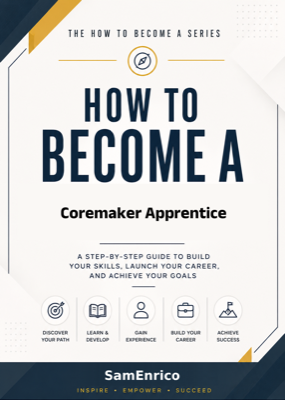
How to Become a Coremaker Apprentice eBook
How to Become a Coremaker Apprentice
How to Become a Coremaker Apprentice
Formats
Free sample
Chapter 1: The Invisible Backbone...-- When you turn the key in your car’s ignition, you expect the engine to roar to life. When you flush a toilet, you expect the water to disappear and reappear where it belongs. When a commercial airliner lifts off the runway, you trust that the turbine blades inside its engines will spin at 50,000 revolutions per minute without shattering. You have never once thought about the coremaker who made that possible. That is precisely the point.The modern world runs on hollow things.
Engine blocks are hollow so pistons can move. Valves are hollow so fluid can flow. Aircraft components are hollow so weight can be reduced. Pipes, pumps, housings, calipers, manifolds, turbines – all of them contain internal passages, chambers, and voids that give them their function. Without those carefully designed empty spaces, a car engine would be a solid brick of metal.
A faucet would be an ornament. A jet engine would be a paperweight.Someone has to create those voids. That someone is a coremaker.This chapter is not a technical manual. It is not a chemistry lesson. It is not a blueprint reading exercise.
Those will come later. This chapter is an invitation to see a hidden world – a world of sand, fire, iron, and skill that operates silently beneath the surface of modern manufacturing. It is the story of why coremaking matters, what a coremaker actually does, and why this obscure trade might be the most secure, rewarding, and surprising career you have never considered.The Casting: A Brief History of Making Things from Metal Before you can understand what a coremaker does, you must understand what a casting is – and why casting remains one of the most important manufacturing processes on earth.Casting is the art of pouring molten metal into a shaped container – called a mold – and letting it solidify. Humans have been casting metal for over 6,000 years. The Bronze Age was essentially the Casting Age.
Swords, bells, statues, tools, and weapons were all made by pouring molten bronze into clay or stone molds. The process was simple: create a hollow shape in sand or clay, pour in the hot metal, wait for it to cool, break away the mold, and reveal the finished object.That process worked perfectly for solid objects. A sword is solid. A bell is solid. A hammer head is solid.
But what if you need something that is not solid? What if you need a hollow tube? What if you need a chamber inside a block? What if you need a winding passage that carries coolant through an engine?You cannot pour metal around nothing. If you try to cast a hollow object in a simple mold, you will get a solid object.
The metal fills every space it can reach. So how do you create a void?The answer, discovered thousands of years ago and refined ever since, is the core.Defining the Core: Sand That Becomes a Shadow A core is a solid shape made of sand and binder that is placed inside a mold before the molten metal is poured. The metal flows around the core, filling the mold cavity but unable to penetrate the core itself. When the metal solidifies and the casting is removed, the core is broken or shaken out, leaving behind an empty space exactly the shape of the original core.Think of a core as a “negative” of the hole you want to create. If you want a cylindrical hole, you make a cylindrical core.
If you want a complex, curved passage that twists through an engine block, you make a core that twists through that block. The core is a ghost. It appears in the mold, does its job, and then is destroyed – shaken out as sand that can be recycled and reused.The coremaker is the person who designs, creates, assembles, and finishes those cores. Every core is a small sculpture. It must be strong enough to survive being handled, placed, and surrounded by 2,600-degree-Fahrenheit molten iron.
It must be permeable enough to allow gases to escape. It must be dimensionally accurate to within fractions of a millimeter. And it must do all of this while being made from little more than sand and glue.That is the miracle of coremaking. That is also why it is so difficult.The Critical Distinction: Moulder vs. Coremaker In any foundry, two distinct trades work side by side, and confusing them is a common mistake.The moulder creates the external shape of the casting.
The moulder builds or operates the equipment that forms the mold – the outer container that gives the casting its overall form. If you are looking at a finished engine block, the moulder is responsible for the outer surfaces: the flat mating faces, the mounting bosses, the external ribs and contours.The coremaker creates the internal voids. The coremaker makes the sand shapes that will become the cylinders, water jackets, oil passages, and every other hollow space inside the block. Without the coremaker, the engine block would be a solid lump of iron.Here is a crucial distinction that many beginners misunderstand, and it is worth stating clearly: the coremaker never sees the final hole they create. You will never hold a finished casting and point to “your” hole.
Your work is always hidden, always internal, always destroyed in the process of revealing the final product. You work in sand, not metal. Your masterpiece is a core that will be broken apart and discarded after a single use. That can be philosophically unsettling, or it can be deeply satisfying – the satisfaction of knowing that your invisible work made everything else possible.A second critical clarification: coremakers do not always place their own cores into molds. In some foundries, the coremaker produces cores and hands them to a moulder or a core setter who places them.
In other foundries, the coremaker does both. In modern automated foundries, robots may handle the placement. This book covers all three scenarios, but you should ask potential employers which model they use. Your day-to-day experience will differ significantly depending on the answer.The Unseen Universe: Where Coremakers Work Coremakers do not work in gleaming glass towers. They do not wear suits.
They do not attend Zoom calls about synergy. They work in foundries – and foundries are among the most intense industrial environments on earth.A typical foundry is a cathedral of noise, heat, and dust. The air smells of burnt sand and hot metal. The floor is concrete stained dark by decades of use. Overhead, cranes carry ladles of molten metal glowing orange-white.
Machines hammer and hiss and clatter. And somewhere in the middle of all that chaos, a coremaker stands at a bench or a machine, focused entirely on a single sand core.Foundries come in many sizes and specializations. Some are massive integrated plants employing hundreds of people, producing engine blocks for major automotive manufacturers. These are often found in the industrial belts of the United States (the Midwest), Germany (the Ruhr valley), China (the Pearl River Delta), and other manufacturing hubs.Others are small, specialized jobbing foundries that produce a few hundred castings per month for niche industries…
This is the end of the free sample. Get the eBook to keep going. Buy now
About this book
Details
- Author
- Swisher Bernita
- Publisher
- SamEnrico
- Language
- English
- ISBN
- 9781505735062
- Genre
- Non-Fiction, Informative, Educational
- Released
- 2026-05-09
- Pages (approx.)
- 137
- Available as
- eBook, Paperback, Audiobook

Read better in the ZLOADR app
Your eBooks on your phone or tablet. Sign in with your SamEnrico account and start reading.
More by Swisher Bernita
 Louisiana Slave Ship MutinySwisher Bernita$11.99
 Japanese Kamikaze SurvivorSwisher Bernita$11.99
 Metta for GuiltSwisher Bernita$11.99
 Sam's Club Origin StorySwisher Bernita$11.99
 The Phantom of Kabukicho: Tokyo's Unsolved Yakuza Massacre (1961)Swisher Bernita$11.99
 How to Produce Bottle Warmers and SterilizersSwisher Bernita$11.99
 Latin America Franchise GuideSwisher Bernita$12.99
 Client Service OfficerSwisher Bernita$11.99
You may also like
 Hong Kong Handover 1997Dunn Johnnie$11.99
 Zumba For Postnatal Recovery CourseNeal Christian$11.99
 Zumba for BeginnersLadner Nikia$11.99
 YouTube Comment Mining GuideHumes Pandora$12.99
 Worry Box MeditationCarlin Rudy$11.99
 Workplace Stress MeditationNguyen Lynn$11.99
 Workplace Stress and Sleep RepairHawley Ivory$11.99
 Workplace Perfectionism CureDelaney Jeffry$11.99
 Workplace Injustice Anger GuideWallen Isabelle$11.99
 Work Addiction and Burnout LinkGreenwood Ester$11.99
 Women in Yoga and WellnessBeattie Galina$11.99
 Women in Stand Up ComedyChun Evangeline$11.99