
Non-FictionInformativeEducational
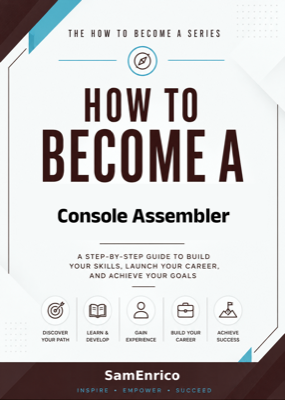
How to Become a Console Assembler eBook
How to Become a Console Assembler
by Schulze Lang
How to Become a Console Assembler
Formats
Free sample
Chapter 1: The Soldering Mind...--–- The first time I watched a professional console assembler work, I felt embarrassed. Not because I was bad at soldering—I had been building guitar pedals and fixing arcade sticks for years—but because I realized I had been confusing activity with progress. The assembler, a quiet woman named Elena who had been building medical devices before switching to gaming hardware, placed a tiny 0402 capacitor onto a board with tweezers, tacked one end with her iron, then inspected it under a microscope for three full seconds before soldering the other end. I asked why she paused. She said, “I’m checking if it’s straight.
If it’s off by a hair now, it will fail in six months.” That moment changed everything I thought I knew about assembly.This chapter is not about how to hold a soldering iron. You can learn that from a You Tube video in eight minutes. This chapter is about why you will fail if you only learn that. Becoming a console assembler—whether you want to repair classic NES consoles, build custom Game Boys, or assemble prototype handhelds for a startup—requires a complete mental shift. You must stop thinking like a hobbyist who celebrates “it works” and start thinking like a professional who asks “for how long?” and “under what conditions?” and “how many of them will survive?”Let me tell you a story.
A few years ago, a small company launched a Kickstarter for a retro-inspired handheld console. They raised over a million dollars. The prototypes worked beautifully. The production units? Forty percent failed within three months.
The company collapsed. The post-mortem revealed that the assemblers—well-meaning hobbyists hired for the job—had never learned the difference between a “functional” solder joint and a “reliable” one. Their joints passed a continuity test but failed thermal cycling. When the consoles heated up during gameplay and cooled down overnight, microscopic cracks formed. Every joint looked fine under a loupe.
But under a microscope? The evidence was undeniable: cold solder joints, insufficient wetting, and flux residue that became conductive over time.That company’s failure was not a soldering problem. It was a mindset problem.The Three Pillars of Professional Assembly Professional console assembly rests on three pillars. Every technique, every tool, and every test in this book serves one or more of these pillars. If you internalize nothing else from this chapter, remember these three words: Reliability, Repeatability, and Root Cause.Reliability means your work survives real-world conditions: heat, cold, vibration, humidity, and time.
A console that works on your bench at 22°C but crashes when played on a hot summer day is not reliable. A solder joint that conducts electricity today but cracks after fifty thermal cycles is not reliable. Reliability is measured in hours of operation, not in “it turned on.”Repeatability means you can do the same task the same way a hundred times in a row, and the hundredth joint is indistinguishable from the first. Hobbyists often celebrate their best work. Professionals are judged by their worst work, because that worst joint is the one that will fail.
Repeatability requires process control: the same iron temperature, the same tip shape, the same flux application, the same inspection criteria, every single time.Root Cause means when something fails, you do not just fix it and move on. You ask why it failed. You trace the failure to its origin—a bad batch of capacitors, a contaminated PCB, a technician who skipped a step—and you correct the system, not just the symptom. Without root cause analysis, the same failure will recur. With it, you improve not only your own work but the entire assembly process.These three pillars separate the hobbyist from the professional.
They are the foundation of every chapter that follows.Why “Good Enough” Is Never Good Enough I want to spend a moment on something uncomfortable. If you are reading this book, you probably consider yourself a competent solderer. You may have built keyboards, modded controllers, or repaired vintage consoles. You have a favorite iron and a drawer full of tips. And you have likely said the phrase “good enough” at some point when a joint looked a little dull, a component sat slightly crooked, or you skipped cleaning the board because it was late.That phrase will destroy your career as a console assembler.“Good enough” is the enemy of reliability.
In consumer electronics, the difference between a product that lasts two years and one that lasts ten years is often a handful of decisions made at the assembly bench. A capacitor placed 2mm too far from its regulator? The trace inductance increases, ripple voltage goes up, and the chip runs hotter. A connector soldered with insufficient heat? The joint looks fine but cracks after a few insertions.
A board not cleaned of flux? Over time, some fluxes become slightly conductive or corrosive, leading to intermittent failures that are nearly impossible to diagnose.The professionals I have worked with over the years share one trait: they are mildly obsessive. They clean boards even when no one is watching. They inspect every joint under magnification. They measure critical voltages before sealing the case.
They keep logs of their work. Not because they enjoy paperwork, but because they have learned—often the hard way—that shortcuts taken at the bench become warranty claims returned by mail.Let me give you a concrete example. A friend of mine assembled fifty handheld consoles for a small production run. He tested each one, and all fifty passed. He shipped them.
Six months later, nine had failed. The symptom was identical: intermittent power loss. When he opened the failed units, he found that the battery connector—a through-hole JST header—had been soldered with a technique that looked fine but had not fully flowed solder to the top side of the PCB. The joint had only wetted the barrel on the bottom. It passed a continuity test because the connector pins were still contacting the plated through-hole.
But after repeated battery swaps and the vibration of normal use, the mechanical connection loosened. That failure was not a design problem. It was an assembly problem caused by rushing through the through-hole step because “it’s just a battery connector, how hard can it be?”The Hidden Cost of Rework Every minute you spend reworking a defective board is a minute you are not building new ones. But the cost of rework goes far beyond time.When you rework a board, you subject it to additional thermal stress. Each time you apply heat to a PCB, you risk delaminating the board, damaging adjacent components, or lifting pads.
A board that is reworked once is statistically less reliable than a board that passed first-pass assembly. A board that is reworked twice is a candidate for the scrap bin.Professional assembly lines measure First Pass Yield (FPY)—the percentage of boards that pass all tests without any rework. A good FPY for manual assembly of complex boards is 90-95%. An excellent FPY is 98% or higher. Every point of FPY is directly tied to your attention to detail, your process control, and…
This is the end of the free sample. Get the eBook to keep going. Buy now
About this book
Details
- Author
- Schulze Lang
- Publisher
- SamEnrico
- Language
- English
- ISBN
- 9781505808032
- Genre
- Non-Fiction, Informative, Educational
- Released
- 2026-06-02
- Pages (approx.)
- 145
- Available as
- eBook, Paperback, Audiobook

Read better in the ZLOADR app
Your eBooks on your phone or tablet. Sign in with your SamEnrico account and start reading.
More by Schulze Lang
 Dreams And Self Harm TraumaSchulze Lang$11.99
 The Syndication Fee Structures GuideSchulze Lang$11.99
 Career Decision Dream Incubation CourseSchulze Lang$11.99
 DBT For Pregnancy LossSchulze Lang$11.99
 The ADHD Student Stress GuideSchulze Lang$11.99
 The Windward Kings: How the Dutch Shaped the SeasSchulze Lang$11.99
 Lube TechSchulze Lang$11.99
 US Inflation Reduction Act CreditsSchulze Lang$12.99
 Pop Up Case Study LondonSchulze Lang$12.99
 Understanding Teebi–shaltout SyndromeSchulze Lang$17.99
You may also like
 Hong Kong Handover 1997Dunn Johnnie$11.99
 Zumba For Postnatal Recovery CourseNeal Christian$11.99
 Zumba for BeginnersLadner Nikia$11.99
 YouTube Comment Mining GuideHumes Pandora$12.99
 Worry Box MeditationCarlin Rudy$11.99
 Workplace Stress MeditationNguyen Lynn$11.99
 Workplace Stress and Sleep RepairHawley Ivory$11.99
 Workplace Perfectionism CureDelaney Jeffry$11.99
 Workplace Injustice Anger GuideWallen Isabelle$11.99
 Work Addiction and Burnout LinkGreenwood Ester$11.99
 Women in Yoga and WellnessBeattie Galina$11.99
 Women in Stand Up ComedyChun Evangeline$11.99