
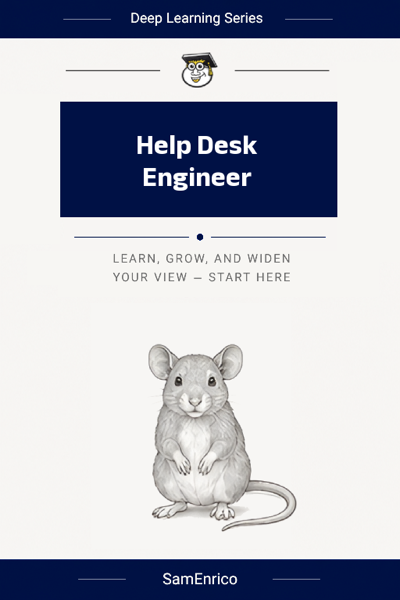
Non-FictionInformativeEducational
Help Desk Engineer eBook
A Coursebook on Help Desk Engineer
by Maki Eliseo
A Coursebook on Help Desk Engineer
Formats
Free sample
Chapter 1: The Great Reinvention--–- The first lie you will hear about the help desk is that it is a dead-end job. The second lie is that it requires no real skill. The third—and most dangerous—lie is that anyone can do it.If you are reading this book, you have likely encountered at least one of these falsehoods. Perhaps a well-meaning relative asked, “So you’re just answering phones?” Perhaps a college advisor steered you toward “something more prestigious” like software development or project management. Perhaps you have been working the help desk for six months and already feel the creeping dread of irrelevance—the sense that you are a human ticket-processing machine, destined to reset passwords until your soul dissolves.Let me stop you right there.The help desk is not a consolation prize.
It is not a punishment for not knowing how to code. It is not a holding cell for IT generalists who lack ambition. In fact, the opposite is true. The help desk is the only role in information technology that forces you to develop three distinct skill sets simultaneously: technical depth, customer-facing communication, and systems-level thinking. No other IT role—not network engineering, not cybersecurity, not cloud architecture—demands this trifecta.
And that is precisely why the help desk is the single best launching pad for a long, varied, and lucrative career in technology.But here is the catch: you have to stop thinking like a ticket-taker and start thinking like an engineer.The Title Is a Promise, Not a Rank Before we go any further, let us resolve a confusion that has derailed more help desk careers than any technical failure. The title of this book is Help Desk Engineer. You might be asking yourself: “But my badge says ‘Help Desk Technician.’ My offer letter said ‘IT Support Analyst.’ My company calls us ‘Service Desk Associates.’ So who exactly is an engineer?”The answer is both simpler and more radical than you expect.The word “engineer” in this context is not a job title. It is a mindset. It is a declaration of how you approach problems, how you document solutions, how you communicate with users, and how you see your role within the larger IT ecosystem.
A ticket-taker resets a password and moves on. An engineer resets the password, documents why the password expired prematurely, checks whether the account lockout policy aligns with business needs, and sends a one-paragraph recommendation to the identity management team. The ticket-taker escalates the printer issue to second-line support. The engineer spends fifteen minutes ruling out the top three causes—paper jam, out-of-tray, corrupted driver—before escalating with a detailed note that saves the second-line team forty-five minutes.Throughout this book, when I say “help desk engineer,” I mean you—provided you are willing to adopt this mindset. You do not need a degree in computer engineering.
You do not need a certification that costs two thousand dollars. You need curiosity, discipline, and the willingness to see every support call as a puzzle, not a nuisance.That said, we need to be honest about how the industry actually works. Many organizations distinguish between first-line support (triage, password resets, basic troubleshooting) and second-line support (deep-dive diagnosis, system configuration, complex repairs). Some companies reserve the title “Engineer” for second-line or even third-line roles. Other companies call everyone “analysts” regardless of skill level.
The job market is a mess of inconsistent titles, and Chapter 11 will teach you exactly how to navigate that chaos on your resume and in interviews.For now, the only thing that matters is this: whether you are first-line or second-line, whether your badge says “Specialist” or “Analyst” or “Associate,” you can act like an engineer. And acting like an engineer is what gets you promoted.The Strategic Heart of ITLet me tell you a story that every help desk professional should hear.In 2016, a regional hospital network in the Midwest suffered a ransomware attack that encrypted patient records across three facilities. The breach did not start with a sophisticated zero-day exploit or a nation-state actor. It started with a help desk call. A receptionist in the cardiology department received an email that looked like it came from the hospital’s HR platform.
She clicked a link. Nothing seemed to happen. Two hours later, she called the help desk to report that “her computer was acting weird.”The first-line technician who answered that call had two choices. He could follow the standard script: reboot, scan for viruses, escalate if the problem persists. Or he could recognize the pattern.
He had taken a ransomware awareness module three months earlier. He remembered the telltale signs: slow performance, weird file extensions, a pop-up he had never seen before. Instead of rebooting, he isolated the machine from the network, escalated immediately to security, and triggered the incident response protocol. The hospital lost one workstation instead of three facilities.That technician was twenty-two years old. He had been on the help desk for eight months.
He had no security certification. He had no degree. He had simply been paying attention.The help desk is not a cost center. It is not a necessary evil. It is the immune system of every organization that depends on technology—which is to say, every organization that intends to exist next year.
You are the first person to hear about the weird email, the slow login, the application that crashed for no reason. You are the earliest possible warning system for problems that could become catastrophes. And you are the face of IT for every single employee in the company. When you solve a problem quickly and kindly, the user thinks, “IT is great.” When you are dismissive or slow, they think, “IT is useless.” You carry the entire department’s reputation on every call.That is not a low-skill job. That is not a dead end.
That is a position of enormous strategic importance—and the organizations that understand this pay accordingly.What You Will Actually Do (And What You Will Not)Let us clear away some romantic illusions. You will not spend your days hacking into mainframes or tracing packets across fiber-optic backbones. You will not be the hero who saves the company from a cyberattack every Tuesday before lunch. The reality of help desk work is more mundane—and that is precisely why it requires an engineer’s discipline.Here is what you will actually do, day in and day out:You will reset passwords. So many passwords.
Passwords for people who have been told twelve times how to use the self-service portal. Passwords for the vice president who refuses to use the self-service portal because “that’s what IT is for.” Passwords for the intern who locked herself out three times before lunch. Password resets are not glamorous, but they are the single highest-volume ticket type at almost every help desk. An engineer does not complain about password resets. An engineer optimizes them—creating templates, suggesting self-service improvements, tracking patterns that might indicate a brute-force attack.You will troubleshoot printing.
Printers are the undisputed champions of help desk frustration. They jam. They run out of toner at 4:45 PM on a…
This is the end of the free sample. Get the eBook to keep going. Buy now
About this book
Details
- Author
- Maki Eliseo
- Publisher
- SamEnrico
- Language
- English
- Genre
- Non-Fiction, Informative, Educational
- Released
- 2026-06-02
- Pages (approx.)
- 152
- Available as
- eBook, Audiobook

Read better in the ZLOADR app
Your eBooks on your phone or tablet. Sign in with your SamEnrico account and start reading.
More by Maki Eliseo
 Values And Mission Alignment Board GovernanceMaki Eliseo$11.99
 Binge Eating Relapse PreventionMaki Eliseo$11.99
 Retail Therapy Alternatives CourseMaki Eliseo$11.99
 Digital Dream Diary App GuideMaki Eliseo$11.99
 Evening Wind Down MeditationMaki Eliseo$11.99
 The Poisoned Chalice: The Deadly Legacy of the Middle East's First Forensic ToxicologistMaki Eliseo$11.99
 How to Start a Shopping Bags Made of Plastic (designed for Prolonged Use) Business (Beginners Guide)Maki Eliseo$11.99
 Understanding Conductive Deafness Malformed External EarMaki Eliseo$17.99
 Pricing For Low Income UsersMaki Eliseo$12.99
 Disability Support ServicesMaki Eliseo$12.99
You may also like
 Hong Kong Handover 1997Dunn Johnnie$11.99
 Zumba For Postnatal Recovery CourseNeal Christian$11.99
 Zumba for BeginnersLadner Nikia$11.99
 YouTube Comment Mining GuideHumes Pandora$12.99
 Worry Box MeditationCarlin Rudy$11.99
 Workplace Stress MeditationNguyen Lynn$11.99
 Workplace Stress and Sleep RepairHawley Ivory$11.99
 Workplace Perfectionism CureDelaney Jeffry$11.99
 Workplace Injustice Anger GuideWallen Isabelle$11.99
 Work Addiction and Burnout LinkGreenwood Ester$11.99
 Women in Yoga and WellnessBeattie Galina$11.99
 Women in Stand Up ComedyChun Evangeline$11.99