
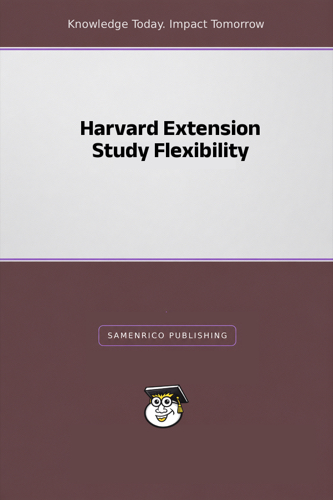
Non-FictionStudent's ShortcutTime Management
Harvard Extension Study Flexibility eBook
Design a part-time schedule around work and family
Design a part-time schedule around work and family with HES's asynchronous options.
Formats
Free sample
Chapter 1: The Parking Lot Epiphany--It was 11:17 PM on a Tuesday when I found myself sobbing in a grocery store parking lot, a half-melted pint of ice cream melting into my passenger seat, my phone buzzing with a Slack message from my boss that began with the words “Let’s talk tomorrow.” My three-year-old had a fever. My midterm was due in forty-three hours. I had not read a single page of the assigned 200 pages. And in that moment, I was absolutely certain of only one thing: I had made a terrible mistake.I had enrolled at Harvard Extension School believing I was different. I believed that my organizational skills, my caffeine tolerance, and my sheer force of will would bend the universe to my schedule.
I had read the blog posts about working adults earning degrees. I had watched the inspirational You Tube videos of parents walking across graduation stages with toddlers on their hips. I had convinced myself that I would simply “find the time” because I wanted it badly enough.The parking lot taught me otherwise.Time is not found. Time is not discovered under couch cushions or behind forgotten calendar invites. Time is not something that reveals itself when you want something badly enough.
Time is built. It is excavated from the bedrock of existing commitments. It is framed and reinforced like a load-bearing wall. And if you do not learn how to build it intentionally, you will collapse under the weight of everything you are trying to carry.This chapter exists because the parking lot moment nearly broke me. But it also saved me.
Because in that moment of absolute failure, I stopped believing the myth that had been selling me false hope for years: the myth that a “slow season” at work, a quieter phase of parenting, or a miraculously empty calendar was just around the corner. That myth is a trap. And if you are reading this book, you have likely fallen into it too.Let me show you how to climb out.The Most Dangerous Myth in Adult Education The myth sounds reasonable. It sounds responsible, even wise. Here is how it whispers to you: “I will start my degree when things calm down at work.” “I will take that class when the kids are older.” “I will apply to the program after this big project ends.” “I will write my thesis when I am less exhausted.”These are not plans.
These are prayers.And prayers, however sincere, do not build schedules.Drawing from David Allen’s Getting Things Done and Stephen Covey’s The 7 Habits of Highly Effective People, we must confront an uncomfortable truth: the “slow season” does not exist for working adults. Not really. Not in the way you imagine. Work does not get less demanding; the demands merely change shape. Children do not need less attention; they need different kinds of attention at different ages.
Your energy does not replenish itself while you wait for perfect conditions.What actually happens when you wait for the slow season is this: you wake up three years later, still without a degree, still feeling the same gnawing regret, and now you are also three years older. The time passed regardless. You just chose not to use it.The students who successfully complete part-time degrees at Harvard Extension School are not the ones who had more time. They are the ones who stopped waiting to find time and started building it.The Reactive Schedule vs. The Time Architect Before we go any further, I need you to look at your calendar.
Not the one you wish you had. The real one. The one with the back-to-back meetings, the pediatrician appointments, the carpool pickups, the late-night work emergencies, the social obligations you said yes to because you felt guilty saying no.Now ask yourself a brutal question: Who designed this calendar?For most working adults, the honest answer is “no one.” Or more accurately, “everyone else.” Your boss designed the meeting blocks. Your children’s schools designed the drop-off and pick-up times. Your spouse’s schedule dictated the dinner hour.
Your friends designed the weekend gatherings. Your email inbox dictated your morning routine. You have been living in a calendar designed by committee—a committee that did not include you as a voting member.That is the reactive schedule. It responds. It accommodates.
It says “yes” to everything and then collapses under the weight of its own generosity. The reactive schedule feels like being busy. It feels like being responsible. But it is actually a form of passivity disguised as diligence.The alternative is the time architect mindset.A time architect does not wait for the calendar to happen to them. They design the calendar before it fills itself.
They protect blocks of time with the same ferocity that a parent protects a sleeping baby. They understand that every “yes” to one thing is a “no” to something else—and they make those trade-offs consciously, not by default.Here is the distinction in practice:Reactive Schedule Time Architect“I will study when I have time.”“I will study Tuesday and Thursday from 6-8 AM, and Saturday from 7-10 AM. Those blocks are non-negotiable.”“I will catch up on readings this weekend.”“I have already scheduled my 2-hour reading blocks for Sunday morning. My family knows I am unavailable.”“I missed my study time because something came up.”“Something always comes up. That is why I built buffer days into my semester plan.”“I am so busy.”“I am intentional.”The shift from reactive to architect is not about having more hours in the day.
It is about claiming the hours you already have before someone else claims them for you.The HES Angle: What Asynchronous Actually Means If you are reading this book, you have likely heard that Harvard Extension School offers “asynchronous” options. You may have been told that this means flexibility. And that is true—but not in the way most people assume.Let me be very clear about what asynchronous learning is and is not.Asynchronous does not mean less work. The 4-credit course at HES still requires 12-15 hours of your time per week. The reading is still dense.
The writing expectations are still rigorous. The exams are still challenging. The only thing that changes is when you do that work.Asynchronous does not mean self-paced in the way a meditation app is self-paced. You still have deadlines. You still have discussion posts due on Wednesdays.
You still have papers due on specific Sundays at 11:59 PM Eastern Time. You cannot simply “get to it whenever.” The structure is still there; it just does not require you to be on a live Zoom call at a fixed hour.What asynchronous actually means is this: you have the radical freedom to choose which 15 hours per week you dedicate to deep learning, not whether you dedicate 15 hours.That is a crucial distinction. If you are a morning person, you can study from 5-8 AM before your children wake up. If you are a night person, you can study from 9 PM to midnight after they go to sleep. If you work a…
This is the end of the free sample. Get the eBook to keep going. Buy now
About this book
Details
- Author
- Silvia Kristal
- Publisher
- SamEnrico
- Language
- English
- Genre
- Non-Fiction, Student's Shortcut, Time Management
- Released
- 2026-06-06
- Pages (approx.)
- 155
- Available as
- eBook, Audiobook

Read better in the ZLOADR app
Your eBooks on your phone or tablet. Sign in with your SamEnrico account and start reading.
More by Silvia Kristal
 Jungle Explorer Sloth RescueSilvia Kristal$11.99
 Glacier National Park's MissingSilvia Kristal$11.99
 Disorganized Attachment RecoverySilvia Kristal$11.99
 When the Sky Split: The Maori Birth of Te Pō and Te AoSilvia Kristal$11.99
 The Frozen Summit: Jesuit Scientists and the Secrets of the AndesSilvia Kristal$11.99
 Understanding Hordnes–engebretsen–knudtson SyndromeSilvia Kristal$17.99
 Security Awareness Training OutlookSilvia Kristal$12.99
 Analytics Goal And Event PrimerSilvia Kristal$12.99
 Pallet Jack Operation (Powered)Silvia Kristal$11.99
You may also like
 Hong Kong Handover 1997Dunn Johnnie$11.99
 Zumba For Postnatal Recovery CourseNeal Christian$11.99
 Zumba for BeginnersLadner Nikia$11.99
 YouTube Comment Mining GuideHumes Pandora$12.99
 Worry Box MeditationCarlin Rudy$11.99
 Workplace Stress MeditationNguyen Lynn$11.99
 Workplace Stress and Sleep RepairHawley Ivory$11.99
 Workplace Perfectionism CureDelaney Jeffry$11.99
 Workplace Injustice Anger GuideWallen Isabelle$11.99
 Work Addiction and Burnout LinkGreenwood Ester$11.99
 Women in Yoga and WellnessBeattie Galina$11.99
 Women in Stand Up ComedyChun Evangeline$11.99