
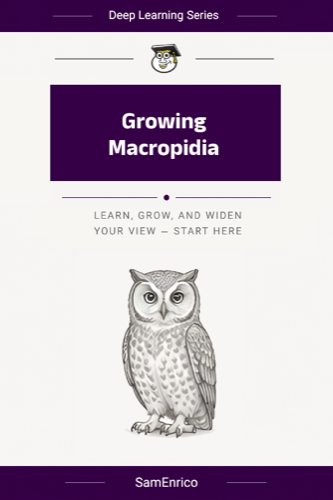
Non-FictionInformativeEducational
Growing Macropidia eBook
This publication, published by SamEnrico, covers G
by Andre Matha
This publication, published by SamEnrico, covers Growing Macropidia
Formats
Free sample
Chapter 1: The Flower That Shouldn't Exist--– In the summer of 1838, a young botanist named John Lindley sat in a London herbarium, staring at a pressed flower that had traveled 12,000 miles from the southwestern edge of Australia. The specimen was unlike anything he had ever seen. Its stem rose nearly a meter tall, clothed in woolly brown hairs. At its tip, a cluster of flowers unfolded in a color combination that Lindley initially thought was a mistake in preservation: deep, velvety black against a striking lime-green. No other member of the vast Haemodoraceae family had ever produced a black flower.
No other monocot, for that matter, had produced anything quite like it. Lindley named it Macropidia fuliginosa—from the Greek makros (long) and pous (foot), referring to the elongated flower stem, and the Latin fuliginosa (sooty or smoky), a nod to that impossible black.For nearly two centuries since that moment, gardeners have been chasing that same impossibility. The Black Kangaroo Paw, as it came to be known, has lured collectors across oceans, emptied wallets, filled graveyards of failed specimens, and sparked an obsession that borders on botanical masochism. This is the flower that shouldn't exist. And yet, in a narrow band of gravelly, ironstone-rich soil in Western Australia's Jarrah Forest and Mallee regions, it not only exists but thrives—on its own terms, in its own time, indifferent to the desires of the humans who try to tame it.This chapter is not about how to grow Macropidia.
That comes later. First, you must understand why this plant is different—not just difficult, but fundamentally unlike any other Kangaroo Paw, any other perennial, any other plant you have ever grown. Understanding its origins, its evolutionary isolation, its ecological stubbornness, and its ethical vulnerabilities is the foundation upon which every successful cultivation attempt is built. Without this understanding, you are not a grower. You are merely a gravedigger with good intentions.The Mystique of the Black Flower Black is not a common color in the plant kingdom.
True black—not deep maroon, not dark purple, not chocolate brown, but black—appears in fewer than one percent of flowering plants. When it does appear, it almost always serves a singular evolutionary purpose: heat absorption. In the harsh, sun-blasted landscapes where black flowers evolve, the dark pigment (usually concentrated anthocyanins) raises the temperature of the reproductive organs, encouraging pollinator activity in cold mornings or attracting specific insects that prefer warm landing surfaces.But Macropidia's black is different. It is not a heat trap—Western Australia's spring temperatures are mild, rarely cold enough to require thermal assistance. Instead, botanists now believe the black-green contrast serves as a visual beacon for the flower's primary pollinator: a specific species of honeyeater bird (Phylidonyris novaehollandiae), the New Holland Honeyeater.
These birds see ultraviolet light, and in UV, the black flower creates a stark silhouette against the bright green perianth, visible from astonishing distances across open heathland.This is the first lesson of Macropidia: nothing about this plant is accidental. Every adaptation, every quirk, every maddening requirement has been honed over millions of years of isolation. When you fail to grow it, you are not failing as a gardener. You are failing to replicate the precise conditions of a very specific, very ancient corner of the world.The mystique, then, is not manufactured by horticultural marketing. It is earned.
Macropidia is the holy grail of Australian native plants not because it is rare in cultivation (though it is), not because it is expensive (though it can be), but because it demands that you understand it. You cannot brute-force this plant with fertilizer, coddle it with too much water, or ignore it with neglect. It requires precision, patience, and a certain humility—the willingness to admit that nature knows more than you do.The Geographic Prison: Where Macropidia Comes From (And Why It Refuses to Leave)Open a map of Western Australia. Find Perth on the coast, then trace your finger south and east toward the Stirling Range. Between the 30th and 35th parallels south, you will find a region roughly 200 kilometers long and 50 kilometers wide.
This is the entire natural range of Macropidia fuliginosa. In botanical terms, this is called a "restricted endemic"—a species that exists nowhere else on Earth, not in similar climates, not in adjacent soil types, not in botanical gardens without human intervention.The specific habitat is known as the Jarrah Forest bioregion, named for the towering Eucalyptus marginata (Jarrah) trees that dominate the canopy. But Macropidia does not grow under those trees. It grows in the clearings, the gravelly slopes, the ancient lateritic plateaus where the soil is thin, acidic, and sharp as broken glass. Laterite—the word comes from the Latin later, meaning brick—is a weathered ironstone formation that forms in tropical and subtropical regions over millions of years.
In Western Australia, these lateritic soils are among the oldest on Earth, some dating back 100 million years, leached of nearly all nutrients except iron and aluminum.Here is what you need to understand about lateritic gravel: water does not pool on it. Water does not soak into it slowly. Rain hits the surface, and within seconds, it has percolated downward through the coarse particles, disappearing into the subsoil or running off entirely. A Macropidia growing in its native habitat receives perhaps 600-800mm of winter rainfall annually, but the soil holds moisture for only a few hours after each storm. The rhizome—that thickened underground stem—is the plant's water reservoir, storing what little it can capture during the wet season to survive the bone-dry summer months.This is the geographic prison.
Macropidia evolved in a place where summer rain almost never falls (December through February in the Southern Hemisphere), where winter is the growing season, where soil fertility is laughably low, and where competition from other plants is limited by the harshness of the environment. Take it out of that context, and you are essentially asking a desert fish to live in a tropical aquarium. It can be done. But the water must be right. The temperature must be right.
The food must be withheld. Everything must be exactly the opposite of what your gardening intuition tells you.A Genus of One: The Evolutionary Divergence To understand why Macropidia will not hybridize with its more famous cousin Anigozanthos—a point of confusion we will return to throughout this book—you need to understand evolutionary time scales.The family Haemodoraceae (the bloodroots, named for the red pigment in their roots) split from its common ancestor with other monocots roughly 100 million years ago, shortly after the breakup of the supercontinent Gondwana. As Australia drifted north, isolating its flora from Africa, South America, and Antarctica, the Haemodoraceae diversified into roughly fourteen genera, including Anigozanthos (the standard Kangaroo Paws) and Macropidia.But here is where the story diverges. Anigozanthos continued to diversify, producing roughly eleven species and countless natural hybrids across a wide range of Western Australian habitats. Macropidia did not.
Genetic analysis suggests that Macropidia fuliginosa has remained essentially unchanged for at least 10 million years. It is a living fossil, a relic of a time when Australia was wetter, greener, and home to…
This is the end of the free sample. Get the eBook to keep going. Buy now
About this book
Details
- Author
- Andre Matha
- Publisher
- SamEnrico
- Language
- English
- Genre
- Non-Fiction, Informative, Educational
- Released
- 2026-05-06
- Pages (approx.)
- 137
- Available as
- eBook, Audiobook

Read better in the ZLOADR app
Your eBooks on your phone or tablet. Sign in with your SamEnrico account and start reading.
More by Andre Matha
 The MBSR for Migraine ReliefAndre Matha$11.99
 Speech Impediment Self EsteemAndre Matha$11.99
 Sales Active Listening GuideAndre Matha$11.99
 Douglas Dynasty - Michael DouglasAndre Matha$11.99
 Environment Creativity BoostAndre Matha$11.99
 Plyometric Injury PreventionAndre Matha$11.99
 Wholesaling PPC Ads GuideAndre Matha$11.99
 Left Lane Aggression GuideAndre Matha$11.99
 Forgiveness Without ChangeAndre Matha$11.99
 The Edge of the Sky: Wiley Post's Perilous Quest for the StratosphereAndre Matha$11.99
 Rhythm in the Shadows: The Untold Story of Pina Bausch's Wuppertal RevolutionAndre Matha$11.99
 Phaëthon’s Fall: The Sun Chariot DisasterAndre Matha$11.99
You may also like
 Hong Kong Handover 1997Dunn Johnnie$11.99
 Zumba For Postnatal Recovery CourseNeal Christian$11.99
 Zumba for BeginnersLadner Nikia$11.99
 YouTube Comment Mining GuideHumes Pandora$12.99
 Worry Box MeditationCarlin Rudy$11.99
 Workplace Stress MeditationNguyen Lynn$11.99
 Workplace Stress and Sleep RepairHawley Ivory$11.99
 Workplace Perfectionism CureDelaney Jeffry$11.99
 Workplace Injustice Anger GuideWallen Isabelle$11.99
 Work Addiction and Burnout LinkGreenwood Ester$11.99
 Women in Yoga and WellnessBeattie Galina$11.99
 Women in Stand Up ComedyChun Evangeline$11.99