
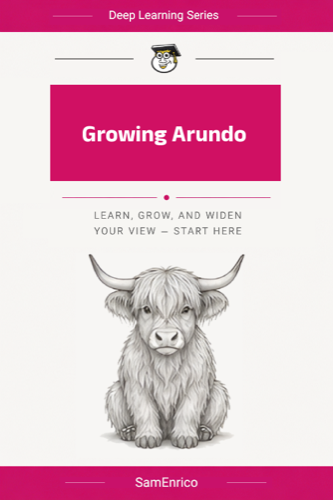
Non-FictionInformativeEducational
Growing Arundo eBook
This publication, published by SamEnrico, covers G
This publication, published by SamEnrico, covers Growing Arundo
Formats
Free sample
Chapter 1: The Green Menace...--I did not intend to become an expert on the world's most controversial plant. It happened the way most accidental obsessions do—slowly at first, then all at once, with muddy boots, a torn rotator cuff, and a certified letter from the county agricultural commissioner that I still keep framed in my office as a reminder of my own hubris.The year was 2017. I had just purchased twelve acres of what the real estate agent generously called "land with potential" and what my wife accurately called "a eroded gully with a meth lab shed." The property sat along a seasonal creek in Northern California's Sonoma County, priced so low that I should have recognized the curse immediately. But I was a permaculture enthusiast, full of the kind of confidence that comes from reading twenty books and actually growing things for maybe two seasons. I had built a few herb spirals, managed a modest vegetable garden, and once kept a sourdough starter alive for nearly four months.
In my mind, I was practically John Jeavons.The creek had a problem. Or rather, the creek was the problem. For as far as I could walk upstream and downstream, the banks were choked with what the neighbors called "bamboo" and what the county would later call "a public nuisance requiring immediate abatement." The plant stood fifteen to twenty feet tall, with hollow green canes as thick as my wrist and leaves that whispered in the wind with an almost menacing rustle. It formed impenetrable walls along the waterway, blocking access to the creek, crowding out everything else, and shedding so much leaf litter that the water ran brown for weeks each autumn."That," my neighbor Harold told me, leaning on a fence post that had seen better decades, "is the devil's cane. You cut it, it grows back twice as thick.
You burn it, it laughs at you. I've been fighting it for thirty years, and I'll die fighting it."I looked at the plant. I looked at my erosion-gullied property. I looked at the notebook where I had scribbled "biomass potential???" with multiple question marks."I think," I said slowly, "I'm going to grow it on purpose."Harold stared at me for a long moment. Then he spat tobacco juice into the dust, turned around, and walked back into his house without another word.
He didn't speak to me for the next eighteen months. When he finally broke his silence, it was to say, "Told you so."This book is the story of what happened next. It is also a confession, a warning, and a practical guide. I am not a botanist. I do not have a Ph D in plant sciences.
I am a moderately stubborn person with a shovel, an internet connection, and a talent for learning things the hard way. In the pages that follow, I will tell you everything I learned about Arundo donax—the plant with a thousand names and a single, relentless will to live.But first, you need to understand what this plant actually is, why humans have carried it across continents for millennia, and why it now inspires everything from industrial greed to environmental holy war. You need to understand the paradox at the heart of this book: Arundo donax may be the most useful plant you have never heard of, and also one of the most dangerous.Let me introduce you properly.What Arundo Is (And What It Absolutely Is Not)Walk up to an Arundo donax for the first time, and your brain will deliver an immediate, confident verdict: bamboo. The tall, segmented canes. The dense clumping growth habit.
The rustling leaves. The way it forms thickets you can get lost in. Every single person who sees my plantings for the first time says the same thing: "Wow, that's some bamboo you've got there."They are wrong.Arundo donax is not bamboo. It is not even closely related to bamboo. The confusion is understandable—both are tall, woody grasses with hollow stems and segmented nodes—but the difference matters.
Bamboo belongs to the tribe Bambuseae, a group of grasses that evolved woody stems and complex rhizome systems independently. Arundo belongs to the tribe Arundineae, making it a much closer relative of common reeds (Phragmites) and pampas grass than of bamboo.The distinctions are more than academic. Bamboo flowers on predictable cycles, sometimes once a century, and spreads through two distinct types of rhizomes (running and clumping). Arundo flowers rarely and produces seed that is almost universally sterile in cultivation. Bamboo has a reputation (deserved or not) for being manageable with proper barriers.
Arundo has a reputation for escaping containment and colonizing entire watersheds. Bamboo is a beloved garden ornamental. Arundo is listed as a noxious weed in more than a dozen US states and multiple countries.Let me give you the botanical facts. Arundo donax is a perennial grass in the family Poaceae, subfamily Arundinoideae. It produces thick, hollow canes (culms) that can reach thirty feet in height and one inch in diameter at the base.
The canes are divided by nodes every six to twelve inches, with leaves emerging from these nodes in alternating directions. The leaves are long and lance-shaped, blue-green in color, two to three feet in length, and rough to the touch along the edges. The root system consists of two components: fibrous roots that draw water and nutrients from the soil, and rhizomes—thick, knobby underground stems that store energy and produce new shoots.The rhizomes are the key to everything. They look like something between a ginger root and a fossilized sea creature, with knuckles and buds and a disturbing ability to regenerate from fragments as small as a thumbnail. I once left a pile of Arundo rhizomes on a concrete pad for three weeks, intending to burn them.
When I finally returned, they had grown new shoots through cracks in the concrete. The plant had found a way to eat through pavement. I am not exaggerating for effect. I have photographs.A Brief History of Humanity's Favorite Invasive Grass The native range of Arundo donax is a subject of scholarly debate, which is academic code for "nobody agrees and everyone has evidence to prove everyone else wrong." Most sources place its origins in the Greater Middle East and Central Asia, stretching from Iran to Pakistan to the Himalayan foothills. Some argue for a Mediterranean origin.
A few fringe botanists suggest it may have no true native range anymore, having been moved around by humans for so long that its original home is lost to history.What is not debated is that Arundo has followed humans wherever we have gone. The plant's usefulness ensured its spread. Ancient Egyptians used Arundo canes to make writing implements and light construction. The Greeks and Romans used it for vineyard stakes, musical instruments, and erosion control along canals and drainage ditches. The Latin name donax comes from the Greek word for "reed" or "pipe," referring to its use as a wind instrument.
Roman agricultural writers like Columella and Pliny the Elder described its cultivation in detail, noting that it preferred wet soils and spread aggressively if…
This is the end of the free sample. Get the eBook to keep going. Buy now
About this book
Details
- Author
- Harrington Felicia
- Publisher
- SamEnrico
- Language
- English
- Genre
- Non-Fiction, Informative, Educational
- Released
- 2026-06-02
- Pages (approx.)
- 156
- Available as
- eBook, Audiobook

Read better in the ZLOADR app
Your eBooks on your phone or tablet. Sign in with your SamEnrico account and start reading.
More by Harrington Felicia
 Second Trimester LossHarrington Felicia$11.99
 Preventing Emotional BurnoutHarrington Felicia$11.99
 HIIT for Beginners GuideHarrington Felicia$11.99
 Voice Actor Longest Running RoleHarrington Felicia$11.99
 Teen Divorce Resilience GuideHarrington Felicia$11.99
 Smart Recovery for StimulantsHarrington Felicia$11.99
 Medigap versus Advantage PlansHarrington Felicia$11.99
 Gambling Relapse Emergency PlanHarrington Felicia$11.99
 The Maestro of the Seas: Nelson's Symphony of Victory at TrafalgarHarrington Felicia$11.99
 How to Produce Construction Machinery PartsHarrington Felicia$11.99
 A Collector's Handbook to the Reliant Scimitar GtHarrington Felicia$11.99
 India Minimum Wage Calculator WorkbookHarrington Felicia$12.99
You may also like
 Hong Kong Handover 1997Dunn Johnnie$11.99
 Zumba For Postnatal Recovery CourseNeal Christian$11.99
 Zumba for BeginnersLadner Nikia$11.99
 YouTube Comment Mining GuideHumes Pandora$12.99
 Worry Box MeditationCarlin Rudy$11.99
 Workplace Stress MeditationNguyen Lynn$11.99
 Workplace Stress and Sleep RepairHawley Ivory$11.99
 Workplace Perfectionism CureDelaney Jeffry$11.99
 Workplace Injustice Anger GuideWallen Isabelle$11.99
 Work Addiction and Burnout LinkGreenwood Ester$11.99
 Women in Yoga and WellnessBeattie Galina$11.99
 Women in Stand Up ComedyChun Evangeline$11.99