
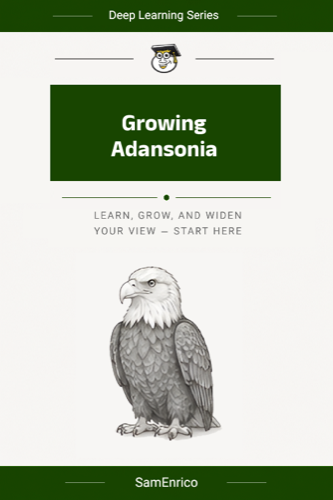
Non-FictionInformativeEducational
Growing Adansonia eBook
This publication, published by SamEnrico, covers G
This publication, published by SamEnrico, covers Growing Adansonia
Formats
Free sample
Chapter 1: The Upside-Down Paradox...--The first time I saw a baobab, I didn’t believe it was real.It stood in the middle of a dust-choked savannah in southern Senegal, its trunk as wide as a small house, its branches spreading outward like roots clawing at the sky. A local farmer named Ibrahim leaned against its bark and laughed at my stunned expression. “You look like every other traveler,” he said. “You think God planted it wrong.” He tapped the trunk with his knuckle—a hollow, drum-like sound. “But the tree knows exactly what it’s doing.”That moment changed me.
Not because I suddenly understood baobabs, but because I realized how little I—and almost everyone I knew—actually understood about them. The baobab is one of the most recognized trees on Earth. Its silhouette appears on national flags, in Disney movies, in corporate logos for African-themed resorts. We’ve all seen the image: a fat, bottle-shaped trunk with those strange, sparse branches that look like roots growing upward. We call it the “upside-down tree” and leave it at that, as if the mystery begins and ends with a clever legend.But the legend is only the beginning.For the past twenty years, I have grown, killed, revived, and studied baobabs across four continents.
I have germinated seeds in frozen New England basements and watched seedlings rot in balmy Florida backyards. I have interviewed baobab stewards in Madagascar, exchanged seeds with Australian aboriginal communities, and corresponded with bonsai artists in Japan who have spent forty years shaping a single Adansonia into a miniature masterpiece. What I have learned is this: the baobab is not one tree but eight distinct species, each with its own personality, its own secrets, and its own demands. And almost everything you think you know about them is probably wrong.This chapter is not an introduction. It is a correction.Before you plant a single seed, before you buy a grow light or mix a batch of sandy soil, you need to understand what you are actually growing.
The baobab you imagine—the thousand-year giant shading an African village—is only one version of Adansonia. There are dwarf baobabs that never exceed fifteen feet. There are baobabs with red flowers, yellow flowers, and flowers that bloom for a single night. There is a baobab that grows in Australia, separated from its African cousins by 100 million years of continental drift. And three of these eight species are now sliding toward extinction, which means that by growing them in your backyard or on your balcony, you are not just gardening.
You are participating in an act of conservation.So let us begin with the paradox. The tree that looks upside-down is actually the most right-side-up tree on Earth. Every part of it—the massive trunk, the strange branches, the nocturnal flowers, the chalky fruit—evolved for one purpose: survival in the harshest environments imaginable. The branches reach up like roots because they are reaching for something. Not the sky.
Not the gods. But the one thing that makes all life possible in the savannah.Water.The Myth and the Biology The most common legend about the baobab comes from the Khoisan people of southern Africa. According to their oral tradition, the gods planted the first baobab near a river. But the tree complained constantly—it was too hot, too dry, too windy. The gods grew tired of its whining, pulled it out of the ground, and replanted it upside-down so its roots would face the sky.
“There,” they said. “Now you can see the sun you complain about.”It is a beautiful story. It is also a useful metaphor.Botanically, the baobab’s appearance is not a punishment but an engineering marvel. The thick, swollen trunk is not actually a trunk in the way an oak or a maple has a trunk. It is a water storage organ—a living cistern.
A mature Adansonia digitata can hold up to 30,000 gallons of water within its fibrous, spongy wood. During the wet season, the tree absorbs rainfall like a sponge, expanding its girth by several feet. During the dry season, it slowly metabolizes that stored water, shrinking back down. If you measure a baobab’s circumference in April and again in October, you will get two different numbers. No other tree on Earth does this at such scale.The branches grow sparsely and irregularly for the same reason.
The baobab invests almost all its energy into two things: the water-storing trunk and the root system that feeds it. Leaves and branches are secondary. During drought or cold, the tree drops its leaves entirely, entering a state of dormancy that can last for months. To an untrained eye, a dormant baobab looks dead—bare branches, shrunken trunk, no signs of life. But inside that fibrous wood, the tree is simply waiting.
This is why so many novice growers throw away their baobabs in winter, assuming they have failed. They have not failed. They have simply misunderstood what survival looks like for an upside-down tree.The Eight Species: A Taxonomic Breakdown One of the most common mistakes in baobab literature is treating Adansonia as a single entity. Walk into any garden center that sells “baobab seeds” and you will almost certainly be buying Adansonia digitata—the African baobab—whether the label says so or not. But there are eight distinct species, and choosing the right one for your climate and goals is the single most important decision you will make as a grower.Adansonia digitata (The African Baobab)This is the baobab of postcards, documentaries, and childhood wonder.
Native to mainland Africa, digitata is the largest and most widespread species. Mature specimens routinely reach 80 feet in height with trunk diameters exceeding 35 feet. The oldest known digitata—the Panke baobab in Zimbabwe—lived for 2,450 years before it finally collapsed in 2011. The flowers are large and white, opening at night and emitting a musky, sweet scent to attract fruit bats. The fruit is the familiar “monkey bread” pod, filled with dry, powdery pulp and kidney-shaped seeds.Digitata is the best choice for tropical and subtropical landscapes.
It is also the most cold-sensitive of the eight species. Temperatures below 40°F will trigger dormancy; frost will kill it outright. If you live in USDA Zone 10 or above (southern Florida, Hawaii, coastal Southern California, most of Australia’s northern coast), you can grow digitata in the ground. If you live anywhere else, you will need a container and a winter storage plan.The Six Madagascan Species Madagascar is the evolutionary heart of the baobab world. Six of the eight species are endemic to this island, each adapted to a different microclimate.
This diversity makes Madagascar both a treasure and a tragedy: three of these species are now endangered due to habitat loss and climate change.Adansonia grandidieri is the most famous of the Madagascan baobabs, and the most endangered. It grows as a tall, smooth-barked cylinder with a flat crown, reaching 80 feet in height. Its silhouette is so distinctive that it has become the iconic image of “baobab alley” in western Madagascar. Only a few thousand mature trees remain in the wild. Growing grandidieri from seed…
This is the end of the free sample. Get the eBook to keep going. Buy now
About this book
Details
- Author
- Theriault Ngan
- Publisher
- SamEnrico
- Language
- English
- Genre
- Non-Fiction, Informative, Educational
- Released
- 2026-06-02
- Pages (approx.)
- 150
- Available as
- eBook, Audiobook

Read better in the ZLOADR app
Your eBooks on your phone or tablet. Sign in with your SamEnrico account and start reading.
More by Theriault Ngan
 Attention Residue Reduction GuideTheriault Ngan$11.99
 Networking Across Sectors HandbookTheriault Ngan$11.99
 Child Funeral and MemorialTheriault Ngan$11.99
 Burnout And Adrenal FatigueTheriault Ngan$11.99Networking Across Sectors HandbookTheriault Ngan$11.99
 Mindfulness for DivorceTheriault Ngan$11.99
 Body Double Anti ProcrastinationTheriault Ngan$11.99
 Benzo Prescribing GuideTheriault Ngan$11.99
 The Great London Zoo Escape: The Trial of the Century (1962)Theriault Ngan$11.99
 Blood and Ivory: The Battle of Tabora and the Collapse of the East African Slave TradeTheriault Ngan$11.99
 A Collector's Handbook to the Nsu Prinz 4Theriault Ngan$11.99
 Employee Misclassification HandbookTheriault Ngan$12.99
You may also like
 Hong Kong Handover 1997Dunn Johnnie$11.99
 Zumba For Postnatal Recovery CourseNeal Christian$11.99
 Zumba for BeginnersLadner Nikia$11.99
 YouTube Comment Mining GuideHumes Pandora$12.99
 Worry Box MeditationCarlin Rudy$11.99
 Workplace Stress MeditationNguyen Lynn$11.99
 Workplace Stress and Sleep RepairHawley Ivory$11.99
 Workplace Perfectionism CureDelaney Jeffry$11.99
 Workplace Injustice Anger GuideWallen Isabelle$11.99
 Work Addiction and Burnout LinkGreenwood Ester$11.99
 Women in Yoga and WellnessBeattie Galina$11.99
 Women in Stand Up ComedyChun Evangeline$11.99