
Non-FictionSelf-HelpDecision Making
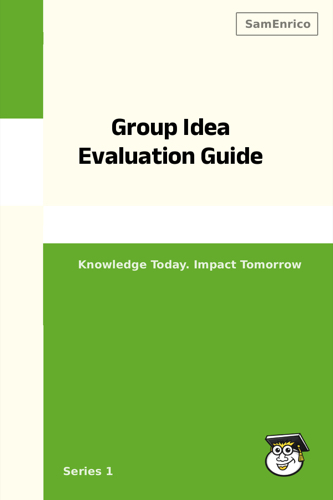
Group Idea Evaluation Guide eBook
Selects best concepts without killing creativity.
Selects best concepts without killing creativity.
Formats
Free sample
Chapter 1: The Innovation Massacre--–- The meeting started at 9:00 AM on a Tuesday. By 9:14 AM, the best idea in the room was dead. By 9:22 AM, no one else was willing to speak. By 10:00 AM, the team had committed to a safe, boring, forgettable concept that everyone knew would fail—but no one said a word. This is not an outlier.
This is Tuesday in most organizations.The Fourteen-Minute Graveyard Let me describe a scene you have either witnessed, participated in, or secretly dreaded your entire career. A team of eight people gathers in a conference room (or, increasingly, a grid of Zoom faces). The facilitator, usually a manager or team lead, opens with something like: “Okay everyone, we’ve got a lot of ideas on the table. Let’s hear them, and then we’ll figure out what’s actually realistic.”The first person speaks. She’s a junior designer who stayed up late preparing.
Her idea is fresh, unconventional, and slightly risky. She finishes speaking. There is a pause—that terrible pause where the room decides who will speak first. The senior vice president leans forward. “That’s interesting,” he says, “but we tried something like that three years ago and it didn’t work.” Another voice chimes in: “The budget would never allow that.” A third: “I think we need to be more practical here.”The junior designer says nothing.
She does not defend her idea. She does not explain the differences between her proposal and the failed attempt from three years ago. She simply retreats, silently, into the safety of silence. The facilitator, relieved that the “difficult” idea has been handled, moves to the next person. That person has already mentally deleted the risky part of their idea.
By the third speaker, everyone in the room has calibrated their contribution to survive the incoming criticism. The meeting ends with a consensus around the safest, most incremental, most forgettable concept on the board.This is what I call the Fourteen-Minute Graveyard. It is the amount of time it takes for a typical group to kill a promising idea and train everyone in the room to self-censor. It happens in startups and Fortune 500 companies. It happens in nonprofits and government agencies.
It happens in creative agencies and engineering departments. And it happens not because people are malicious, but because the default evaluation process is structurally designed to destroy creativity while pretending to select the best ideas.The 75% Catastrophe Here is a number that should alarm you: 75%. According to meta-analyses of group creativity research spanning four decades, traditional evaluation methods—immediate criticism, unstructured debate, devil’s advocacy without guardrails—reduce the quantity of ideas generated by a group by an average of 75% within the first fifteen minutes of evaluation. But the damage is worse than quantity loss. The same research shows that the quality of the surviving ideas drops by approximately 60%, because the evaluation process systematically selects for safety, feasibility, and low risk while systematically eliminating novelty, surprise, and disruptive potential.Let me give you the anatomy of this catastrophe.
When a person shares an idea and receives immediate criticism, three things happen simultaneously. First, the idea itself is damaged—not because criticism is inherently bad, but because the criticism arrives before the idea has been fully heard, understood, or developed. Second, the person who shared the idea experiences a measurable drop in psychological safety, which neuroscientific research has shown reduces their creative output for the next 45 to 90 minutes. Third, every other person in the room observes this interaction and unconsciously adjusts their future contributions downward. One moment of premature criticism can contaminate an entire meeting.I have facilitated hundreds of evaluation sessions across industries, and I have watched this pattern repeat with mechanical predictability.
The pattern has five stages:Stage One: Enthusiasm. The group begins with energy. People share ideas freely. The room feels productive.Stage Two: The First Criticism. Someone—usually the most senior person or the most vocal skeptic—offers a critique.
It is almost always well-intentioned. It is almost always about feasibility, resources, or past failures.Stage Three: The Retreat. The original contributor stops talking. Other contributors begin editing their ideas before sharing them. The energy shifts from generative to defensive.Stage Four: The Consensus Cascade.
The group rapidly converges on the safest ideas. No one explicitly votes for safety; safety simply emerges as the path of least resistance.Stage Five: The Post-Mortem Denial. The meeting ends. Everyone nods. And then, in the hallway or over Slack, people privately admit that they knew the selected idea was mediocre but didn’t want to cause more conflict.This pattern is so common that most professionals assume it is inevitable.
It is not. It is the product of a specific set of design flaws in how groups evaluate ideas. And those design flaws can be fixed.The Neuroscience of Shutting Down To understand why traditional evaluation fails, we need to look at what happens inside the human brain during creative work versus critical evaluation. This is not academic abstraction; this is the biological reality of every meeting you have ever suffered through.Creative generation—the act of producing novel ideas—is primarily driven by the default mode network and the executive control network working in loose, associative patterns. When you are generating ideas, your brain is making distant connections, tolerating ambiguity, and deferring judgment.
This state is metabolically expensive and psychologically vulnerable. Your brain is essentially trying things out without knowing whether they will work.Critical evaluation—the act of judging, ranking, and selecting ideas—is primarily driven by the salience network and the central executive network. This state is focused, comparative, and judgmental. Your brain is looking for errors, risks, and misalignments. It is designed to protect you from bad decisions.Here is the problem: these two neural networks cannot operate optimally at the same time.
When you ask a group to generate ideas and evaluate them in the same conversation, you are forcing each brain to switch rapidly between two incompatible modes. The switching cost is enormous. But the real damage comes from the amygdala hijack—the brain’s threat-detection system activating in response to perceived social danger.When someone offers a criticism of your idea, your amygdala (the brain’s rapid threat-detection system) activates within milliseconds. It does not distinguish between a critique of your idea and a threat to your social standing. To your ancient, pattern-matching brain, criticism in a group setting feels like being voted off the tribe.
The result is a cascade of stress hormones—cortisol and adrenaline—that shut down the prefrontal cortex’s creative capacities for 20 to 60 minutes. You literally cannot generate good ideas after being criticized, because your brain has switched from exploration mode to survival mode.This is not weakness. This is biology. And every organization that evaluates ideas in real time is fighting a losing battle against the human nervous system.The Illusion of “Constructive Criticism”Perhaps the most insidious myth in modern work culture is the belief that “constructive criticism” delivered with good intentions can safely evaluate ideas without damaging creativity. This myth persists because it feels true: surely a thoughtful, well-meaning critique is different from a harsh, dismissive one.…
This is the end of the free sample. Get the eBook to keep going. Buy now
About this book
Details
- Author
- Lawson Donald
- Publisher
- SamEnrico
- Language
- English
- Genre
- Non-Fiction, Self-Help, Decision Making
- Released
- 2026-06-09
- Pages (approx.)
- 144
- Available as
- eBook, Audiobook

Read better in the ZLOADR app
Your eBooks on your phone or tablet. Sign in with your SamEnrico account and start reading.
More by Lawson Donald
 Meerkat Influencer StoryLawson Donald$11.99
 Stress Induced Hormone ImbalanceLawson Donald$11.99
 Deep Focus Zone GuideLawson Donald$11.99
 Persuasive Cover Letter FormulaLawson Donald$11.99
 NVC for Couples WorkbookLawson Donald$11.99
 The Stowaway RatLawson Donald$11.99
 Blue Zone Breakfast HabitsLawson Donald$11.99
 Office Desk Nap SetupLawson Donald$11.99
 The Maestro of Sound: Granville T. Woods and the Electric RevolutionLawson Donald$11.99
 The Art of the Steal: How a Billion-Dollar Art Heist Funded a Crime EmpireLawson Donald$11.99
 Descartes and the Birth of Modern Thought: The Architect of ReasonLawson Donald$11.99
 The Mineral Guide to MoganiteLawson Donald$11.99
You may also like
 Hong Kong Handover 1997Dunn Johnnie$11.99
 Zumba For Postnatal Recovery CourseNeal Christian$11.99
 Zumba for BeginnersLadner Nikia$11.99
 YouTube Comment Mining GuideHumes Pandora$12.99
 Worry Box MeditationCarlin Rudy$11.99
 Workplace Stress MeditationNguyen Lynn$11.99
 Workplace Stress and Sleep RepairHawley Ivory$11.99
 Workplace Perfectionism CureDelaney Jeffry$11.99
 Workplace Injustice Anger GuideWallen Isabelle$11.99
 Work Addiction and Burnout LinkGreenwood Ester$11.99
 Women in Yoga and WellnessBeattie Galina$11.99
 Women in Stand Up ComedyChun Evangeline$11.99