
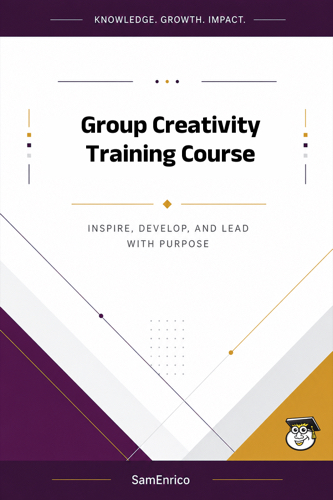
Non-FictionSelf-HelpTraining Design
Group Creativity Training Course eBook
Teach teams structured methods for collaborative i
Teach teams structured methods for collaborative innovation.
Formats
Free sample
Chapter 1: The Genius Trap--–- On a Tuesday morning in Cupertino, California, a team of twelve engineers sat in a glass-walled conference room. They had been tasked with solving a problem that their CEO had called “the most important initiative of the year.” The project lead, a brilliant designer named Elena with three patents to her name, had prepared thirty-seven slides. The room smelled of expensive coffee and desperate optimism. Ninety minutes later, they had exactly zero actionable ideas. What they had instead were four polite nods, seven people checking their phones, one person who hadn't spoken at all, and a growing sense of collective failure.
Afterward, Elena pulled me aside and said, “I thought if I just had the smartest people in the room, the ideas would take care of themselves. I was wrong.”She was wrong in a way that most teams are wrong, and the cost of that wrongness is staggering. Every day, in offices across the world, highly intelligent, well-intentioned teams gather to solve important problems. They have budgets, deadlines, and pressure. They have domain expertise, advanced degrees, and deep industry knowledge.
And they fail. Not because they aren't smart enough. Not because they don't work hard enough. They fail because they are operating under a fundamental misunderstanding about where breakthrough ideas actually come from.This misunderstanding has a name. I call it the Genius Trap.The Myth We Have Swallowed Whole The Genius Trap is the belief that innovation is the product of solitary brilliance—that a lone genius has a lightning-bolt moment of insight, scribbles something on a napkin, and changes the world.
This story is everywhere. We tell it about Albert Einstein and his thought experiments in the Swiss patent office. We tell it about Steve Jobs and the garage where he supposedly built the first Apple computer. We tell it about J.K. Rowling conceiving Harry Potter on a delayed train.
These stories are not just oversimplified. They are dangerously misleading.Let me show you what actually happened.Einstein’s annus mirabilis—his “miracle year” of 1905—did not emerge from solitary meditation. It emerged from years of intense, often heated, collaboration with a small group of friends and colleagues who called themselves the Olympia Academy. They read philosophy together, debated physics until three in the morning, and ripped each other’s arguments to shreds over beer and sausage. Einstein’s most famous equation, E=mc², was the product not of a lone flash of genius but of a sustained, messy, social process of challenge and refinement.The Apple garage story is even more instructive.
The garage was real. But the myth leaves out that Steve Wozniak had already designed the Apple I computer before the garage “company” existed. And the critical innovation—the thing that made Apple Apple—was not the hardware. It was the insight that ordinary people would buy computers if they were easy to use. That insight came from conversations, arguments, and shared frustrations between Wozniak, Jobs, and a rotating cast of friends and early employees.
The garage was not a laboratory of solitude. It was a meeting place.And Harry Potter? Rowling has said repeatedly that the idea came to her fully formed on a train, yes. But she also spent the next five years workshopping those ideas with editors, beta readers, her sister, and eventually an entire publishing team. The Harry Potter the world knows is not the Harry Potter on the train.
It is the Harry Potter that survived hundreds of critiques, suggestions, and collaborative refinements.The research backs this up. In a landmark study published in the journal Organization Science, researchers tracked twenty-two product development teams over two years. They found that the teams who produced the most innovative outcomes were not the teams with the highest average IQ or the most impressive individual credentials. They were the teams with the highest levels of what the researchers called “collaborative iteration”—the willingness to share unfinished work, invite criticism, and build on each other’s ideas. The lone genius, it turns out, is a statistical outlier at best and a fantasy at worst.The Real Source of Breakthrough Ideas If not from solitary geniuses, where do breakthrough ideas actually come from?
The answer, supported by decades of research in organizational psychology, cognitive science, and network theory, is this: breakthrough ideas emerge from the space between people.Consider the concept of “creative confidence,” introduced by David Kelley and Tom Kelley of IDEO, the legendary design firm. Creative confidence is not about being the smartest person in the room. It is about the belief, built through practice and reinforced by social feedback, that anyone can generate novel solutions when the environment is right. Notice what this definition includes: “when the environment is right.” The environment is not neutral. It either amplifies or suppresses creativity.
And the single most important feature of that environment is what Harvard researcher Amy Edmondson calls “psychological safety.”Psychological safety is the shared belief that a team is safe for interpersonal risk-taking. In a psychologically safe team, you can raise your hand and say, “I have a half-baked idea that might be stupid,” without fearing that your career will be damaged or your colleagues will mock you. You can say, “I think we are solving the wrong problem,” and be heard rather than punished. You can say, “I need help,” and receive it.The evidence for psychological safety as the foundation of group creativity is overwhelming. Google’s Project Aristotle, a massive two-year study of 180 internal teams, found that psychological safety was by far the most important predictor of team performance—more important than who was on the team, how they were organized, or what incentives they received.
Teams with high psychological safety generated more ideas, caught more errors, and learned faster than teams without it. Teams without psychological safety, no matter how individually talented, underperformed consistently.But psychological safety alone is not enough. Teams also need what Pixar’s co-founder Ed Catmull calls the “Braintrust.” The Braintrust is a group of trusted peers who gather every few months to watch an unfinished film—a rough cut with missing scenes, placeholder animation, and obvious problems. After the screening, the Braintrust gives feedback. But here is the critical rule: the Braintrust has no authority.
The director of the film does not have to follow any of the suggestions. The only requirement is that the director listens.This is genius in its simplest form. The Braintrust works because it separates idea generation from evaluation, and it separates evaluation from authority. The Braintrust cannot order changes. They can only offer perspectives.
This frees everyone to speak candidly. It frees the director to receive feedback without defensiveness. And it creates a culture where unfinished, imperfect, vulnerable work is the norm, not the exception.The results speak for themselves. Pixar has released more than twenty consecutive box office hits. No other film studio comes close to that record.
The Braintrust is not the only reason, but it is the engine. It is collaboration institutionalized.The Hard Truth About Soft Skills If psychological safety and collaborative iteration are so powerful, why do so few teams practice them? The answer is uncomfortable…
This is the end of the free sample. Get the eBook to keep going. Buy now
About this book
Details
- Author
- Newkirk Jolanda
- Publisher
- SamEnrico
- Language
- English
- Genre
- Non-Fiction, Self-Help, Training Design
- Released
- 2026-06-07
- Pages (approx.)
- 157
- Available as
- eBook, Audiobook

Read better in the ZLOADR app
Your eBooks on your phone or tablet. Sign in with your SamEnrico account and start reading.
More by Newkirk Jolanda
 Detox in Intensive Care UnitNewkirk Jolanda$11.99
 Chronic Pain Sleep PracticeNewkirk Jolanda$11.99
 Jackal vs Giraffe LanguageNewkirk Jolanda$11.99
 Quadrant One Crisis GuideNewkirk Jolanda$11.99
 Self HeimlichNewkirk Jolanda$11.99
 Remote Work for TherapistsNewkirk Jolanda$11.99
 Empathy in NegotiationNewkirk Jolanda$11.99
 The Maori Star Compass: Polynesian Navigation Meets Western ScienceNewkirk Jolanda$11.99
 The Iron General: How Liu Bang Forged an EmpireNewkirk Jolanda$11.99
 How to Start a Nozzles Made of Refractory Ceramic Business (Beginners Guide)Newkirk Jolanda$11.99
 How to Produce TongsNewkirk Jolanda$11.99
 Service Providers Guide to OncologyNewkirk Jolanda$11.99
You may also like
 Hong Kong Handover 1997Dunn Johnnie$11.99
 Zumba For Postnatal Recovery CourseNeal Christian$11.99
 Zumba for BeginnersLadner Nikia$11.99
 YouTube Comment Mining GuideHumes Pandora$12.99
 Worry Box MeditationCarlin Rudy$11.99
 Workplace Stress MeditationNguyen Lynn$11.99
 Workplace Stress and Sleep RepairHawley Ivory$11.99
 Workplace Perfectionism CureDelaney Jeffry$11.99
 Workplace Injustice Anger GuideWallen Isabelle$11.99
 Work Addiction and Burnout LinkGreenwood Ester$11.99
 Women in Yoga and WellnessBeattie Galina$11.99
 Women in Stand Up ComedyChun Evangeline$11.99