
Non-FictionSelf-HelpEngineering
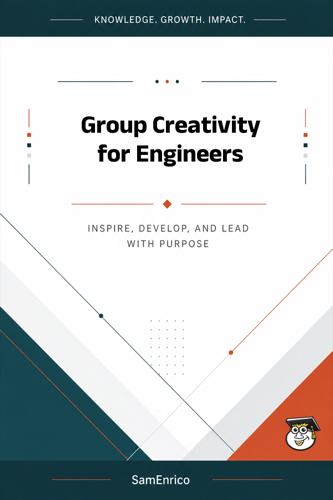
Group Creativity for Engineers eBook
Technical team collaborative problem solving.
Technical team collaborative problem solving.
Formats
Free sample
Chapter 1: The Lone Genius Delusion...--Chapter 1: The Lone Genius Delusion--The call came in at 2:17 AM on a Tuesday. Maya, a senior infrastructure engineer at a fast-growing fintech company, was the only one who answered. A critical payment service had stopped processing transactions. The on-call rotation had three other engineers listed, but Maya knew the system better than anyone. She had built large parts of it herself, working late nights and weekends while the rest of the team struggled to keep up.By 4:30 AM, Maya had identified the problem.
A race condition in a Redis cache layer, triggered by an edge case that only appeared when transaction volume spiked above a threshold no one had tested. By 6:00 AM, she had deployed a hotfix. By 7:30 AM, she was writing the post-mortem while drinking her third coffee. The CEO sent a Slack message to the whole company: "Huge thanks to Maya for saving us overnight. Our rockstar."Maya was promoted three months later.
She was given a team of five engineers to lead. The company expected her to replicate her heroics across the organization.Eighteen months after that, Maya quit. She was burned out, resentful, and convinced she had failed as a leader. Her team's velocity had never matched what she could produce alone. Her engineers deferred to her on every technical decision.
And when she took a two-week vacation, the payment service broke again—and no one on her team could fix it.The company's post-mortem blamed "knowledge silos" and recommended "better documentation." Maya blamed herself. But the real culprit was something deeper: a shared belief that engineering excellence meant individual heroism, and that the best teams were simply collections of the best individuals.That belief is a lie. And it is destroying your team's creative potential.The Myth That Won't Die The "lone genius engineer" is one of the most persistent and damaging myths in the technology industry. It appears in every job description that asks for a "rockstar" or a "ninja." It is reinforced by every promotion that rewards individual contribution over team acceleration. It is romanticized in films about reclusive programmers who crack impossible problems in basement apartments while eating cold pizza.But the myth is not just harmless folklore.
It actively damages the creative capacity of engineering teams. When engineers believe that creativity is an individual trait—something you either have or you don't—they hoard problems instead of sharing them. They wait for the smartest person in the room to speak instead of contributing their own partial insights. They measure their worth by the complexity of the problems they solve alone, not by the problems they help the team solve together.The research is devastatingly clear. Decades of studies on group dynamics and problem-solving have shown that high-IQ, highly specialized individuals often perform significantly worse in groups than they do alone.
Not because they aren't smart enough, but because they over-rely on individual problem-solving scripts. They fail to share unique information that only they possess. And they fall victim to social dynamics that suppress the very creativity they were hired to deliver.This chapter will dismantle the lone genius myth piece by piece. It will introduce the concept of collective intelligence—a team-level capability that bears almost no relationship to the average IQ of its members. It will name the mechanisms that sabotage group creativity: process loss, social loafing, and evaluation apprehension.
And it will provide the first set of structural countermeasures that transform a collection of brilliant individuals into a genuinely intelligent team.But first, we need to understand how the myth seduces us.The Seduction of Simplicity There is a reason the lone genius story is so appealing. It is simple. A single hero identifies the problem, finds the solution, and saves the day. The narrative has a clear protagonist, a clear antagonist (the problem), and a satisfying resolution. It requires no messy group dynamics, no compromise, no politics.The real world of engineering problem-solving is none of these things.When Maya fixed the payment service alone at 2 AM, she appeared to be the lone genius.
But her ability to solve that problem depended on a vast infrastructure that she did not build alone: the monitoring system that alerted her, the logging system that helped her trace the race condition, the deployment pipeline that let her push the hotfix, and the codebase that hundreds of engineers had contributed to over years. Maya was not a genius working in a vacuum. She was the visible tip of an invisible collective iceberg.The myth obscures this interdependence. It trains engineers to seek individual credit rather than team capability. It encourages leaders to reward the loudest or most visible problem-solver rather than the team members who enabled that solution.
And it creates a vicious cycle: the more we reward heroes, the more engineers compete to be heroes, and the less they invest in making their teams heroic.The term for this gap between what a team could achieve and what it actually achieves is called process loss. Introduced by organizational psychologist Ivan Steiner in the 1970s, process loss refers to the performance degradation that occurs when individuals work together rather than alone. In Steiner's models, a team's potential productivity is the sum of its members' individual abilities. But actual productivity is always lower—sometimes dramatically so—because of two types of loss:Coordination loss occurs when team members waste time and energy managing their interactions. They talk past each other, duplicate work, or fail to synchronize their efforts.
In engineering terms, this is the equivalent of two developers both fixing the same bug in different branches, or a design review where everyone waits for the senior architect to speak before offering their own ideas.Motivation loss occurs when team members exert less effort in a group setting than they would alone. This is the classic social loafing effect: individuals working collectively on a task put in less effort than the same individuals working on the same task alone. In engineering, this manifests as the developer who stays silent in a debugging session because "someone else will figure it out," or the engineer who contributes superficial feedback in a design review because they assume the lead architect has already made the decision.Process loss is not a sign of a bad team. It is a universal feature of human collaboration. The question is not whether your team experiences process loss—it does—but whether you have engineered countermeasures to minimize it.The Collective Intelligence Breakthrough For decades, the dominant approach to improving team performance was simple: hire smarter people.
If you want a smarter team, the logic went, increase the average IQ of its members. Teams are just collections of individuals, after all.In 2010, a team of researchers led by Anita Woolley at Carnegie Mellon University published a study that shattered this assumption. They assembled 699 people into small teams and asked them to perform a wide range of tasks: brainstorming, problem-solving, decision-making, and motor tasks. The researchers measured each individual's cognitive ability, personality traits, and social sensitivity. Then they looked for what predicted team performance.The results were stunning.
The average intelligence of team members was only weakly correlated with team performance. A team of moderately smart people often…
This is the end of the free sample. Get the eBook to keep going. Buy now
About this book
Details
- Author
- Reedy Sherell
- Publisher
- SamEnrico
- Language
- English
- Genre
- Non-Fiction, Self-Help, Engineering
- Released
- 2026-06-06
- Pages (approx.)
- 155
- Available as
- eBook, Audiobook

Read better in the ZLOADR app
Your eBooks on your phone or tablet. Sign in with your SamEnrico account and start reading.
More by Reedy Sherell
 Trauma Trigger Prevention PlanReedy Sherell$11.99
 Breast Health For Wheelchair UsersReedy Sherell$11.99
 Truck Blind Spot Rage PreventionReedy Sherell$11.99
 Postpartum Joy Finding GuideReedy Sherell$11.99
 Influence Techniques for Product DesignersReedy Sherell$11.99
 Fireplace Warmth MeditationReedy Sherell$11.99
 Startup Layoff RecoveryReedy Sherell$11.99
 The Republic of Letters: Florence’s Intellectual RevolutionReedy Sherell$11.99
 The First Flash of Glory: How a 19th-Century Photographer Captured Africa’s Olympic DreamsReedy Sherell$11.99
 How to Produce Cooling RacksReedy Sherell$11.99
 UK Export Sustainability WorkbookReedy Sherell$12.99
 Export Payment Dispute ResolutionReedy Sherell$12.99
You may also like
 Hong Kong Handover 1997Dunn Johnnie$11.99
 Zumba For Postnatal Recovery CourseNeal Christian$11.99
 Zumba for BeginnersLadner Nikia$11.99
 YouTube Comment Mining GuideHumes Pandora$12.99
 Worry Box MeditationCarlin Rudy$11.99
 Workplace Stress MeditationNguyen Lynn$11.99
 Workplace Stress and Sleep RepairHawley Ivory$11.99
 Workplace Perfectionism CureDelaney Jeffry$11.99
 Workplace Injustice Anger GuideWallen Isabelle$11.99
 Work Addiction and Burnout LinkGreenwood Ester$11.99
 Women in Yoga and WellnessBeattie Galina$11.99
 Women in Stand Up ComedyChun Evangeline$11.99