
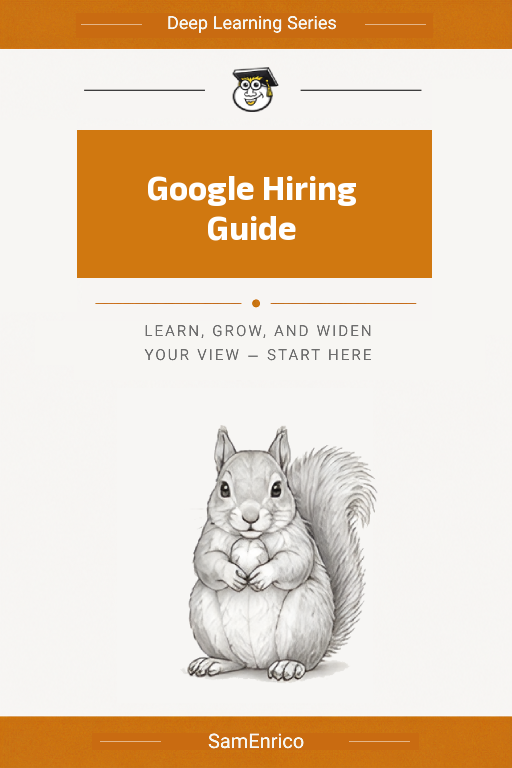
Non-FictionStrategic AtlasTalent Intelligence
Google Hiring Guide eBook
Explore structured behavioral interviewing, cognit
Explore structured behavioral interviewing, cognitive ability tests, and 7+ interview rounds for engineering talent.
Formats
Free sample
Chapter 1: The 0.2% Reality–- Three million applications. Twelve thousand hires. One question that changes everything.Every January, as performance review season fades and new headcount is approved, Google’s recruiting system awakens like a massive sleeping engine. By March, the queue holds over 300,000 active applications. By summer, that number will double.
And by December, when the final Hiring Committee of the year adjourns, Google will have hired roughly 12,000 people globally across all roles—engineers, product managers, sales, finance, everything.That means if you are a software engineer applying to Google today, your statistical odds of receiving an offer letter are approximately 0.2 percent.Let that number sit with you for a moment. Harvard University’s undergraduate acceptance rate hovers around 3.2 percent. MIT’s is roughly 4 percent. Y Combinator, the world’s most selective startup accelerator, accepts about 1.5 percent of applicants. Google’s engineering hiring rate is an order of magnitude more selective than the Ivy League.
You are more likely to be struck by lightning in your lifetime (1 in 15,000) than you are to receive a Google offer in any given application cycle (1 in 500).Yet thousands of engineers do receive offers every year. They are not geniuses. They are not child prodigies who wrote compilers at age twelve. They are, by and large, methodical, self-aware, and strategic engineers who understood something that most candidates never learn: Google does not hire the way you think it hires.This book exists because the gap between perception and reality in Google’s hiring process is vast enough to swallow entire careers. Walk into any coding bootcamp or browse any engineering forum, and you will hear the same myths repeated with religious certainty.
“Google asks brainteasers.” “You need to be a Leet Code grandmaster.” “It’s all about who you know.” “The interviews are random and unfair.” Each of these statements is demonstrably false. Each has been proven false by Google’s own internal data, published in peer-reviewed studies and detailed in books like Work Rules! by former Google People Operations chief Laszlo Bock. And yet the myths persist because the truth is counterintuitive: Google’s hiring process is not designed to be hard. It is designed to be accurate.That accuracy comes at a cost—your time, your patience, and your nerves—but it also means that the process is predictable.
Not easy, but predictable. And anything predictable can be prepared for.This chapter will tear down the three most dangerous myths about Google hiring, introduce the four-core-attribute framework that every single interview measures, and explain why Google abandoned “cult of the genius” hiring in favor of evidence-based selection. By the end of this chapter, you will understand not just what Google looks for, but why they look for it—and why that knowledge is the single greatest lever you have in your preparation.The Three Myths That Ruin Candidates Before we can build a winning strategy, we must demolish the false beliefs that cause otherwise excellent engineers to fail. These myths are not harmless. They are actively destructive, leading candidates to waste hundreds of hours practicing the wrong skills, walking into interviews with the wrong mindset, and leaving confused when a “perfect” technical performance yields a rejection.Myth #1: Google Wants Geniuses Who Can Solve Any Puzzle The most persistent myth is also the oldest.
In the early 2000s, Google was famous for asking brainteasers like “Why are manholes round?” or “How many golf balls fit in a school bus?” These questions spread through early interview prep websites like wildfire. They made for great blog posts. They also made for terrible hiring decisions.In 2013, Google’s internal analytics team conducted a retrospective study correlating interview question types with eventual job performance. The results were unambiguous: brainteasers predicted nothing. Candidates who aced the puzzle questions were no more likely to be high-performing Googlers than candidates who stumbled.
In some cases, the correlation was slightly negative—the kind of candidate who enjoyed abstract puzzles was not necessarily the kind of candidate who could ship reliable code under deadline pressure.Laszlo Bock, then head of People Operations, made the decision public: Google would stop asking brainteasers entirely. In an interview with the New York Times, he said, “They’re a complete waste of time. They don’t predict anything. They serve primarily to make the interviewer feel smart.”And yet, fifteen years later, candidates still report being asked “estimation questions” (a cousin of brainteasers) and assume the myth lives on. Here is the distinction: estimation questions like “How many EV charging stations does London need?” are not brainteasers.
They test structured thinking, not trivia. Estimation questions have a rubric. Brainteasers do not. We will cover estimation questions extensively in Chapter 7 (The General Cognitive Ability Interview). For now, understand that Google has no interest in whether you know why manholes are round.
They care about how you think.Myth #2: You Must Solve 500 Leet Code Problems to Pass This myth is seductive because it offers a clear, measurable goal. “If I just solve enough algorithm problems,” the logic goes, “I will eventually be ready.” Candidates spend three, six, even twelve months grinding through hundreds of Leet Code problems, memorizing patterns for dynamic programming, graph traversal, and binary search variations.Then they sit for the Google phone screen, receive a problem they have never seen before, freeze, and fail.The problem with the “500 problems” approach is not that practice is bad. Practice is essential. The problem is that Google does not test memorization. Google tests transfer learning—your ability to apply known patterns to unfamiliar problems under time pressure.
A candidate who has solved 500 problems but never practices articulating their thought process will consistently lose to a candidate who has solved 100 problems but can clearly explain trade-offs, edge cases, and alternatives.Worse, the “500 problems” approach creates a false sense of security. Candidates assume that if they have seen every pattern, they will recognize the interview problem instantly. But Google interviewers are trained to modify problems in small but meaningful ways precisely to defeat pattern matching. The problem you receive will be similar to problems you have seen, but not identical. The candidate who relies on recognition will panic.
The candidate who relies on first principles will adapt.Throughout this book, you will learn a different approach: pattern fluency over pattern memorization. Chapters 3 and 8 will teach you the specific data structures Google cares about (Strings, Hash Maps, Graphs via BFS/DFS) and the specific coding hygiene practices that separate Hire from No Hire. You will practice not just solving problems, but solving them out loud, verbalizing your assumptions, testing your edge cases, and refactoring your code. That is what Google actually scores.Myth #3: The Process Is Random and Unfair Every rejected candidate has, at some point, thought: “That interviewer was unfair.” “They asked a question no one could solve.” “They had already decided before I walked in.”Here is the uncomfortable truth: sometimes, interviewers are unfair. Sometimes, a candidate gets a bad draw.
Google is not perfect. But the structure of Google’s hiring process is explicitly designed to make randomness and bias average out across multiple rounds.This is why Google uses multiple interviewers (typically five to seven per candidate). This is why…
This is the end of the free sample. Get the eBook to keep going. Buy now
About this book
Details
- Author
- Mcarthur Mafalda
- Publisher
- SamEnrico
- Language
- English
- Genre
- Non-Fiction, Strategic Atlas, Talent Intelligence
- Released
- 2026-05-30
- Pages (approx.)
- 146
- Available as
- eBook, Audiobook

Read better in the ZLOADR app
Your eBooks on your phone or tablet. Sign in with your SamEnrico account and start reading.
More by Mcarthur Mafalda
 King's Boston University PhDMcarthur Mafalda$11.99
 Body Scan For Menstrual PainMcarthur Mafalda$11.99
 Whale vs Dolphin SpendingMcarthur Mafalda$11.99
 Conversation Starters WorkbookMcarthur Mafalda$11.99
 The Breakup and Separation TalkMcarthur Mafalda$11.99
 The Last Words of Hypatia: A Martyr’s Legacy in a World of ShadowsMcarthur Mafalda$11.99
 Enterprise Renewals Account ManagerMcarthur Mafalda$11.99
 Paid Ads One Page PlanMcarthur Mafalda$12.99
 A Beginners Guide to Goaltimate (Volume 1)Mcarthur Mafalda$11.99
 Understanding Psoriatic ArthritisMcarthur Mafalda$17.99
You may also like
 Hong Kong Handover 1997Dunn Johnnie$11.99
 Zumba For Postnatal Recovery CourseNeal Christian$11.99
 Zumba for BeginnersLadner Nikia$11.99
 YouTube Comment Mining GuideHumes Pandora$12.99
 Worry Box MeditationCarlin Rudy$11.99
 Workplace Stress MeditationNguyen Lynn$11.99
 Workplace Stress and Sleep RepairHawley Ivory$11.99
 Workplace Perfectionism CureDelaney Jeffry$11.99
 Workplace Injustice Anger GuideWallen Isabelle$11.99
 Work Addiction and Burnout LinkGreenwood Ester$11.99
 Women in Yoga and WellnessBeattie Galina$11.99
 Women in Stand Up ComedyChun Evangeline$11.99