
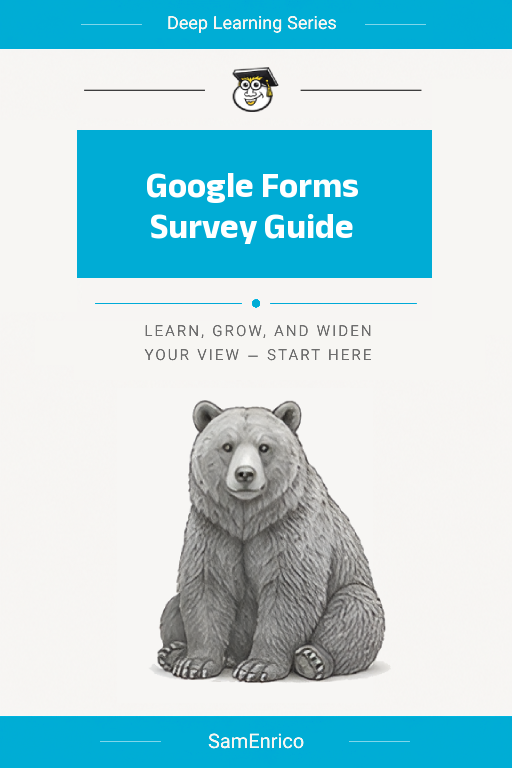
Google Forms Survey Guide eBook
Create free surveys with Google Forms to validate
by Puente Micah
Create free surveys with Google Forms to validate demand. Analyze responses to refine your idea.
Formats
Free sample
Chapter 1: The Validation Mindset--In 2018, a software developer named Michelle spent nine months building a mobile app for freelance photographers. She called it Snap Order. It allowed photographers to manage client bookings, send invoices, and deliver photos from a single dashboard. She built it alone, nights and weekends, sacrificing sleep, social life, and sanity.On launch day, she posted the link to Product Hunt, seven Facebook groups for photographers, and three subreddits. She waited for the upvotes, the comments, the rush of users.Crickets.Fifteen people downloaded the app.
Ten of them were friends who deleted it within a week. The other five were strangers who never opened it twice.Michelle had spent nine months and thousands of dollars building something nobody wanted. She had never asked a single photographer if they actually needed a booking dashboard. She had never tested her assumptions. She had built first and asked later.That night, Michelle discovered Google Forms.
She built a survey in twenty minutes. She asked five simple questions to twenty photographers in a Facebook group. The data was brutal: photographers were already using spreadsheets for bookings and loved them. The problem Michelle was solving didn't exist. Her solution was elegant and entirely unnecessary.She pivoted.
She asked a different question: "What is your biggest frustration with running your photography business?" The answer was not booking management. It was client communication: chasing clients for signatures, tracking changes across email threads, never knowing where a project stood.Michelle rebuilt Snap Order as a client communication tool. She launched again. This time, fifty people signed up on day one. Within six months, she had paying customers.
Within a year, she sold the company.The difference between failure and success was not harder work. It was not better coding. It was not more features. It was a free form from Google and twenty minutes of asking the right questions before she built anything.This chapter will teach you the mindset that separates people who validate from people who guess. You will learn why your opinions do not matter, why twenty good responses are better than two thousand bad ones, and why validation is never a one-time event.
By the end of this chapter, you will be ready to design your first validation survey.The Three Principles of the Validation Mindset Most people approach validation with the wrong mindset. They want to prove they are right. They ask leading questions. They ignore contradictory data. They fall in love with their solution before they understand the problem.
The validation mindset is the opposite of all these instincts.The validation mindset rests on three core principles. Master these principles, and everything else in this book will make sense. Ignore them, and no amount of survey sophistication will save you.Principle 1: You Are Not Your Customer The most dangerous assumption in any product development effort is that you know what people want. You do not. Your opinions, preferences, and assumptions are irrelevant.
The only thing that matters is what your target audience actually thinks, wants, and will pay for.This principle sounds obvious, but it is violated constantly. A founder loves their idea, so they assume others will love it too. A product manager has used a competitor's product, so they assume they know what features are missing. A marketer has strong opinions about messaging, so they write copy that resonates with themselves, not with customers.The problem is not that these people are arrogant. The problem is that they are biased by their own experience.
You are not a blank slate. You have been shaped by your income, your education, your geography, your age, and your thousands of previous experiences. Your target audience has a completely different set of influences. What seems obvious to you may be invisible to them. What seems compelling to you may be boring to them.
What seems like a fair price to you may be unaffordable to them.Consider this example: A team of twenty-something tech founders in San Francisco wants to build a productivity app for "busy professionals." They assume their target audience wants automation, integration, and AI features. But their actual target audience—forty-something lawyers in the Midwest—wants simplicity, reliability, and offline access. The founders' opinions are worse than useless. They are actively misleading.The validation mindset requires you to admit that you are probably wrong about most things. Your job is not to confirm what you believe.
Your job is to discover the truth, even when the truth is uncomfortable.Every survey question you write must be designed to surface your customer's truth, not confirm your bias. That means avoiding leading questions that suggest a preferred answer. It means including answer options you disagree with. It means asking open-ended questions and letting respondents tell you what matters to them, not what you think should matter.Practical exercise: Before you write a single survey question, list every assumption you are making about your target audience. Write them down.
Now ask yourself: which of these, if wrong, would cause my idea to fail? Those are the assumptions you must test first. Your opinions do not matter. The data does.Principle 2: Small Data Is Better Than No Data Many people believe they need hundreds or thousands of survey responses before they can make a decision. This is a myth.
It is also an excuse for inaction.Twenty thoughtful responses from your target audience are more valuable than two thousand random responses. Why? Because quality matters more than quantity. A random person on the internet has no stake in your success. They will click through your survey in thirty seconds, providing garbage data that you cannot trust.
But a member of your target audience—someone who actually experiences the problem you are trying to solve—will give you thoughtful, detailed, honest feedback.This principle is liberating. It means you do not need a massive email list or a big advertising budget. You need access to twenty people who match your target audience. You can find them in a Facebook group, a subreddit, a Linked In community, or your own network.What "small data" looks like in practice:Twenty responses: Enough to identify major patterns and obvious deal-breakers. If eight out of twenty people say the same thing, that is a signal worth acting on.
If zero out of twenty people say something, you can tentatively deprioritize it.Fifty responses: Enough to have confidence in the patterns you are seeing. The margin of error on a 50-person sample of a specific target audience is roughly plus or minus fourteen percent. That is sufficient for go/no-go decisions.One hundred responses: Enough to segment your audience and compare subgroups. You can ask questions like "Do freelance designers have different priorities than agency owners?" with reasonable confidence.Five hundred responses: Excellent for statistical significance, but rarely necessary for early validation. By the time you need five hundred responses, you should already have built something and be scaling it.The important nuance is that these numbers assume quality respondents who match your target audience.
Five hundred random responses from a paid survey panel are worse than fifty responses from a targeted Facebook group. Always prioritize quality over…
This is the end of the free sample. Get the eBook to keep going. Buy now
About this book
Details
- Author
- Puente Micah
- Publisher
- SamEnrico
- Language
- English
- Genre
- Non-Fiction, Startup Guide, Lean Methodology
- Released
- 2026-06-01
- Pages (approx.)
- 121
- Available as
- eBook, Audiobook

Read better in the ZLOADR app
Your eBooks on your phone or tablet. Sign in with your SamEnrico account and start reading.
More by Puente Micah
 The Addiction Relapse Prevention GuidePuente Micah$11.99
 Data Center Manager StressPuente Micah$11.99
 The Gut Directed CBT GuidePuente Micah$11.99
 Social Comparison CurePuente Micah$11.99
 Parental Anger at Spoiled BehaviorPuente Micah$11.99
 The Forger’s Gambit: How a Journalist Uncovered the Greatest Art Scam of the CenturyPuente Micah$11.99
 Understanding Thrombocytopenia PurpuraPuente Micah$17.99
 Residential Property ManagerPuente Micah$11.99
 How to Start a Doors (wholesale) Business (Beginners Guide)Puente Micah$11.99
 Payment Escrow for High RiskPuente Micah$12.99
You may also like
 Lean Business Plan TemplateSwart Jannette$11.99
 No Money Idea Validation GuideLevy Joel$12.99
 Zero Cost Pivot GuideJoyner Cammie$12.99
 Solution Interview TechniqueCreech Blythe$12.99
 Reddit Validation MethodBarnette Ellie$12.99
 Quora Question ValidationMcmanus Jenifer$12.99
 Problem Interview TechniqueCordero Mafalda$12.99
 MVP Without Coding GuideRoche Alejandra$12.99
 LinkedIn Poll ValidationMojica Gavin$12.99
 Free YouTube Channel GuideNixon Odette$12.99
 Free Video Validation GuideMcallister Tosha$12.99
 Free Validation Template PackGrubbs Delicia$12.99