
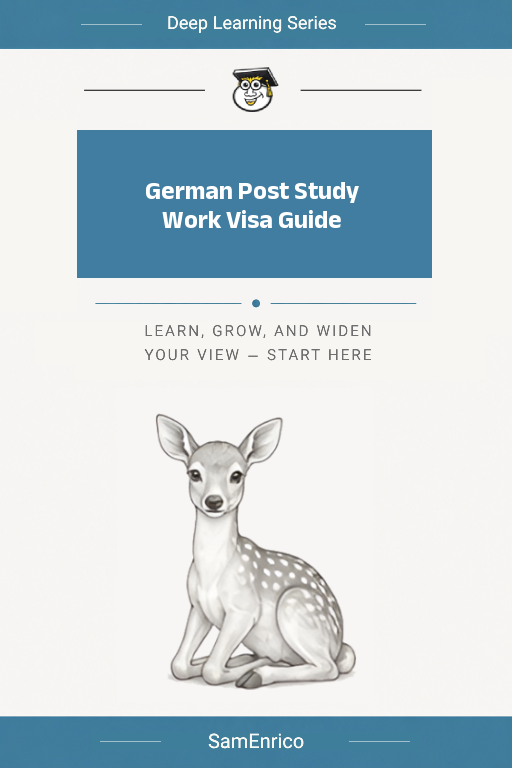
German Post Study Work Visa Guide eBook
Stay 18 months after graduation to find a job in G
by Sewell Judie
Stay 18 months after graduation to find a job in Germany and transition to permanent residence.
Formats
Free sample
Chapter 1: The Countdown Begins--The day you receive your final exam results or submit your master's thesis, an invisible clock begins ticking. You cannot see it, pause it, or reset it. But unlike the countdowns in movies—the ones with dramatic music and flashing red lights—this clock is quiet, bureaucratic, and utterly unforgiving. It runs for exactly eighteen months. When it reaches zero, one of two things will happen: you will have transformed from a student into a permanent resident of Germany, or you will be packing your bags to leave.This chapter is about understanding that clock before you learn to outrun it.Most international graduates arrive at their graduation day believing they have plenty of time.
Eighteen months sounds generous. It sounds like a gap year with a visa attached. But here is the first and most important truth you will read in this entire book: your eighteen months are not eighteen months of job searching. They are not even eighteen months of opportunity. By the time you account for graduation delays, application processing, holidays, and the famously slow German hiring cycle, your effective job search window is closer to twelve to fourteen months.This chapter exists because thousands of graduates before you have learned this lesson too late.
They celebrated after graduation. They traveled. They took their time updating their CVs. They assumed the clock started when they received their visa card in the mail. They were wrong.
And when they finally began applying in month six or seven, they discovered that German companies take three months just to schedule a second interview. By month fourteen, panic set in. By month seventeen, they were accepting any job offer—any job offer—regardless of whether it led to permanent residence. And some of them, the unluckiest ones, found themselves at the Ausländerbehörde on month eighteen with no offer at all.You are not going to be one of those graduates. Not after reading this chapter.The Legal Foundation: What the Post-Study Visa Actually Is The post-study work visa is officially governed by Section 20 of the German Residence Act (Aufenthaltsgesetz §20).
This specific provision grants graduates of German universities an eighteen-month residence permit for the purpose of seeking qualified employment. The language of the law is intentionally broad: "A foreigner who has successfully completed a course of study at a German university shall be granted a residence permit for up to eighteen months for the purpose of seeking a job commensurate with their qualification."That word "commensurate" matters. Unlike the standard six-month Job Seeker Visa available to graduates of non-German universities, the post-study visa does not require you to prove you can support yourself beyond the standard financial threshold. More importantly, it comes with an advantage that student visa holders would envy: unlimited work authorization. During these eighteen months, you can work any job, any number of hours, in any field, without seeking additional permission.
You can deliver pizzas on Monday, freelance as a translator on Tuesday, work twenty hours as a junior developer on Wednesday, and take Thursday off. The visa does not care.But do not misunderstand this freedom. The purpose of the visa is not to let you work odd jobs for eighteen months. The purpose is to give you time to find qualified employment—a job that uses your degree and pays enough to support you without government assistance. The unlimited work authorization is a bridge, not a destination.The Critical Distinction: Post-Study Visa vs.
Six-Month Job Seeker Visa Many international graduates confuse these two visas. The confusion is understandable—both are for job seeking, both require a university degree, and both lead to work permits if successful. But the differences are substantial enough to change your entire strategy.The six-month Job Seeker Visa is available to graduates of foreign universities who want to come to Germany to look for work. It lasts six months, not eighteen. It requires proof of financial solvency (the same €1,027 per month).
It does not allow unlimited work—you can work only trial periods of up to ten hours per week, not regular employment. And critically, you must apply for it from your home country before entering Germany.The post-study visa is only available to graduates of German universities. You apply from within Germany while your student visa is still valid. You get eighteen months, not six. You get unlimited work authorization.
And you have already proven you can succeed in the German system—you graduated from a German university, which means you already understand German academic culture and, presumably, have some German language skills.This distinction matters because some graduates accidentally let their student visa expire before applying for the post-study visa. When that happens, they cannot apply from within Germany. They must leave, apply for the six-month Job Seeker Visa from their home country, and restart the entire process with half the time and no work authorization. Do not let this be you.The Eighteen-Month Clock: When It Actually Starts Here is where most graduates make their first and most expensive mistake.The eighteen-month clock does not start when you receive your visa card. It does not start when you submit your application to the Ausländerbehörde.
It does not start when you receive your Fiktionsbescheinigung (the temporary permit paper).The clock starts on your official graduation date. That is the date printed on your degree certificate or the date your university officially confirms you have completed all requirements for your degree. For most students, this is not the day of the graduation ceremony. It is not the day you defend your thesis. It is the day the examination office enters your final grade into the system and generates your certificate.This legal reality has devastating consequences for graduates who delay.Imagine you finish your thesis on March 15th.
Your advisor approves it on March 20th. The examination office processes your grades on March 25th and prints your degree certificate with that date. You decide to celebrate with friends, visit Paris for a week, and return to update your CV at your own pace. By the time you gather your documents and book an Ausländerbehörde appointment, it is June 1st. You receive your post-study visa card on July 15th.Your visa card will say it expires eighteen months from March 25th—not from July 15th.
You have effectively lost nearly four months of your visa because you did not apply immediately. The clock was running the entire time you were celebrating, traveling, and procrastinating.This is not a hypothetical edge case. This is the most common mistake among international graduates, and it is entirely preventable.The Mathematics of Delay: How Eighteen Becomes Twelve Let us walk through a realistic timeline to show you why immediate action is not just advice—it is a survival strategy.Assume you graduate on January 15th. Your clock expires on July 14th of the following year. That is eighteen months.
But here is what actually happens in the real world:January 15 to February 15 (one month lost): You wait for your official degree certificate to be printed and mailed. The examination office is under no obligation to rush this.…
This is the end of the free sample. Get the eBook to keep going. Buy now
About this book
Details
- Author
- Sewell Judie
- Publisher
- SamEnrico
- Language
- English
- Genre
- Non-Fiction, Student's Shortcut, Career Pathways
- Released
- 2026-06-01
- Pages (approx.)
- 136
- Available as
- eBook, Audiobook

Read better in the ZLOADR app
Your eBooks on your phone or tablet. Sign in with your SamEnrico account and start reading.
More by Sewell Judie
 Virtual Reality PalaceSewell Judie$11.99
 Parental Stress Physical SymptomsSewell Judie$11.99
 Fractional Self Hypnosis GuideSewell Judie$11.99
 REIT Preferred SharesSewell Judie$11.99
 Driving Calm SuggestionSewell Judie$11.99
 The ED Recovery GuideSewell Judie$11.99
 Pet Loss and Appetite ChangesSewell Judie$11.99
 ED and Masturbation HabitsSewell Judie$11.99
 The Red Army's Gold: How Stalin Funded the Eastern FrontSewell Judie$11.99
 Grace in Motion: The Black Pioneers Who Defined BalletSewell Judie$11.99
 How to Produce Riveting ToolsSewell Judie$11.99
 A Collector's Handbook to the Alta 2-litreSewell Judie$11.99