
Non-FictionHealth & WellnessDigital Balance
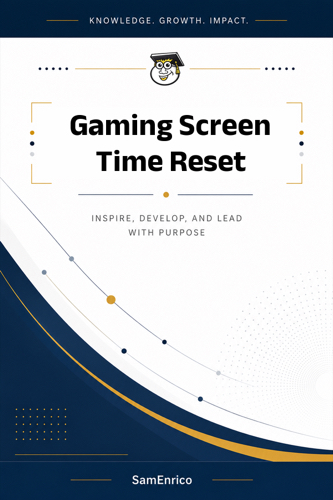
Gaming Screen Time Reset eBook
Implement graduated reduction schedules for compul
by Sam Cecille
Implement graduated reduction schedules for compulsive video game play.
Formats
Free sample
Chapter 1: The Willpower Trap--–- The screen glows at 2:13 a.m. You told yourself you would stop at midnight. Then one more match. Then just the daily quests. Then “I’ll finish this level and go to bed.” Now your eyes burn, your back aches, and somewhere beneath the fog of exhaustion, a quiet voice whispers: What is wrong with me?Nothing is wrong with you.
That is the first and most important sentence in this book. You are not lazy. You are not broken. You do not lack moral fiber. You are, however, fighting a battle you were never designed to win—a battle against the most sophisticated attention-hijacking machinery in human history, armed only with a weapon that was obsolete before you were born.
That weapon is willpower. And it has been failing you not because you are weak, but because willpower was never meant to do what you are asking it to do.This chapter dismantles the single most destructive myth in the entire conversation about compulsive gaming: the belief that wanting to stop should be enough to make you stop. If you have ever promised yourself “tomorrow will be different” only to find yourself in the exact same chair at the exact same hour, you have been victimized by this myth. If you have ever screamed at a child or partner “Just stop playing!” and watched them play more, you have been betrayed by this myth. If you have ever felt the hot wash of shame after a six-hour binge you swore would be two hours, you are not a failure.
You are a casualty of bad advice dressed up as common sense.We are going to fix that. But first, we have to understand exactly why willpower fails, what is actually happening inside your brain during a gaming session, and why the most well-intentioned attempts to “just play less” often make things worse. By the end of this chapter, you will never blame yourself—or anyone you love—for failing at a task that was impossible from the start. And you will understand, for the first time, what real change actually requires.The Finite Fuel Tank Let us start with a simple experiment. For the next ten seconds, do not think about a white bear.
Do not picture its fur, its claws, its dark nose. Do not let the image enter your mind under any circumstances. Ready? Go.If you are like the vast majority of human beings, you just thought about a white bear approximately seven times. This is not a failure of character.
It is a feature of how your brain processes suppression. In a landmark study conducted by social psychologist Daniel Wegner, participants who were explicitly told to suppress thoughts of a white bear actually thought about it more than participants who were given no instructions at all. The act of suppression created a rebound effect. The more you try not to think about something, the more your brain scans for that very thing to ensure you are not thinking about it—which, paradoxically, makes you think about it.Willpower works the same way. When you tell yourself “I will not play games today,” your brain must first activate the concept of “playing games” in order to suppress it.
That activation creates cravings. Those cravings require energy to resist. And that energy, known in the scientific literature as ego depletion, is a finite resource that drains throughout the day.Think of your willpower as a fuel tank that starts each morning mostly full. Every decision you make—what to eat for breakfast, whether to answer an email, how long to stay on task at work, whether to scroll social media—burns a little bit of that fuel. By late afternoon, your tank is running on fumes.
By evening, the most common gaming hours, you are operating with whatever vapors remain. This is not a moral failing. It is neurology.A landmark study by Roy Baumeister and his colleagues demonstrated this effect with stunning clarity. Participants were asked to sit in a room filled with the aroma of freshly baked chocolate chip cookies. On a table in front of them sat two bowls: one filled with the warm cookies, the other filled with radishes.
Some participants were told to eat the cookies. Others were told to eat only the radishes—to resist the cookies entirely. Afterward, both groups were given a set of unsolvable puzzles to work on. The cookie-eaters persisted for an average of nineteen minutes. The radish-eaters, whose willpower had been depleted by resisting the cookies, gave up after barely eight minutes.
They had not become lazier. They had simply run out of fuel.Now translate this to gaming. You wake up. You resist the urge to check your phone immediately. Fuel burned.
You force yourself to eat a healthy breakfast instead of something convenient. Fuel burned. You sit through a boring meeting without checking Discord. Fuel burned. You complete a tedious work assignment without opening a browser tab for game攻略.
Fuel burned. You drive home in traffic without losing your temper. Fuel burned. You help a child with homework while every neuron in your body is screaming for a break. Fuel burned.By 8 p.m., when you finally sit down in front of your gaming setup, your willpower tank is empty.
The game does not have to be particularly addictive to pull you in at this point. It just has to be there. And it is. So you tell yourself “just one hour,” and then “just one more match,” and then “well, it’s already midnight, might as well finish this ranked grind.” You are not weak. You are running on empty.
And no one can drive a car with no gas.Dopamine Dysregulation vs. Behavioral Avoidance Here is where most conversations about gaming addiction go off the rails. They treat all excessive gaming as the same problem with the same solution. But there are two fundamentally different pathways into compulsive play, and confusing them is like treating a broken leg and a fever with the same medicine. Both hurt.
Both require intervention. But the interventions are different.The first pathway is dopamine dysregulation. This is what most people mean when they say a game is “addictive.” It involves the brain’s reward system being hijacked by unpredictable reinforcement schedules—the same mechanism that makes slot machines so compelling. When you open a loot box, defeat a rare boss, or rank up after a close match, your brain releases a surge of dopamine not primarily because you won, but because you did not know you were going to win. Uncertainty amplifies reward.Dr.
Alok Kanojia, a Harvard-trained psychiatrist who has treated thousands of compulsive gamers, puts it bluntly: “The opposite of addiction is not sobriety. The opposite of addiction is connection.” But when a game is designed to deliver unpredictable rewards at exactly the right intervals—every few minutes, not so often that you get bored, not so rarely that you give up—it creates a neural loop that bypasses conscious choice. You are not deciding to play. You are being pulled by a system your brain cannot ignore.The second pathway is…
This is the end of the free sample. Get the eBook to keep going. Buy now
About this book
Details
- Author
- Sam Cecille
- Publisher
- SamEnrico
- Language
- English
- Genre
- Non-Fiction, Health & Wellness, Digital Balance
- Released
- 2026-06-11
- Pages (approx.)
- 141
- Available as
- eBook, Audiobook

Read better in the ZLOADR app
Your eBooks on your phone or tablet. Sign in with your SamEnrico account and start reading.
More by Sam Cecille
 Umayyad Expansion Conquest GuideSam Cecille$11.99
 HGH and Kidney AgingSam Cecille$11.99
 AI Video Production Cost ReductionSam Cecille$11.99
 Agoraphobia School Pickup Anxiety ManualSam Cecille$11.99
 The Great Moon Hoax: When Newspapers Tricked the WorldSam Cecille$11.99
 The Poisoned Perfume: The Untold Story of the Tylenol MurdersSam Cecille$11.99
 Overnight Veterinary AssistantSam Cecille$11.99
 Small Business Payroll AI GuideSam Cecille$12.99
 Global Coding Bootcamp RankingsSam Cecille$12.99
 Understanding Bronchogenic CystSam Cecille$17.99
 How to Start a Rubber Cement Manufacturing BusinessSam Cecille$11.99
You may also like
 Hong Kong Handover 1997Dunn Johnnie$11.99
 Zumba For Postnatal Recovery CourseNeal Christian$11.99
 Zumba for BeginnersLadner Nikia$11.99
 YouTube Comment Mining GuideHumes Pandora$12.99
 Worry Box MeditationCarlin Rudy$11.99
 Workplace Stress MeditationNguyen Lynn$11.99
 Workplace Stress and Sleep RepairHawley Ivory$11.99
 Workplace Perfectionism CureDelaney Jeffry$11.99
 Workplace Injustice Anger GuideWallen Isabelle$11.99
 Work Addiction and Burnout LinkGreenwood Ester$11.99
 Women in Yoga and WellnessBeattie Galina$11.99
 Women in Stand Up ComedyChun Evangeline$11.99