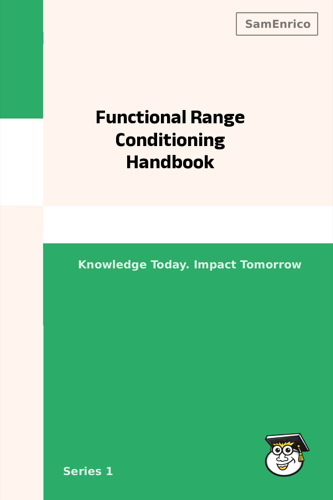
Functional Range Conditioning Handbook eBook
Apply controlled articular rotations with this sci
by Norris Lloyd
Apply controlled articular rotations with this science based stretching routine manual for joint health.
Formats
Free sample
Chapter 1: The Flexibility Trap--For the past twenty years, you have been told a lie about your body. It is a seductive lie, repeated in yoga studios, gym locker rooms, and physical therapy clinics across the world. The lie sounds like this: You are tight because your muscles are short. Stretch them longer, and you will be fixed. This assumption has spawned an entire industry of foam rollers, stretching straps, compression boots, and flexibility challenges.
Yet despite billions of dollars spent on stretching, the rates of lower back pain, knee injuries, and shoulder impingements have not declined. They have risen.The problem is not that stretching is useless. The problem is that stretching addresses the wrong variable. When you passively pull a muscle into a longer position—using gravity, a strap, or a partner—you are training your body to tolerate a position, not to control it. And tolerance without control is a recipe for injury.
This chapter will dismantle the conventional wisdom around flexibility, introduce the scientific framework that actually explains how joints adapt, and set the stage for a completely different approach to mobility: one based on active control, joint rotation, and neurological precision.The Static Stretching Paradox Let us begin with a simple experiment you can perform right now. Sit on the floor with your legs extended in front of you. Reach forward toward your toes, bending from your hips. Feel the sensation in your hamstrings. Most people can reach somewhere between their shins and their toes.
Now stand up, walk around for ten seconds, and sit back down. Reach again. You will likely find that your range has decreased slightly. This is not a failure of effort; it is a neurological phenomenon. Your nervous system just reminded you that range without context is dangerous.This paradox lies at the heart of static stretching research.
A landmark 2020 meta-analysis published in the Scandinavian Journal of Medicine & Science in Sports reviewed forty-two studies on static stretching and injury prevention. The conclusion was unambiguous: static stretching performed before exercise does not reduce injury rates. In some cases, it increases injury risk by temporarily reducing the muscle’s ability to absorb force. A 2013 review in the British Journal of Sports Medicine found that static stretching before strength training decreased maximal strength by an average of 5.5 percent and power output by 2.8 percent. These are not trivial numbers.
A 5 percent reduction in strength over a three-year training career represents months of lost progress.Yet static stretching persists. Why? Because it feels like it works. The immediate sensation of lengthening creates a temporary increase in range—what exercise scientists call "acute stretch-induced range of motion gain." This gain, however, comes from two sources, neither of which is permanent muscle lengthening. The first is neurological: the stretch reflex habituates, meaning your nervous system temporarily stops protesting the end range.
The second is viscoelastic creep: the connective tissue temporarily deforms under sustained tension, like a cold piece of taffy pulled slowly. Both effects reverse within thirty minutes of returning to normal activity.The more insidious problem is that chronic static stretching can actually increase joint laxity without increasing stability. This is particularly dangerous for individuals with hypermobility spectrum disorders, dancers, and yogis who already possess excessive range. They stretch because they feel "tight" in certain positions, but their tightness is not muscular shortness—it is neurological guarding. By stretching into that guarding, they override the nervous system’s protective signals without addressing the underlying instability.
The result is a joint that moves too far in one direction and cannot control any of its ranges.The Mechanotransduction Revolution To understand why CARs work and static stretching fails, we must journey inside the joint capsule. The joint capsule is a ligamentous sleeve that surrounds every synovial joint in your body—shoulders, hips, knees, wrists, ankles, and the facet joints of your spine. This capsule is not a passive bag of tissue. It is densely populated with mechanoreceptors: specialized nerve endings that detect stretch, compression, shear, and rotation. These mechanoreceptors send constant feedback to your brain about the position and tension of each joint.
When the capsule becomes stiff—a process called capsular fibrosis—those mechanoreceptors fire less accurately. Your brain loses the ability to feel where your joint is in space. This condition is called "movement blindness," and it is epidemic in sedentary populations.The key insight from recent biomechanics research is that joint capsules adapt in response to mechanical load through a process called mechanotransduction. This is the mechanism by which physical forces—tension, compression, shear, and rotation—are converted into cellular signals that remodel tissue. When you apply a controlled, rotational load to a joint capsule, the fibroblasts (connective tissue cells) within the capsule produce new collagen fibers in an organized, functional pattern.
When you do not apply that load, the capsule becomes fibrotic, disorganized, and stiff.Here is the crucial distinction: static stretching applies a linear load (pulling the muscle in one direction). The joint capsule, however, is not primarily loaded in linear tension. Its fibers run in oblique and spiral patterns designed to resist rotation. This is a profound anatomical fact that most stretching books ignore. The hip capsule, for example, contains three distinct ligamentous structures—the iliofemoral, ischiofemoral, and pubofemoral ligaments—each oriented to limit specific rotational movements.
The shoulder capsule has a spiral arrangement of fibers that tightens in external rotation. The spine’s facet capsules are designed to resist axial rotation. Every major joint in your body is engineered for rotational control, not linear stretching.Therefore, the only way to load the capsule in a way that triggers healthy mechanotransduction is through controlled rotation. This is the first principle of Functional Range Conditioning. You cannot stretch a capsule; you must rotate it.
And you must rotate it actively, using your own muscular control, because passive rotation (having someone else move your joint) does not engage the same mechanoreceptor pathways. Active rotation sends rich proprioceptive data to your brain, expanding your cortical map of that joint. Passive rotation does not.Passive Range Versus Active Range Let us formalize a distinction that will appear throughout this book. Passive range of motion is the amount of movement available at a joint when an external force—gravity, a strap, a partner, a foam roller—provides the effort. Active range of motion is the amount of movement you can achieve using only your own muscular control, without external assistance.The gap between these two numbers is one of the most revealing measurements in all of mobility training.
To measure your own passive-active gap, try this test. Lie on your back with both legs straight. Lift your right leg as high as you can without bending your knee, using only your hip flexors and quadriceps. That is your active range. Now, keeping the leg straight, loop a yoga strap or towel around your right foot and gently pull the leg toward your head, allowing the strap to do the work.
That is your passive range. For most sedentary individuals, the passive range will be ten to thirty degrees greater than the active range.This gap represents several things simultaneously. First, it represents capsular restriction: the capsule is tight enough…
This is the end of the free sample. Get the eBook to keep going. Buy now
About this book
Details
- Author
- Norris Lloyd
- Publisher
- SamEnrico
- Language
- English
- Genre
- Non-Fiction, Health & Wellness, Functional Fitness
- Released
- 2026-06-09
- Pages (approx.)
- 152
- Available as
- eBook, Audiobook

Read better in the ZLOADR app
Your eBooks on your phone or tablet. Sign in with your SamEnrico account and start reading.
More by Norris Lloyd
 Leave Earlier to Reduce Road RageNorris Lloyd$11.99
 The Museum Viewing CuesNorris Lloyd$11.99
 The Caregiver Parent DeathNorris Lloyd$11.99
 Echoes of the Unseen: The Secret Lives of the Apollo 11 AstronautsNorris Lloyd$11.99
 The Great Tea Heist: How a 19th-Century Smugglers Outwitted the British EmpireNorris Lloyd$11.99
 Gen X Subscription Spending HandbookNorris Lloyd$12.99
 One Page Personal Brand MarketingNorris Lloyd$12.99
 Understanding Baraitser–brett–piesowicz SyndromeNorris Lloyd$17.99
 Forensic PathologyNorris Lloyd$11.99
 How to Start a Hobby in Homebrewing (beer making)Norris Lloyd$11.99