
Non-FictionBusiness BriefAbuse Prevention
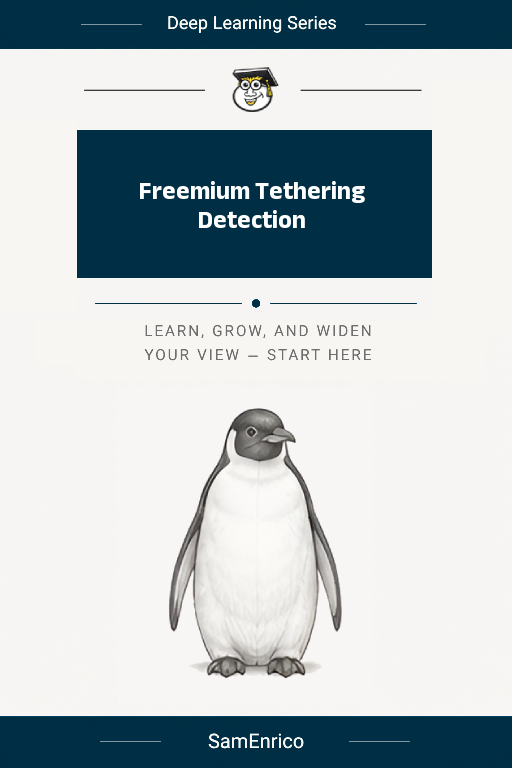
Freemium Tethering Detection eBook
Detect and limit freemium usage when tethered to p
by Little Damon
Detect and limit freemium usage when tethered to prevent abuse on unmetered connections.
Formats
Free sample
Chapter 1: The Billion-Dollar Hotspot--–- It was 3:47 AM on a Tuesday when Ahmed, the overnight network operations manager at a mid-sized European mobile carrier, noticed something strange. His dashboard, usually a quiet sea of green metrics during the witching hour, was screaming red. Not a security breach, not a tower failure—just traffic. A tsunami of traffic flooding out of a single cell sector in a residential suburb. Deep packet inspection showed the culprit: You Tube, 4K resolution, streaming continuously for eleven hours.
The subscriber was on a “Free You Tube for 12 Months” promotional plan, designed for teenagers scrolling on their phones, not for a 75-inch OLED television playing nature documentaries while its owner slept. By morning, that single user had consumed more data than the previous hundred customers combined. And Ahmed had just discovered the billion-dollar loophole.This is the story of that loophole—and how to close it.The Economics of “Free”Let’s start with a simple truth that the marketing departments don’t want you to hear: there is no such thing as free data. Every megabyte that travels across a cellular network costs real money to produce. Towers require electricity, backhaul lines require leasing fees, spectrum licenses cost billions in government auctions, and the engineers who keep the lights on require salaries.
When a carrier offers a “Free Music Streaming” add-on or an “Unlimited Social Media” plan, they are making a calculated bet. The bet is that the average user’s consumption will remain within the bounds of profitability, and that the revenue from paying customers will subsidize the freemium users. It’s a cross-subsidy model as old as the printing press—give away the razors, sell the blades.But in the world of mobile data, the “blades” are supposed to be high-margin overage fees, premium plans, and business services. Tethering abuse shatters this model. When a user takes a connection that was subsidized to be “free for their phone” and routes it to a laptop, a tablet, or a television, they bypass the economic agreement entirely.
They are, in effect, stealing the razor and forging their own blades.To understand the scale, consider the mathematics of revenue leakage. A typical “unlimited but fair use” plan might have a wholesale cost to the carrier of €0.50 per gigabyte. A user streaming 4K video on a tethered laptop uses approximately 7 GB per hour. If that user watches for two hours every night, that’s 14 GB per day, or 420 GB per month. The cost to the carrier: €210.
The revenue from the user: €0 (if on a freemium plan) or a flat €20 (if on an unlimited plan with hotspot caps). The carrier is losing €190 per month per abuser. Multiply that by one thousand abusers in a medium-sized city, and you are losing €2.28 million annually. Multiply it by the 5-15% of users who typically engage in this behavior, and you are looking at losses that can bankrupt a small MVNO (Mobile Virtual Network Operator) within a year.The Two Faces of Fraud: Zero-Rating vs. Hotspot Caps Before we dive into the technical trenches of packet headers and TTL flags, we must first draw a sharp line between two different types of abuse.
Most engineers and product managers conflate them, and that conflation leads to failed detection strategies. Let’s separate them clearly.Scenario A: The Zero-Rating Bypass Zero-rating is a practice where a carrier exempts specific applications from counting against a user’s data cap. For example, a plan might say: “Facebook, Instagram, and Whats App are free. All other apps consume your data allowance.” The carrier implements this by inspecting the traffic (usually via DPI) to see if the destination IP or domain matches Facebook’s servers. If it does, the data meter does not increment.The abuse scenario is obvious: the user enables tethering, connects a laptop, and uses a VPN or a proxy to trick the carrier’s DPI into thinking that a Netflix stream is actually Facebook traffic.
This is a deliberate, malicious act of fraud. The user knows they are stealing. The detection challenge here is deep packet inspection (DPI) evasion, and the primary tools are SNI spoofing, domain fronting, and TLS tunneling.Scenario B: The Hotspot Cap Evasion Most unlimited plans do not allow unlimited tethering. They allow, for example, “Unlimited data on your phone, plus 15 GB of hotspot data.” Once the 15 GB is exhausted, hotspot speeds drop to 2G (or stop entirely). The carrier detects hotspot usage by analyzing the TTL (Time to Live) of packets.
Phones send packets with a TTL of 64. When a phone acts as a hotspot, it decrements the TTL by 1, so the carrier sees packets with a TTL of 63 or 127 (depending on the tethered device’s OS). The carrier enforces the cap based on those TTL values.The abuse scenario is technical but often less malicious. A user might simply want to watch a movie on their i Pad while traveling. They don’t realize they are violating terms, or they feel entitled because “unlimited should mean unlimited.” The detection challenge here is TTL manipulation and user-agent forgery.The critical insight, which will echo throughout this book, is that Scenario A requires L7 inspection (SNI, domain names), while Scenario B requires L3/L4 analysis (TTL, TCP windows, OS fingerprints).
If you deploy an L7 solution against Scenario B, you will miss every abuser. If you deploy an L3 solution against Scenario A, sophisticated attackers will laugh at you. You must know which problem you are solving.The Threat Model: Actors, Motivations, and Methods Every security book worth its salt includes a threat model, and this one is no exception. Let us enumerate the players in this drama.The Casual Leecher Motivation: Convenience. They are at a coffee shop, their laptop can’t get Wi-Fi, and their phone has a signal.
They turn on the hotspot for “just a minute.” They do not consider themselves criminals.Methods: None. They use default OS settings. They are trivially detectable.Risk to Carrier: Low per user, but high in aggregate because they are numerous.The Informed Consumer Motivation: Frugality. They know about the 15 GB hotspot cap and have discovered a Reddit thread that says “Change your TTL to 65 to get unlimited hotspot.”Methods: Simple TTL manipulation. They increment the TTL on their laptop by +1 so that after the phone decrements it, the carrier sees a “native” TTL of 64 (looking like a phone).Risk to Carrier: Medium.
They consume more than their cap but not enough to break the network.The Abuser (The “Data Whale”)Motivation: Maximum value extraction. They have canceled their home internet and run their entire household—gaming PCs, 4K TVs, smart home hubs—through a single prepaid SIM card.Methods: Advanced. They use VPNs to encrypt all traffic, rotate MAC addresses, spoof user agents, and may even use multiple SIM cards to cycle through IP addresses.Risk to Carrier: High. A single abuser can cost the carrier hundreds of dollars per month.The Entrepreneur (The “Injector Seller”)Motivation: Profit. They develop and sell “HTTP Injector” apps on Telegram or clandestine forums for 5−5-5−20 per license.
These apps tunnel SSH over HTTPS to evade DPI.Methods: Industrial-grade. They maintain lists of active “squid proxies” and use domain…
This is the end of the free sample. Get the eBook to keep going. Buy now
About this book
Details
- Author
- Little Damon
- Publisher
- SamEnrico
- Language
- English
- Genre
- Non-Fiction, Business Brief, Abuse Prevention
- Released
- 2026-06-01
- Pages (approx.)
- 136
- Available as
- eBook, Audiobook

Read better in the ZLOADR app
Your eBooks on your phone or tablet. Sign in with your SamEnrico account and start reading.
More by Little Damon
 Habit Formation for Smoking CessationLittle Damon$11.99
 Road Rage and HealthLittle Damon$11.99
 Compuscan Business Credit GuideLittle Damon$11.99
 Presentation Rehearsal TechnologyLittle Damon$11.99
 Self Esteem for High Pressure JobsLittle Damon$11.99
 Empty Nest ReconnectionLittle Damon$11.99
 Forgiveness After Childhood AbuseLittle Damon$11.99
 Charles Eastman Dakota DoctorLittle Damon$11.99
 The Aztec Ballgame Champions: The First Rules of Ultra in MesoamericaLittle Damon$11.99
 Hiawatha's Song: The Great Peacemaker's JourneyLittle Damon$11.99
 A Collector's Handbook to the Jaguar 4.2 Series ILittle Damon$11.99
 Service Providers Guide to Pooper ScoopersLittle Damon$11.99
You may also like
 Hong Kong Handover 1997Dunn Johnnie$11.99
 Zumba For Postnatal Recovery CourseNeal Christian$11.99
 Zumba for BeginnersLadner Nikia$11.99
 YouTube Comment Mining GuideHumes Pandora$12.99
 Worry Box MeditationCarlin Rudy$11.99
 Workplace Stress MeditationNguyen Lynn$11.99
 Workplace Stress and Sleep RepairHawley Ivory$11.99
 Workplace Perfectionism CureDelaney Jeffry$11.99
 Workplace Injustice Anger GuideWallen Isabelle$11.99
 Work Addiction and Burnout LinkGreenwood Ester$11.99
 Women in Yoga and WellnessBeattie Galina$11.99
 Women in Stand Up ComedyChun Evangeline$11.99