
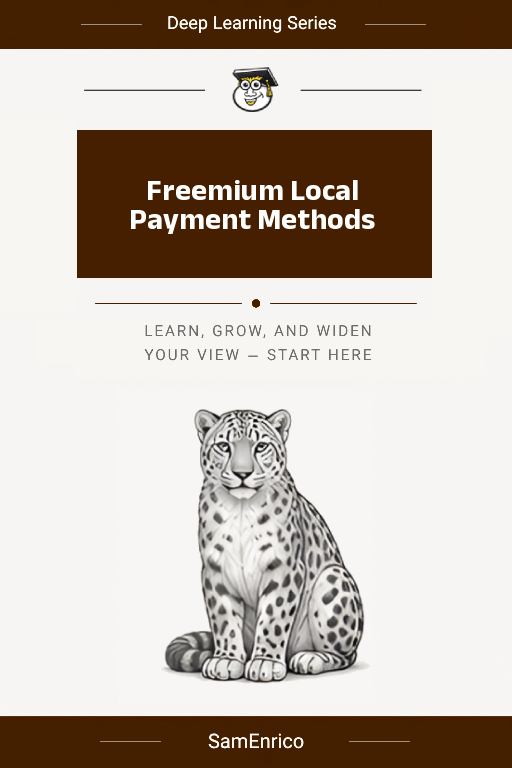
Freemium Local Payment Methods eBook
Accept mobile money and prepaid airtime for freemi
by Shank Heike
Accept mobile money and prepaid airtime for freemium upgrades.
Formats
Free sample
Chapter 1: The Airtime Economy--I first understood the airtime economy in a taxi in Nairobi. It was 2018, and I was running late for a meeting with a mobile payment executive. The driver, a man named James, had no bank account. He had no credit card. He had never used Pay Pal in his life.
But when his phone ran out of data midway through the journey, he did not panic. He pulled over to the side of the road, walked twenty meters to a wooden kiosk, handed the vendor a crumpled 200-shilling note, and returned with a scratch card. Within ninety seconds, he was back online, navigating us through traffic as if nothing had happened. He had just paid for internet access with airtime. He had just transacted in the largest payment system most digital businesses have never heard of.That moment changed how I thought about payments.
For years, I had been building digital products the way every entrepreneur is taught: optimize for credit cards, reduce friction at checkout, assume your customers have bank accounts. But James was not a statistical anomaly. He was one of over a billion people worldwide who participate in the digital economy every day without ever touching a credit card. They buy airtime from street vendors. They transfer mobile money to family members.
They pay for goods and services using SMS and USSD codes. They are not unbanked in the sense of being excluded from finance. They are underbanked in the sense that they have found better, more convenient, more trusted alternatives to traditional banking. And the vast majority of digital businesses have built checkouts that explicitly exclude them.This book is about fixing that. It is about understanding the airtime economy, designing for local payment methods, and unlocking the billions of dollars in freemium revenue that are currently being left on the table.
This first chapter establishes the scale of the opportunity, introduces the two distinct customer segments you need to understand, and explains why freemium models are uniquely suited to emerging markets.The Invisible Trillion-Dollar Economy Let me give you the numbers that should keep every digital product manager awake at night. According to the GSMA's 2023 State of the Industry Report on Mobile Money, there are now over 1.4 billion registered mobile money accounts worldwide. These accounts process over $2 trillion in annual transactions. In over two dozen countries—including Kenya, Tanzania, Ghana, Myanmar, and Bangladesh—mobile money accounts now exceed traditional bank accounts. In Kenya, M-PESA processes more transactions domestically than Western Union does globally.But here is the problem.
When I ask digital founders what payment methods they accept, the answer is almost always the same: credit cards, Pay Pal, maybe Apple Pay or Google Pay. When I ask about mobile money, I get blank stares. When I ask about prepaid airtime, I get confusion. These are sophisticated, successful entrepreneurs who have built products used by millions. Yet they are ignoring the payment methods used by the majority of potential customers in some of the world's fastest-growing markets.The result is what I call the invisible checkout tax.
Every time a user in Nairobi, Lagos, or Jakarta clicks "upgrade" and sees only a credit card form, they experience a moment of exclusion. Some of them will close the tab and never return. Some will try to find a friend with a credit card. Some will give up on the product entirely. A few will jump through hoops—borrowing a card, finding a workaround—but most will not.
The invisible checkout tax is not a technical limitation. It is a strategic blind spot. And it is costing digital businesses billions.The Two Segments You Need to Know To understand the opportunity, you need to stop thinking about "the unbanked" as a single monolith. The academic literature and mobile money provider data reveal two distinct segments with different behaviors, different devices, and different willingness to pay.Segment 1: Mobile Money Users These are the customers most digital businesses are missing first. Mobile money users have smartphones.
They have data plans. They have disposable income for digital upgrades. They are often young, urban, and employed in the formal or informal economy. They have chosen mobile money over traditional banking because it is more convenient, more accessible, and more trusted. They check their mobile money balance several times a day.The numbers are staggering.
Safaricom's M-PESA has over 30 million active users in Kenya alone. MTN Money operates across multiple African countries. Airtel Money spans Africa and Asia. Orange Money is dominant in Francophone Africa. These are not niche products.
They are the mainstream payment systems for hundreds of millions of consumers. Typical transaction values range from 1to1 to 1to50. Monthly active users in Kenya average over 90% of registered accounts. Customer acquisition cost through agent networks is near zero because users already have accounts.When mobile money users want to upgrade your freemium product, they open their mobile money app, enter a PIN, and confirm the transaction. The friction is lower than entering a sixteen-digit credit card number.
Conversion rates for mobile money users are consistently higher than for credit card users—typically 7-12% of active users compared to 3-5% for credit cards in similar markets.Segment 2: Airtime-Only Users The second segment is smaller in transaction value but larger in potential reach. Airtime-only users have feature phones, not smartphones. They do not have mobile money accounts. Their primary financial instrument is prepaid airtime—the minutes, SMS, and data bundles they buy from street vendors. They transfer airtime to friends and family.
They use airtime to pay for everything from bus fare to utility bills. They are more price-sensitive than mobile money users, with lower disposable income. They may be older, rural, or newly connected to the digital economy.When airtime-only users want to upgrade your product, they send a premium SMS or dial a USSD code. The transaction is deducted from their airtime balance. The fees are higher (30-50% for direct carrier billing), and the friction is higher.
Expected conversion rates are lower—typically 3-5% of active users for airtime billing. But here is the critical insight: the airtime-only segment includes users that mobile money cannot reach. If you accept only mobile money, you still exclude this group. If you accept airtime, you capture both.I cannot emphasize this enough: mobile money and airtime are not substitutes. They serve different users.
A complete local payment strategy requires both.Why Freemium Is the Perfect Model for Emerging Markets You might be thinking: this is a lot of complexity. Why not just charge everyone by credit card? Because freemium lowers the barrier to entry for users who are uncertain about digital payments. In emerging markets, where digital fraud is common and consumer protection is weak, trust must be earned. Users will not hand over payment information to an unknown product.
But they will try it for free.Freemium solves the trust problem. Users can experience the product's value before committing any money. They can see that it works, that it is legitimate, that it delivers on its promises. Only after building trust do they convert to paid. This trust-building phase is not optional.
It is essential in markets where users have been burned by scams. I have seen products fail in emerging markets…
This is the end of the free sample. Get the eBook to keep going. Buy now
About this book
Details
- Author
- Shank Heike
- Publisher
- SamEnrico
- Language
- English
- Genre
- Non-Fiction, Business Brief
- Released
- 2026-05-30
- Pages (approx.)
- 105
- Available as
- eBook, Audiobook

Read better in the ZLOADR app
Your eBooks on your phone or tablet. Sign in with your SamEnrico account and start reading.
More by Shank Heike
 Task Assignment FrameworkShank Heike$11.99
 Gacy's Phone Calls from PrisonShank Heike$11.99
 TM And Other Spiritual PracticesShank Heike$11.99
 Anxiety Disorder at Work GuideShank Heike$11.99
 HIV Mental Health Integration Poor NationsShank Heike$11.99
 The Catholic Restoration DramaShank Heike$11.99
 Prescription Sleep Aid MemoryShank Heike$11.99
 Overcoming Pay Per View PornShank Heike$11.99
 Pattern Recognition PuzzlesShank Heike$11.99
 Neon Shadows: The Rise and Fall of the First AI PresidentShank Heike$11.99
 Grimalkin's Cunning: The Witch's Familiar Who Outwitted KingsShank Heike$11.99
 The Jade Serpent’s Vow: A Dragon’s Oath in the Forbidden MountainsShank Heike$11.99
You may also like
 Hong Kong Handover 1997Dunn Johnnie$11.99
 Zumba For Postnatal Recovery CourseNeal Christian$11.99
 Zumba for BeginnersLadner Nikia$11.99
 YouTube Comment Mining GuideHumes Pandora$12.99
 Worry Box MeditationCarlin Rudy$11.99
 Workplace Stress MeditationNguyen Lynn$11.99
 Workplace Stress and Sleep RepairHawley Ivory$11.99
 Workplace Perfectionism CureDelaney Jeffry$11.99
 Workplace Injustice Anger GuideWallen Isabelle$11.99
 Work Addiction and Burnout LinkGreenwood Ester$11.99
 Women in Yoga and WellnessBeattie Galina$11.99
 Women in Stand Up ComedyChun Evangeline$11.99