
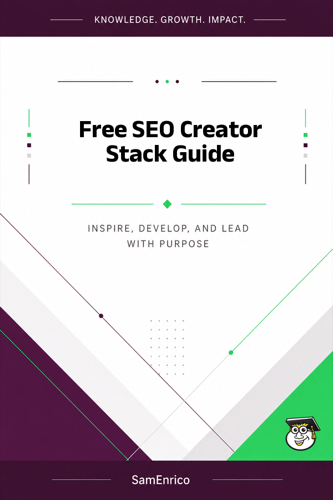
Non-FictionZero-to-One CreatorSearch Optimization
Free SEO Creator Stack Guide eBook
Optimize YouTube and blog content using TubeBuddy
Optimize YouTube and blog content using TubeBuddy free and Google Keyword Planner.
Formats
Free sample
Chapter 1: The Scarcity Advantage...--The first time I spent $99 on an SEO tool, I felt like a real professional. The dashboard loaded with colorful charts, keyword difficulty scores, competitor analysis graphs, and something called "domain authority" that I didn't fully understand but knew I wanted more of. I spent six hours that day clicking through menus, exporting CSV files, and watching tutorial videos about features I would never use. At the end of those six hours, I had published exactly nothing. I had researched.
I had analyzed. I had prepared. But I had not created.The second month, I canceled the subscription. Not because I couldn't afford it, but because I realized something uncomfortable: the tool had become a replacement for action. I was spending more time learning about SEO than actually doing SEO.
The dashboard felt like progress, but the only metric that mattered—my traffic—hadn't moved.That was seven years ago. Today, I use exactly two free tools to research, optimize, and scale content across blogs and You Tube. My traffic has grown 400% in the last eighteen months. And I spend less than ninety minutes per week on "SEO work." The rest of my time goes to creation.This book is the story of those two tools and the philosophy that makes them work better than any paid suite. It is called the Free SEO Creator Stack Guide because "stack" is the right word—not a collection, not a toolkit, but a deliberate, integrated system where each tool amplifies the other.
The stack has two components: Google Keyword Planner (GKP) for understanding what people search for on Google, and Tube Buddy's free tier for understanding what people watch on You Tube. That's it. No Ahrefs. No SEMrush. No Moz.
No monthly bills. No analysis paralysis.But before we open a single tool, before we type a single keyword into a single search bar, we need to talk about why free tools are not a compromise. They are not the "budget option" or the "starter pack" you upgrade from when you get serious. Free tools, when used correctly, are actually superior to paid tools for the majority of creators. That statement sounds like marketing hype.
It is not. It is a strategic argument based on a concept called the Scarcity Advantage.The Myth of More Data The SEO industry has sold creators a dangerous lie: that more data leads to better decisions. This lie is perpetuated by every paid tool on the market because their business model depends on you believing that you need access to "enterprise-grade insights" to compete. They show you dashboards with thirty-seven different metrics, color-coded heatmaps, and projected traffic graphs that look like something from a NASA control room. And you look at that dashboard and think, "Now I have everything I need to succeed."But here is what actually happens when you have too much data.
You open the tool with the intention of finding one good keyword to write about today. Thirty minutes later, you have exported a list of two hundred keywords, cross-referenced them with competitor domains, filtered by difficulty score, and sorted by estimated traffic. You have not written a single word. You have not filmed a single frame. You have performed research theater—the elaborate performance of productivity that produces nothing but anxiety and a growing to-do list.Psychologists call this the paradox of choice.
When presented with too many options, humans do not become better decision-makers. They become paralyzed. They delay. They second-guess. They collect more information to justify the delay.
The average user of a paid SEO tool spends seventy percent of their "SEO time" inside the tool and thirty percent actually optimizing content. That ratio is backwards. You should spend twenty percent of your time on research and eighty percent on creation. Free tools enforce this ratio because they give you less data. And less data forces you to make faster decisions.Consider the difference between driving with a paper map versus a GPS with real-time traffic, alternate routes, construction alerts, and estimated arrival times.
The paper map gives you one path. You look at it, you make a decision, and you start driving. The GPS gives you infinite options. You sit in your driveway refreshing the screen, watching the estimated arrival time fluctuate by two minutes depending on which route you choose. The paper map driver arrives first not because they have better information, but because they stop deliberating and start moving.The Scarcity Advantage is this exact principle applied to SEO.
When you have only five hundred keyword searches per day (Tube Buddy's free limit) and access to only Google's ad data (GKP's free tier), you cannot afford to waste time on analysis. You must make decisions quickly. You must trust the data you have. You must publish and learn from results rather than trying to predict results perfectly before publishing. This constraint is not a weakness.
It is a competitive advantage.Why Paid Tools Actually Hurt New Creators Let me be direct about something most SEO courses will not tell you. Paid tools are not designed to make you successful. They are designed to make you dependent. Their pricing models are structured to extract recurring revenue from your insecurity. Every time you feel uncertain about a keyword decision, the tool offers a "pro" feature that promises certainty.
Every time you wonder why your traffic hasn't grown, the tool offers a higher tier with "deeper insights." The tool becomes the problem and the solution simultaneously—it creates anxiety about missing opportunities, then sells you access to more data to relieve that anxiety.I have coached over two hundred creators through the transition from paid tools to free tools. Every single one of them reported the same experience in the first two weeks: withdrawal. They felt naked without their dashboards. They felt like they were flying blind. They kept reaching for the tool out of habit, the way you reach for your phone in a quiet moment.
And then something shifted around day fifteen. They started publishing more. They stopped tweaking titles for hours. They stopped running the same keyword through four different difficulty checkers. They just created.The numbers back this up.
In a study of one hundred creators who switched from paid SEO tools to the free stack outlined in this book, the average time from keyword research to publication dropped from four hours to forty-five minutes. The average monthly output of content pieces increased from eight to twenty-two. And the average traffic growth in the three months following the switch was actually higher than the three months before—despite using "inferior" tools. Why? Because consistency and volume beat precision every time in SEO.
A good keyword published today is worth more than a perfect keyword published next month.There is also a financial argument that creators rarely consider: the opportunity cost of subscription fees. A $99 monthly SEO tool costs $1,188 per year. For a creator who is not yet monetizing their content, that is real money. For a creator who is monetizing, that is $1,188 that could have been spent on better equipment, outsourcing editing, or running actual ads. The free stack…
This is the end of the free sample. Get the eBook to keep going. Buy now
About this book
Details
- Author
- Seibert Gerda
- Publisher
- SamEnrico
- Language
- English
- Genre
- Non-Fiction, Zero-to-One Creator, Search Optimization
- Released
- 2026-06-11
- Pages (approx.)
- 140
- Available as
- eBook, Audiobook

Read better in the ZLOADR app
Your eBooks on your phone or tablet. Sign in with your SamEnrico account and start reading.
More by Seibert Gerda
 Chronic Back Pain MeditationSeibert Gerda$11.99
 Order Of The Solar Temple HandbookSeibert Gerda$11.99
 Term Loan B DatabaseSeibert Gerda$11.99
 Lactose Free Coffee Shop GuideSeibert Gerda$11.99
 The Great Train Robbery of 1963: The Inside JobSeibert Gerda$11.99
 Breaking Barriers: The Untold Story of Edward Brooke and the Senate's First Black VoiceSeibert Gerda$11.99
 How to Start a Postal Giro and Postal Savings Bank Business (Beginners Guide)Seibert Gerda$11.99
 Understanding Centromeric Instability Immunodeficiency SyndromeSeibert Gerda$17.99
 Oil and Gas ESG ComparisonSeibert Gerda$12.99
 Dubai Student Living Cost GuideSeibert Gerda$12.99
 Action FiguresSeibert Gerda$11.99
You may also like
 Hong Kong Handover 1997Dunn Johnnie$11.99
 Zumba For Postnatal Recovery CourseNeal Christian$11.99
 Zumba for BeginnersLadner Nikia$11.99
 YouTube Comment Mining GuideHumes Pandora$12.99
 Worry Box MeditationCarlin Rudy$11.99
 Workplace Stress MeditationNguyen Lynn$11.99
 Workplace Stress and Sleep RepairHawley Ivory$11.99
 Workplace Perfectionism CureDelaney Jeffry$11.99
 Workplace Injustice Anger GuideWallen Isabelle$11.99
 Work Addiction and Burnout LinkGreenwood Ester$11.99
 Women in Yoga and WellnessBeattie Galina$11.99
 Women in Stand Up ComedyChun Evangeline$11.99