
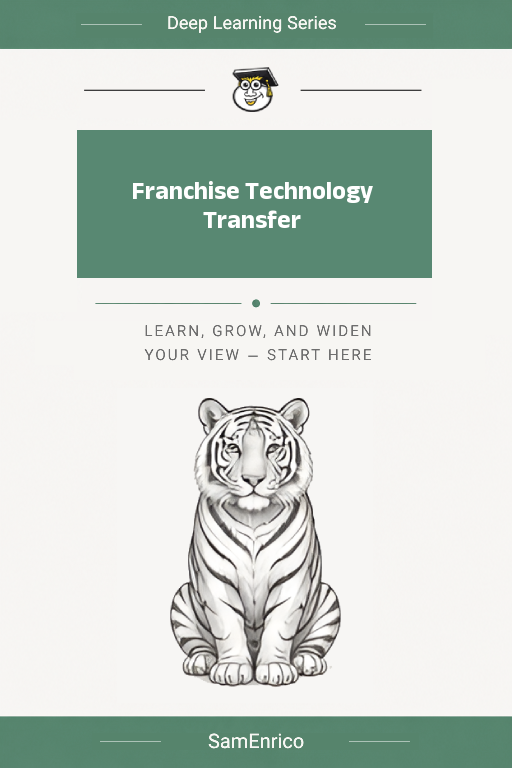
Non-FictionBusiness BriefTech Licensing
Franchise Technology Transfer eBook
Share systems and software across borders legally.
Share systems and software across borders legally. This guide covers data privacy and export controls for international franchise technology.
Formats
Free sample
Chapter 1: The Digital Avalanche...--The franchise lawyer across the table slid a thick binder toward me. "Standard international franchise agreement," he said. "We've used this template for thirty years. It's bulletproof."I opened it. Two hundred pages of trademark licenses, operations manuals, quality control standards, and royalty calculations.
Exactly two paragraphs mentioned "technology." Both described the franchisor's right to send the franchisee a hard drive containing the POS software. The word "data" appeared zero times. "Privacy" was absent. "Export control" might as well have been a foreign language.The lawyer was proud of this document. He should not have been.This was 2023.
The franchise in question operated 400 locations across seventeen countries. The franchisor had recently migrated every single store to a cloud-based management system. Every transaction, every customer loyalty profile, every employee schedule, every real-time inventory feed – all of it flowed from franchisee servers in Milan, Shanghai, and São Paulo directly to the franchisor's data center in Virginia. Every night, millions of records crossed international borders automatically, silently, and – as I was about to discover – almost certainly illegally.The lawyer did not know that the European Union had fined a hotel chain €20 million the previous year for transferring customer data from European franchisees to a US-based central system without proper safeguards. He did not know that China had blacklisted three international companies for violating its new data transfer rules, cutting them off from receiving any data from their Chinese franchisees for two full years.
He did not know that the US Department of Commerce had recently referred a franchisor to the Department of Justice for exporting encryption-enabled POS software to a franchisee in Russia without a license.He did not know that his "bulletproof" agreement was a ticking bomb.This book exists because that lawyer's ignorance is the industry standard. International franchising is in the midst of a silent revolution – and most franchisors have not noticed.The Old World: Shrink-Wrapped and Shipped For most of franchising's modern history, technology transfer meant something remarkably simple. A franchisor developed an operations manual, a training video, perhaps a simple software program for point-of-sale transactions. They printed the manual, duplicated the videos, burned the software onto CDs or later USB drives. They shipped these physical objects to franchisees.
The franchisee installed the software locally. The transaction was complete.This model had a hidden advantage: it was legally simple. Physical goods crossing borders faced customs duties and maybe import restrictions, but the legal framework was well-established. More importantly, once the software was installed on a local server in the franchisee's country, data stayed there. A customer's purchase history in a London franchise never left London.
A franchisee's employee payroll data never crossed the Channel. The franchisor received aggregated reports – weekly sales totals, inventory turnover rates – but these contained no personal information. They were just numbers.Regulators did not care about numbers.Then came the cloud. Then came Software as a Service. Then came real-time business intelligence dashboards that required live data feeds from every store on the planet.
Then came AI-driven analytics that demanded access to raw transaction data – not just totals, but what each customer bought, when they bought it, how they paid, what loyalty discounts they used, what they looked at before deciding not to buy.The shift from on-premise software to cloud-based systems changed everything about international franchising – except the legal agreements governing it.Most franchise agreements today are still built on the physical-shipment model. They contemplate a one-time transfer of technology at the start of the franchise relationship. They do not contemplate continuous, real-time, bidirectional data flows that never stop. They do not contemplate that the "technology" being transferred is not a static piece of software but a dynamic relationship in which the franchisee's data becomes the franchisor's raw material.The New Reality: Continuous, Invisible, Regulated Consider what actually happens in a modern international franchise network on any given Tuesday.A customer walks into a coffee shop franchise in Paris. She uses the loyalty app on her phone to pay for a cappuccino.
The transaction is recorded. Her name, her purchase history, her favorite drink, her birthday (stored for the free-birthday-drink promotion), and her precise location are captured. The franchisee's POS system processes the payment.Within seconds, that data is transmitted to multiple destinations. It goes to the franchisor's central data center in Texas for loyalty point aggregation. It goes to a cloud analytics platform hosted on AWS servers in Frankfurt for real-time inventory tracking.
It goes to a marketing automation vendor based in Ireland that will send her a personalized offer tomorrow morning. It goes to a payment processor headquartered in Singapore that handles the currency conversion from euros to dollars.That single cup of coffee has just triggered four separate cross-border data transfers involving three different legal regimes: the European Union (where the data originated), the United States (where the franchisor is based), and Singapore (where the payment processor operates). Each transfer must comply with the GDPR's Chapter V restrictions on data leaving the EU. Each vendor involved must have appropriate legal mechanisms in place. The franchisor – not the franchisee, not the vendors – is ultimately responsible for every link in this chain.Now multiply that single transaction by thousands of stores, hundreds of thousands of daily transactions, millions of customer profiles.
The scale is staggering. The legal complexity is even more so.This is not a theoretical problem. Regulators are actively enforcing these rules. In 2021, the French data protection authority fined a US-based franchisor €15 million for using Google Analytics on its French franchisees' websites – a seemingly innocuous decision that resulted in customer IP addresses being transferred to the US without adequate safeguards. In 2022, China's CAC ordered an American fast-food franchisor to cease all data transfers from its Chinese franchisees after an audit revealed that customer facial recognition data (collected for a "smile detection" loyalty program) was being sent to servers in California without the required separate consent.
In 2023, the US Bureau of Industry and Statistics initiated an investigation into a hotel franchisor whose management software – containing encryption rated at 256-bit AES – had been accessed by franchisees in Iran, Syria, and North Korea through a cloud portal that the franchisor had never restricted by geography.The era of assuming that "technology transfer" is simple is over. The era of pretending that data privacy and export controls are someone else's problem has ended. The era of hoping that regulators will not notice has crashed headlong into the reality of aggressive enforcement.The Central Conflict: Standardization Versus Sovereignty Every franchisor faces a fundamental operational tension. To protect the brand, ensure quality consistency, and maximize the value of the network, the franchisor needs uniform systems. The same POS software should run in every store.
The same reporting dashboards should display the same metrics. The same customer loyalty program should recognize the same members whether they walk into a franchise in Tokyo or Toronto.This is the logic of standardization. It is the engine of franchising's success. A Mc Donald's in Mumbai should feel familiar to someone who has eaten at a Mc Donald's in Miami. A Marriott in Madrid should offer the same check-in experience as a Marriott in Manila.
Standardization creates trust, predictability, and brand value.But standardization collides directly with a newer, equally powerful force: data sovereignty. Dozens of…
This is the end of the free sample. Get the eBook to keep going. Buy now
About this book
Details
- Author
- Graves Orlando
- Publisher
- SamEnrico
- Language
- English
- Genre
- Non-Fiction, Business Brief, Tech Licensing
- Released
- 2026-06-01
- Pages (approx.)
- 152
- Available as
- eBook, Audiobook

Read better in the ZLOADR app
Your eBooks on your phone or tablet. Sign in with your SamEnrico account and start reading.
More by Graves Orlando
 The Hoarder Household SurvivorGraves Orlando$11.99
 Social Media and Imposter SyndromeGraves Orlando$11.99
 Gambling Relapse Warning SignsGraves Orlando$11.99
 Rewiring Betrayal Self BlameGraves Orlando$11.99
 Prescription Pills TrapGraves Orlando$11.99
 Optimism Resilience GuideGraves Orlando$11.99
 The Cholera Vaccine GuideGraves Orlando$11.99
 Imposter Syndrome For ManagersGraves Orlando$11.99
 The Quantum Whisperer: How Schrödinger’s Cat Changed the WorldGraves Orlando$11.99
 Whispers of the Marid: The Djinn Who Drowned the MoonGraves Orlando$11.99
 The Frozen Gambit: Russia's Desperate Stand at Narva (1700)Graves Orlando$11.99
 The Dancer's Guide to RumbaGraves Orlando$11.99
You may also like
 Hong Kong Handover 1997Dunn Johnnie$11.99
 Zumba For Postnatal Recovery CourseNeal Christian$11.99
 Zumba for BeginnersLadner Nikia$11.99
 YouTube Comment Mining GuideHumes Pandora$12.99
 Worry Box MeditationCarlin Rudy$11.99
 Workplace Stress MeditationNguyen Lynn$11.99
 Workplace Stress and Sleep RepairHawley Ivory$11.99
 Workplace Perfectionism CureDelaney Jeffry$11.99
 Workplace Injustice Anger GuideWallen Isabelle$11.99
 Work Addiction and Burnout LinkGreenwood Ester$11.99
 Women in Yoga and WellnessBeattie Galina$11.99
 Women in Stand Up ComedyChun Evangeline$11.99