
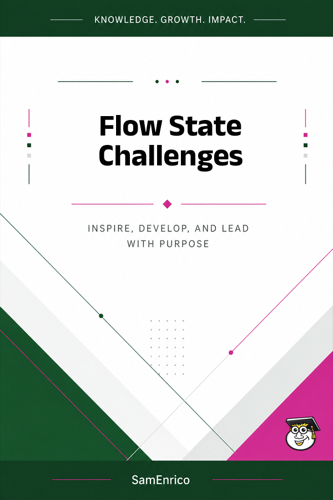
Flow State Challenges eBook
30 day program to increase flow frequency.
30 day program to increase flow frequency.
Formats
Free sample
Chapter 1: The Rage Journal--–- You are about to do something that will feel counterintuitive, even wrong. Before you track a single distraction, before you measure your focus, before you attempt any of the challenges in this book, you are going to sit down and write for five minutes about the last time you felt stupid. Not vaguely annoyed. Not mildly unfocused. Stupid.
The kind of stupid where you read the same paragraph three times and still could not tell anyone what it said. The kind of stupid where you walked away from your desk after four hours and realized you had accomplished exactly nothing except changing three commas and checking Instagram seventeen times. The kind of stupid where someone asked you what you worked on all day, and you felt your face get hot because you had no answer.That feeling—the heat, the shame, the quiet voice that says what is wrong with you—is the starting point of this book. Not because shame is productive. It is not.
But because shame is honest. And honesty is the only foundation upon which you can build a new relationship with your own attention.Most books about focus and productivity begin with a lie. The lie is that you are already a high performer who simply needs to optimize a few systems. They assume you wake up motivated, sit down at your desk with a clean slate, and merely need to tweak your calendar or install an app blocker. Those books are written for a version of you that does not actually exist.
The real you has been staring at spreadsheets for forty-five minutes without reading a single number. The real you has been scrolling through your phone while a deadline looms, feeling the pressure build but somehow unable to move. The real you has closed your laptop at the end of the day and felt a specific kind of exhaustion that is not physical and not even mental—it is the exhaustion of having tried to focus and failed, over and over, until trying itself feels pointless.This chapter is not about fixing that yet. First, you are going to look at it directly.The Myth of the Natural Focuser Before we design a single solution, we need to destroy a myth. The myth is that some people are naturally good at focusing and others are not.
This myth is pervasive and damaging because it turns a skill into an identity. When you believe that focus is a fixed trait, every moment of distraction feels like evidence of a permanent flaw. I am just not a focused person. I have no willpower. My brain does not work that way.None of that is true.
Focus is not a personality trait. It is a neurochemical state. And like any neurochemical state—hunger, alertness, fatigue, excitement—it is governed by conditions, not character. Put a human being in the right conditions, and their brain will enter a state of deep concentration automatically. Put the same human being in the wrong conditions, and they will feel scattered, restless, and incapable of sustained attention.
The difference between the two scenarios has almost nothing to do with willpower and almost everything to do with environment, expectation, and the invisible architecture of distraction that most of us have built around ourselves without realizing it.Consider this: the same person who cannot focus on a spreadsheet for fifteen minutes can often spend three hours playing a video game, building furniture, cooking a complex meal, or arguing passionately about a topic they care about. In those moments, they are not forcing concentration. They are not grimacing through the task with sheer willpower. They are simply engaged. Time moves differently.
The inner monologue quiets. Actions feel automatic. That is flow. And if you have ever experienced it—even for ten minutes—you have proof that your brain is capable of it.The question is not whether you can focus. The question is why you cannot focus on the things you actually need to do.The Hidden Cost of Forcing Concentration There is a specific behavior that most people mistake for discipline.
I call it flow faking. Flow faking is the act of grimacing through a task using sheer willpower while your brain is actively resisting. You know the feeling. You are sitting at your desk. You have told yourself you are going to work.
But your eyes keep drifting to the window. Your hand keeps reaching for your phone. You read the same sentence five times. You open a new tab for no reason. You are present in the sense that your body is in the chair, but your attention is a wild animal that refuses to be caged.Most people respond to this feeling by trying harder.
They clench their jaw. They close their eyes and take a deep breath. They say come on, focus like they are scolding a dog. This is flow faking. And it does not work.
In fact, it makes everything worse.Here is the neuroscience. When you force concentration, your brain detects a mismatch between what you are doing and what it wants to do. That mismatch triggers a low-grade stress response. Your sympathetic nervous system activates. Cortisol rises.
Your brain begins to associate the task with threat. Over time, this conditioning makes the task harder to start because every time you approach it, your brain anticipates the upcoming struggle. The very act of trying creates resistance. This is why procrastination is not a failure of will. It is a learned response.
Your brain has learned that certain tasks feel terrible, so it avoids them automatically.Flow faking is the enemy of flow because flow requires a very specific neurochemical profile: high dopamine (reward anticipation), moderate norepinephrine (alertness), low cortisol (low threat), and high anandamide (bliss, creativity). When you force concentration through willpower, you spike cortisol and norepinephrine while suppressing dopamine. You create the exact opposite chemistry of flow.The first step to fixing this is to stop doing it. That is the purpose of this chapter’s challenge. For the next seven days, you are prohibited from forcing concentration.
If you sit down to work and your brain resists, you are not allowed to grit your teeth and push through. You are not allowed to scold yourself. You are not allowed to reread the same sentence seventeen times hoping it will eventually stick. If concentration is not happening, you must either change the conditions or walk away.This sounds counterintuitive. It sounds like permission to be lazy.
It is not. It is permission to stop wasting energy on a strategy that has never worked and will never work. Forcing concentration is like trying to start a car by pushing it downhill. Sometimes it works for a moment, but you are exhausting yourself for negligible gain. There is a better way, and it begins with admitting that your current way is broken.The Neurochemical Audit: What You Are Actually Measuring The core tool of this chapter is called the Neurochemical Audit.
For seven days, you will carry a small notebook or use a notes app on your phone. You will record three…
This is the end of the free sample. Get the eBook to keep going. Buy now
About this book
Details
- Author
- Dayton Maurine
- Publisher
- SamEnrico
- Language
- English
- Genre
- Non-Fiction, Self-Help, 30 Day Challenge
- Released
- 2026-06-09
- Pages (approx.)
- 135
- Available as
- eBook, Audiobook

Read better in the ZLOADR app
Your eBooks on your phone or tablet. Sign in with your SamEnrico account and start reading.
More by Dayton Maurine
 The Flow State GuideDayton Maurine$11.99
 Kite Flying Calm GuideDayton Maurine$11.99
 Perimenopause Symptom Tracking GuideDayton Maurine$11.99
 Eisenhower Matrix for TeachersDayton Maurine$11.99
 Stress Wound Healing DelayDayton Maurine$11.99
 Affirmations for RetirementDayton Maurine$11.99
 Badminton Player's HypnosisDayton Maurine$11.99
 Ashen Echoes: The Day Krakatoa Shook the WorldDayton Maurine$11.99
 Zero Day: The Stuxnet HeistDayton Maurine$11.99
 Woolly Monkeys: Large PrimateDayton Maurine$11.99
 How to Produce Digital Video RecordersDayton Maurine$11.99
 Target Market Profile SheetDayton Maurine$12.99
You may also like
 Social Media Sabbatical PlanPantoja Shayla$11.99
 Walking Meditation ChallengeOkeefe Angelique$11.99
 The Self Talk ResetMarshall Renee$11.99
 The 30 Day Anxiety ResetNorton Felipe$11.99
 Chunking Challenge WorkbookMcallister Wilford$11.99
 The 30 Day Morning ChallengeHadley Ludivina$11.99
 The Persuasion ChallengeDias Codi$11.99
 The 30 Day Assertiveness ChallengeConyers Mohammed$11.99